Experience · Celtic & Folk Europe
The old man is dying in the back room of a farmhouse in County Limerick. Late at night, the family hears it outside: a long, rising, sorrowful cry, unlike any animal. Nobody goes to the window. Everyone knows what it is. By morning he is dead. Stories like this were told in Ireland for centuries, and some families still tell them today.
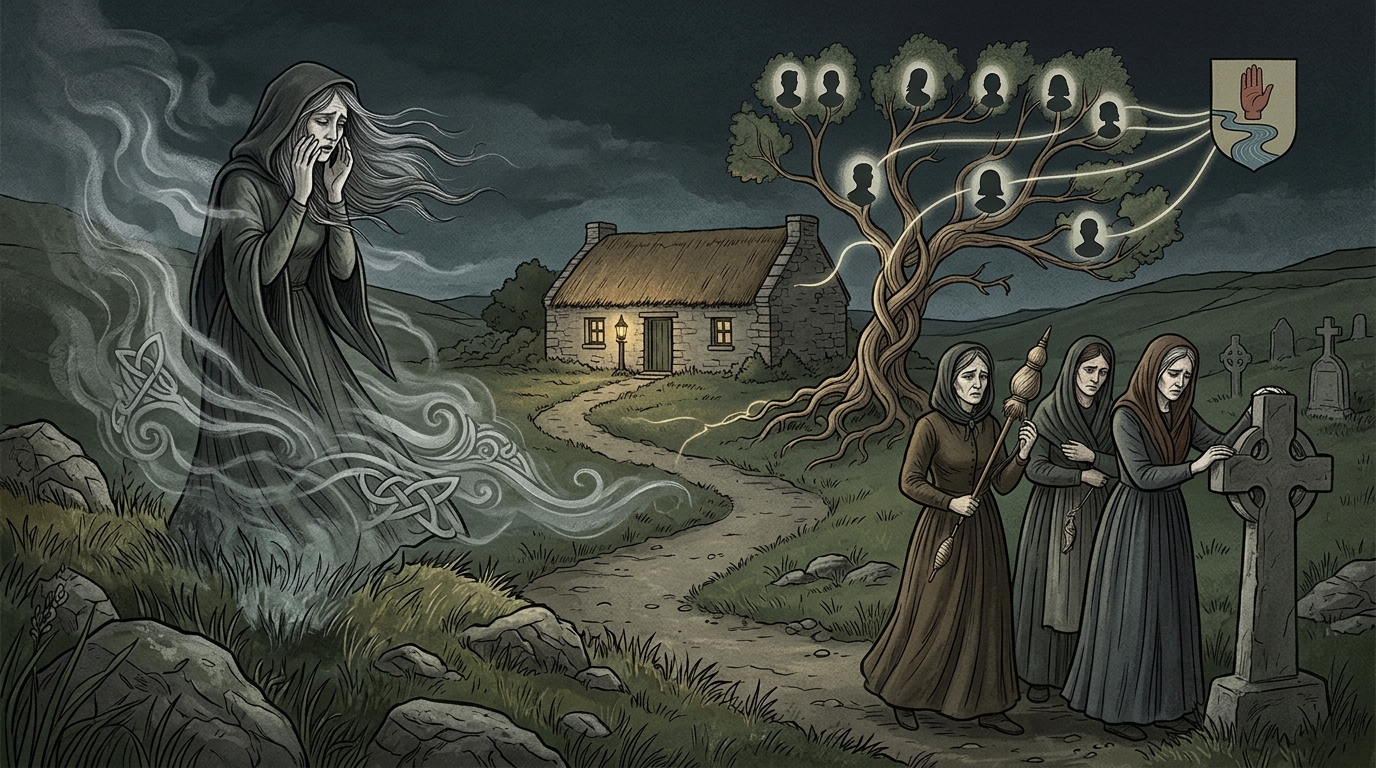
In short: The banshee (Irish bean sí, “woman of the fairy mound”) is a female spirit in Irish folklore whose cry announces a death in certain families — traditionally old Gaelic families. She is usually heard rather than seen; when seen, she is an old woman with long grey or white hair, combing it, or a young woman in white. She is not a killer but a mourner: her cry echoes the keening (caoineadh) of the women who once lamented the dead at Irish wakes.
How people experience it
Most accounts describe only the sound: a long, high, mournful cry, often heard by several family members, sometimes at the moment of death of a relative far away. People who say they heard it describe a deep chill and an immediate certainty. Folklore collectors in the 20th century recorded hundreds of such testimonies, and many were told not as legends but as family events.
How the tradition explains it
- Who she follows. Popular belief says the banshee cries only for certain old families — names beginning with Ó or Mac, such as O’Neill, O’Brien, O’Connor, O’Grady and Kavanagh. Families who “have” a banshee sometimes regard it as a mark of ancient lineage.
- The comb. In many stories she combs her long hair. People warned children never to pick up a comb found on the road, in case it was hers.
- The keening women. At traditional wakes, women performed the caoineadh, a wailing improvised lament over the body. The Church discouraged keening, and it faded in the 19th and 20th centuries. Folklorists see the banshee as the supernatural keener, mourning for the family even before death.
- Relatives. Similar figures exist in Scotland (the bean nighe, washing the shroud of the one who will die at a ford) and Wales (the gwrach y Rhibyn).
How science explains it — and where it stops
The night cries of foxes (especially the vixen’s scream) and barn owls are startlingly human and are often suggested as sources of banshee reports. In a household waiting for a death, every sound is interpreted through fear and expectation, and stories are reshaped in memory after the event. Anthropologists also emphasise the banshee’s social function: a shared belief that gives a family a way to prepare for and speak about death.
Some accounts describe a cry coinciding with a distant death before news arrived. These are reported experiences, not independently established predictions. Without contemporaneous records, independent timing and a comparison with cries not followed by a death, coincidence and retrospective interpretation cannot be ruled out. The accounts do not establish a supernatural mechanism.
Known, disputed, open
- Known: belief in the banshee is recorded throughout Ireland; folklorist Patricia Lysaght analysed hundreds of accounts from the Irish Folklore Collection.
- Disputed: whether the banshee derives from pre-Christian goddesses of sovereignty and death.
- Open: what lies behind well-timed “warning” experiences reported across cultures.
Gentle note. Stories of death omens can frighten children and anxious people. If fear of omens or of death is affecting your sleep or daily life, it may help to talk to someone you trust or a counsellor.
Frequently asked questions
What does banshee mean?
From Irish bean sí, “woman of the fairy mound” — a woman of the otherworld.
Is the banshee evil?
No. In Irish tradition she does not cause death; she mourns and announces it.
What does a banshee sound like?
Witnesses describe a long, rising, sorrowful wail, like the keening of women at a wake.
Where next
Sources
- Lysaght P. (1986). The Banshee: The Irish Supernatural Death-Messenger. Dublin: Glendale Press.
- Ó Súilleabháin S. (1967). Irish Wake Amusements. Cork: Mercier Press.
- Bourke A. (1988). The Irish traditional lament and the grieving process. Women’s Studies International Forum 11(4): 287–291.