Practice · Folk Europe · Archaeology of magic
In 2004 archaeologists digging in Greenwich, London, found a stoneware jug buried upside down, still sealed after more than three hundred years. When scientists opened and analysed it, they found bent iron nails, brass pins, a nail driven through a small piece of leather shaped like a heart, hair, nail clippings and human urine. Somebody in the 1600s had made it to fight a witch — and hidden it so no one would ever see it.
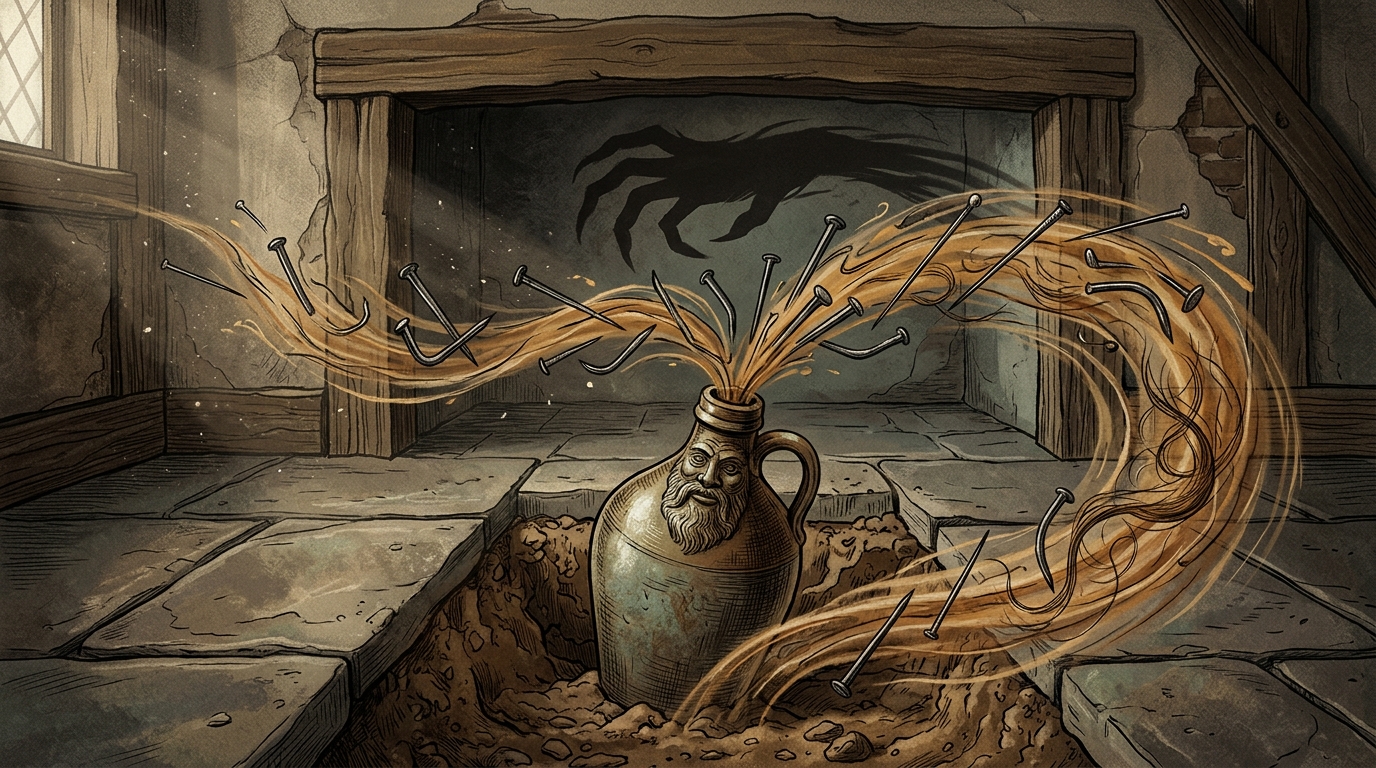
In short: Witch bottles were counter-magical charms used mainly in England from the 16th to the 18th century and later in colonial America. A person who believed they were bewitched filled a jar — often a German “bellarmine” stoneware jug with a bearded face — with their own urine, bent pins, nails, hair or nail clippings, and buried it under the hearth or threshold or heated it in the fire. The aim was to torment the witch through the magical link and force her to break the spell. Hundreds have been found during building work.
How people experienced it
For a 17th-century family, a sudden illness, a dying cow or butter that would not churn could mean that someone had “overlooked” them. The witch bottle gave them something to do: a hidden act of resistance, carried out in secret, which turned fear into action. People who have found such bottles in their homes today often describe an odd feeling of intimacy — a glimpse into the private fears of the people who lived there before them.
How the tradition explains it
The logic is sympathetic magic. A witch was thought to have a bodily link with the victim; the victim’s urine and hair carried that link. By trapping them in a bottle with sharp objects, the pain was sent back along the link to the witch, who would suffer until she lifted the curse. The astrologer-physician Joseph Blagrave described the method in his Astrological Practice of Physick (1671): stop the victim’s urine in a bottle with nails, pins and needles, and bury it — or boil it — and the witch will be “tormented”.
As recorded in early modern sources and archaeology. For familiarization.
- Container: stoneware bellarmine jugs, later glass bottles.
- Contents: urine, bent pins, nails, hair, nail clippings, sometimes a cloth heart pierced with pins, thorns or sulphur.
- Place: under the hearth or threshold — the points where evil could enter — or in walls; often upside down.
Witch bottles belong to a wider family of hidden protective objects found in old houses: concealed shoes, dried cats in walls, “witch marks” scratched near doors and fireplaces.
How science explains it — and where it stops
Chemical analysis of the Greenwich bottle, led by Alan Massey, confirmed human urine (with signs that the owner may have been a smoker) and identified the other contents. Historians see witch bottles as a response to real suffering in a world without germ theory: disease, infant death and livestock loss needed an explanation, and blaming a neighbour’s malice gave one. The bottle offered psychological relief — a sense of control — and, unlike accusations in court, it harmed no one directly.
Where science stops: it can tell us what is in the jar. It cannot tell us whether the families who buried them felt the curse lift — though some of them evidently did, since they never dug the bottles up.
Known, disputed, open
- Known: witch bottles are well documented in texts and archaeology; the Greenwich bottle was found sealed and scientifically analysed.
- Disputed: how widespread the practice was beyond the cases we have found.
- Open: what it felt like to live in a house built on hidden protections.
If you find one. Do not open it: old bottles may contain sharp rusty metal and biological material. Wear gloves, keep it upright and contact your local museum or archaeology service — finds like this are historically valuable. In England and Wales, the Portable Antiquities Scheme can advise.
Explore the witch-bottle tradition without sharp objects
Archaeologists have documented concealed bottles associated with protective magic in Britain. To reflect on this custom at home, use an empty, clean, unsealed jar as a symbolic object. Write down a worry on a piece of paper, place it beside the jar for a few minutes, and then record what you hope to protect in your household. This is a modern reflective adaptation, not a historically reconstructed counter-curse. Do not handle rusty nails, bodily fluids or broken glass, and do not bury objects on property without permission.
Frequently asked questions
What is a witch bottle?
A bottle or jug filled with urine, pins, nails and hair, buried to turn witchcraft back on the witch. Common in England in the 1600s.
Why were witch bottles buried under the hearth?
Hearths, chimneys and thresholds were seen as openings where evil could enter the home; the heat of the hearth was also thought to increase the witch’s torment.
Why are they called bellarmine jugs?
Many were German stoneware jugs with a bearded face, popularly nicknamed after Cardinal Robert Bellarmine.
Where next
Sources
- Hoggard B. (2019). Magical House Protection: The Archaeology of Counter-Witchcraft. New York: Berghahn.
- Merrifield R. (1987). The Archaeology of Ritual and Magic. London: Batsford.
- Blagrave J. (1671). Astrological Practice of Physick. London.