Practice card · For familiarization · Folk Europe
Walk along a pebble beach in Sussex or Dorset, look down long enough, and you may find one: a smooth flint with a hole worn right through it. Hold it up and look through the hole at the sea. For centuries people believed that through such a stone you could see what is normally hidden — and that hung over a bed or a stable door, it would keep away the night-hag who sits on sleepers’ chests and rides horses until dawn.
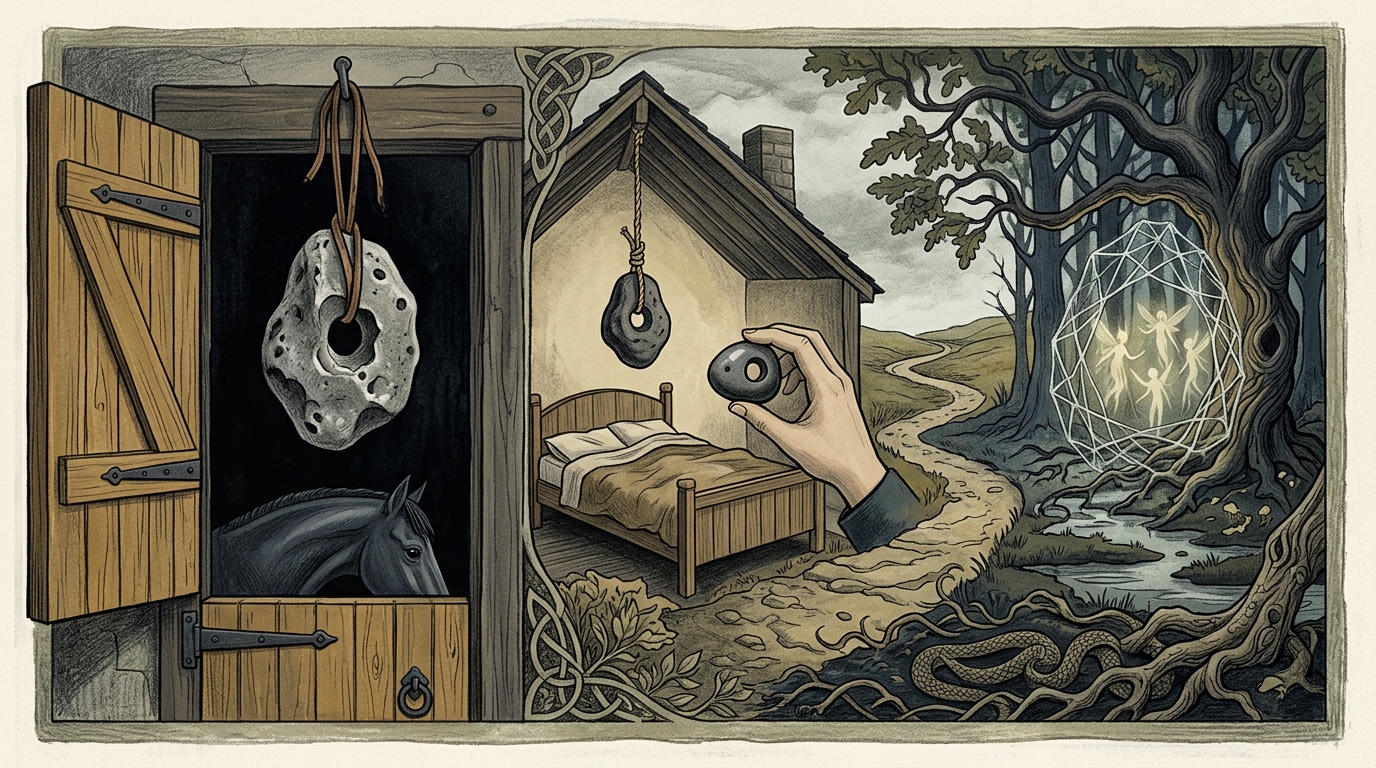
In short: Hag stones (also holey stones, witch stones, adder stones, Odin stones) are stones with a natural hole. In British, Scandinavian, German and Slavic folklore they protected against the “hag” or mare — the spirit blamed for nightmares and for horses found sweating and exhausted in the morning. They were hung on bedposts, over stable doors, on keys and fishing boats, and looked through to see fairies or witches. In Wales and Scotland, the “adder stone” was believed to be formed by snakes, echoing Pliny’s account of the druids’ “serpent’s egg”.
How people experience it
Many people who find a hag stone say they feel compelled to keep it — it seems “chosen”. Some hang one by the bed and report better sleep and fewer nightmares; others simply enjoy the small ritual of looking through the hole at the world, which instantly frames and changes what you see.
How the tradition explains it
As recorded in European folklore. For familiarization.
- Against the night-hag. Hung on a string over the bed, the stone kept away the mare who caused nightmares and the crushing feeling of sleep paralysis.
- Protecting horses. Hung in stables or on the stable door key so that witches or fairies could not take the horses for night rides.
- Seeing the hidden. Looking through the hole was believed to reveal fairies, witches in disguise or the otherworld.
- Healing and fertility. Large holed stones such as Mên-an-Tol in Cornwall were crawled through to cure illness or help conception.
- Adder stones. In Wales, glain neidr; in Scotland, a stone formed when many adders twined together and their venom hardened. Pliny the Elder described a druid “serpent’s egg” (anguinum) made from the foam of snakes — a prized talisman.
Why a hole? In folk logic, a natural opening is a doorway that evil cannot pass, or a “trap” that catches spirits. The stone’s having been made by water, not by human hand, made it all the more powerful.
How science explains it — and where it stops
Geologically, holes in flint often form where a softer fossil — a sponge, for example — weathered out; in other stones, water and grinding pebbles bore holes over time. The “night-hag” beliefs match what we now call sleep paralysis, which is common and harmless. A protective object by the bed can genuinely reduce anxiety before sleep, and less anxiety means fewer episodes — a real benefit, whatever the mechanism.
Where science stops: it explains the hole and the nightmare. It does not explain why so many peoples, independently, decided that looking through a stone lets you see another world.
Known, disputed, open
- Known: hag stones are widely recorded in European folklore as protection against nightmares and witches; Pliny describes the druids’ serpent’s egg.
- Disputed: whether the custom has ancient Celtic roots or developed later.
- Open: the near-universal link between natural openings and other worlds.
Notes. Some beaches and nature reserves forbid removing stones — check local rules. Hang stones securely, not above where a child sleeps. Frequent sleep paralysis or nightmares that disturb your life deserve a conversation with a doctor.
A simple hag-stone observation ritual
A naturally holed stone can be a striking reminder of the landscape. If you already own a clean stone, hold it in daylight and look through its opening at a familiar scene. Notice how the frame changes what attracts your attention; then write a few lines about the experience. This is a present-day observation exercise inspired by folklore, not proof that a stone reveals spirits. Avoid unstable shorelines, protected archaeological sites and collecting stones where prohibited.
Frequently asked questions
What is a hag stone?
A stone with a naturally formed hole, used in folk magic for protection and for “seeing” the otherworld.
What do you do with a hag stone?
Traditionally it is hung by a cord over a bed, a door or in a stable, carried as a charm, or looked through.
Why is it called a hag stone?
Because it protected against the “hag” — the witch or night-mare blamed for nightmares and for riding horses at night.
Where next
Sources
- Pliny the Elder. Natural History, XXIX.12 — the druids’ serpent’s egg.
- Simpson J., Roud S. (2000). A Dictionary of English Folklore. Oxford: Oxford University Press — entries “hag stones”, “holed stones”.
- Davies O. (2003). The nightmare experience, sleep paralysis, and witchcraft accusations. Folklore 114(2): 181–203.