Practice card · For familiarization · Catholic tradition
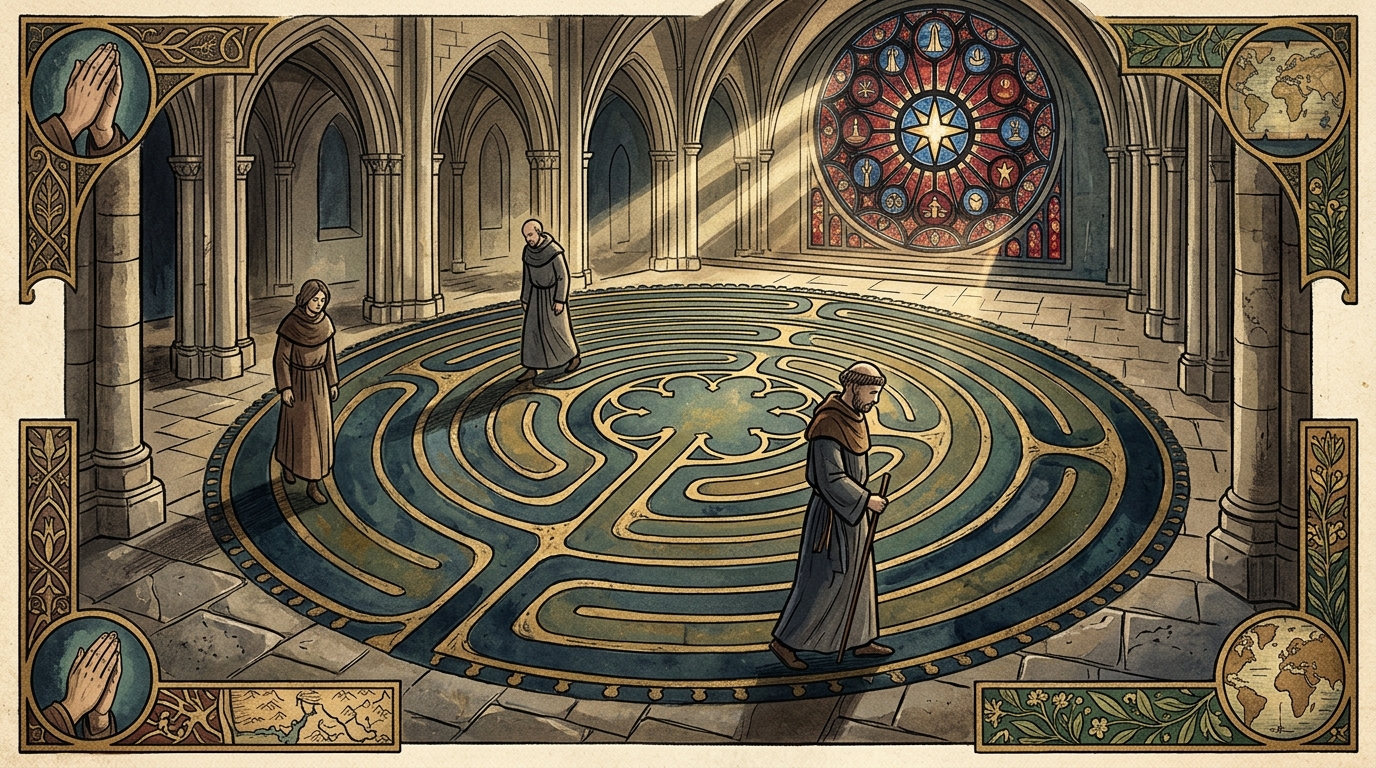
On most days the chairs of Chartres Cathedral cover it. But on certain days they are cleared away, and a great circle of stone appears in the floor of the nave: a single winding path that turns back on itself again and again, sometimes bringing you almost to the centre and then sweeping you out to the edge. People walk it slowly, barefoot, in silence. Some cry when they reach the middle. Nobody gets lost, because a labyrinth is not a maze.
In short: A labyrinth is a single path with no choices or dead ends that leads, by many turns, to a centre and back out. The most famous Christian example is the stone labyrinth laid into the floor of Chartres Cathedral in France in the early 13th century, with eleven circuits. Medieval Christians may have walked such labyrinths as a symbolic pilgrimage. Since the 1990s labyrinths have spread widely as a form of walking meditation and prayer, in churches, hospitals and parks.
How people experience it
Walkers often describe three phases. On the way in, the mind is busy, then gradually lets go as the turns take over. At the centre comes stillness, sometimes a sudden insight or emotion. On the way out, a sense of returning to life with something new. Many say that the moment the path brings them close to the centre and then turns away feels exactly like life — and that trusting the path is the whole lesson.
How the tradition explains it
The labyrinth is ancient: the classical seven-circuit “Cretan” design appears on coins from Knossos and on rock carvings across Europe, and is linked to the myth of Theseus and the Minotaur. Medieval Christians transformed it. Labyrinths appeared in manuscripts and then in cathedral floors in northern France and Italy. Their exact use is not documented in detail; later tradition called the Chartres labyrinth the “road to Jerusalem”, a pilgrimage in miniature, and at some cathedrals clergy performed Easter dances on the labyrinth. In the 1990s the Episcopal priest Lauren Artress, at Grace Cathedral in San Francisco, revived labyrinth walking as a spiritual practice.
A simple way to walk
A common modern form. For familiarization.
- At the entrance: pause, breathe, and if you like hold a question or intention.
- Walking in (releasing): walk at your own pace, attending to your steps and letting thoughts fall away at each turn.
- At the centre (receiving): stand or sit as long as you wish in silence.
- Walking out (returning): follow the same path back, considering what you will take into your life.
If you have no labyrinth nearby, a “finger labyrinth” — tracing a printed or carved design with a finger — is a common substitute.
How science explains it — and where it stops
Labyrinth walking combines slow rhythmic movement, a simple focus (the path) and the removal of decisions — conditions associated in research with reduced rumination and stress. Small studies, some in hospital settings, have reported lower anxiety and blood pressure after labyrinth walks, though the evidence base is modest and few trials are controlled. The constant turning also shifts attention between left and right, which some suggest helps a “flow” state.
Where science stops: it measures calmer walkers. It does not explain why reaching the centre of a stone pattern can feel like arriving somewhere real.
Known, disputed, open
- Known: the Chartres labyrinth dates from the early 13th century; labyrinths are unicursal (no wrong turns); modern labyrinth walking was revived in the 1990s.
- Disputed: how medieval people actually used cathedral labyrinths.
- Open: why such a simple pattern affects people so deeply.
Notes. The many turns can make some people dizzy — walk slowly and stop if needed. In cathedrals, check opening days for the labyrinth and respect worshippers. Wheelchair users can follow most painted or paved labyrinths, or use a finger labyrinth.
Frequently asked questions
What is the difference between a labyrinth and a maze?
A maze is a puzzle with choices and dead ends; a labyrinth has one path that always leads to the centre and back.
When can you walk the Chartres labyrinth?
Usually on certain days of the week in the warmer months, when the chairs are removed. Check the cathedral’s current schedule.
Do you need to be religious to walk a labyrinth?
No. Many people walk labyrinths as a secular meditation, though for Christians it is a form of prayer.
Where next
Sources
- Kern H. (2000). Through the Labyrinth: Designs and Meanings over 5,000 Years. Munich: Prestel.
- Wright C. (2001). The Maze and the Warrior: Symbols in Architecture, Theology, and Music. Cambridge, MA: Harvard University Press.
- Artress L. (1995). Walking a Sacred Path. New York: Riverhead.