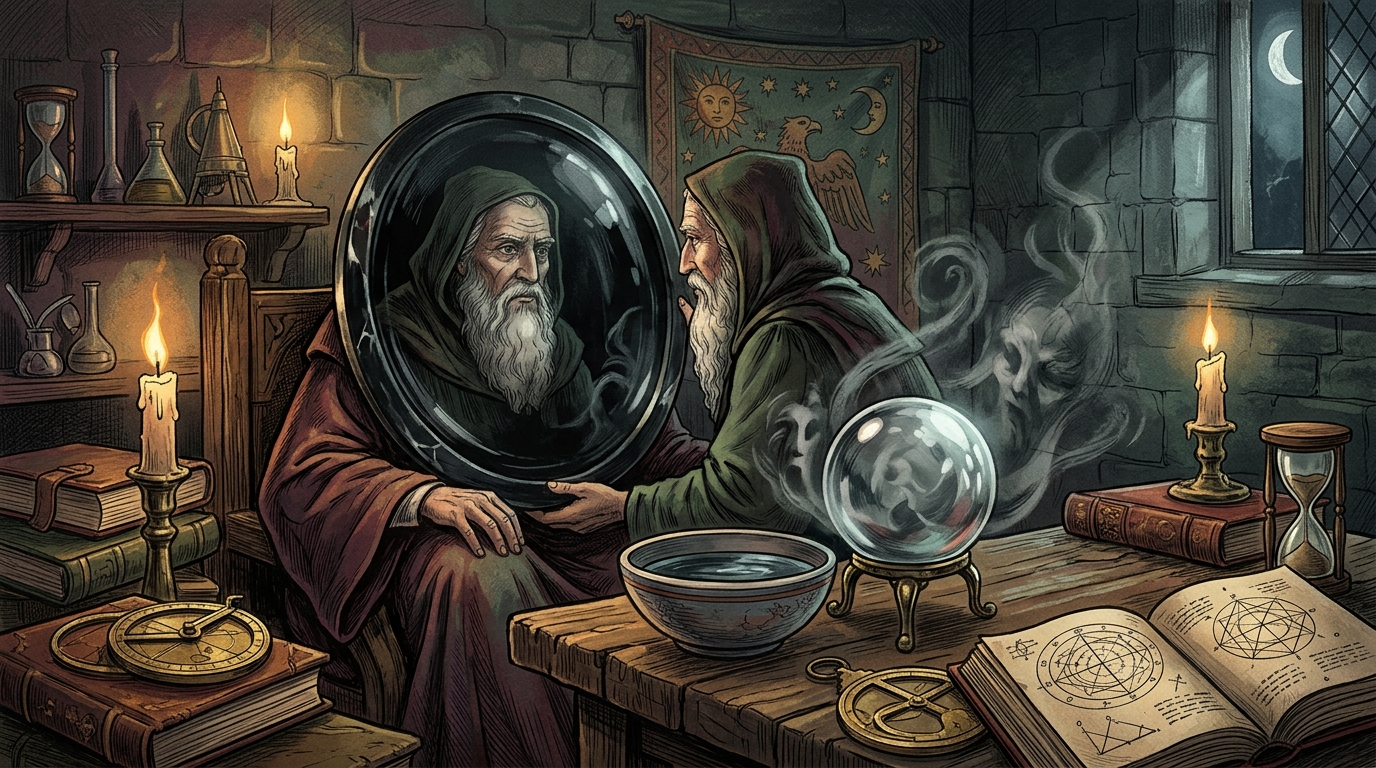
Western esotericism · Practice card · For familiarization
In a glass case in the British Museum lies a polished disc of black volcanic glass, a little smaller than a dinner plate. It belonged to John Dee — mathematician, astrologer to Queen Elizabeth I, one of the most learned men in Europe. In the 1580s Dee and his assistant Edward Kelley spent hundreds of hours gazing into such “shew-stones”, recording conversations they believed they held with angels. In 2021 researchers confirmed that the mirror was made from Mexican obsidian: an Aztec object, brought to Europe after the conquest, used to look into another world.
In short: Scrying is gazing into a reflective or translucent surface — water, oil, a crystal ball, a black mirror — to receive visions, messages or knowledge. It is found in ancient Mesopotamia and Egypt, medieval Europe, Renaissance magic and modern occultism. John Dee’s angelic “actions” with Edward Kelley are its most famous Western example. Psychology offers a partial explanation: staring at a fixed surface in dim light causes the visual system to fade and fill in, producing faces and images — a phenomenon studied as the “strange-face-in-the-mirror” illusion.
How people experience it
Scryers describe the surface first clouding or “misting”, then images forming — figures, landscapes, symbols, sometimes moving scenes. Many say the images arise on their own, like dream images, while they are fully awake. Some find the experience beautiful and insightful; others are unsettled, especially by faces that seem to look back.
How the tradition explains it
- Ancient roots. Divination by oil on water (lecanomancy) was practised in Mesopotamia; Egyptian magical papyri describe lamp and bowl divination with a child as medium.
- John Dee and Edward Kelley. From 1582 Kelley scryed while Dee recorded. The “angels” dictated a whole language, later called Enochian, and gave instructions — including, notoriously, that the two men share their wives.
- Crystal balls. Popular in the 19th century among spiritualists and fortune-tellers; the Victorian researcher Frederic Myers studied “crystal vision” as a form of automatism.
A simple method
For familiarization.
- Fill a dark bowl with water, or use a mirror. Place one candle behind you so its light does not reflect directly.
- Sit comfortably, relax your breathing, and let your gaze rest softly on the surface, as if looking into it rather than at it.
- Do not chase images. Note what appears without judging. Ten to fifteen minutes is enough.
- Write down what you saw immediately afterwards.
How science explains it — and where it stops
When you stare at a fixed point, unchanging parts of the visual field fade from awareness (Troxler fading), and the brain fills the gaps. In 2010 the Italian psychologist Giovanni Caputo asked volunteers to gaze at their own face in a mirror in dim light for ten minutes. Within a minute most began to see distortions; many saw the faces of strangers, relatives, animals or “monsters”. He called it the strange-face-in-the-mirror illusion. Dim light, steady gaze and expectation — exactly the conditions of scrying — produce vivid images from the brain’s own visual machinery.
Where science stops: it explains how images arise. It does not explain the content — why one person sees a dead grandmother and another a landscape they later recognise — or what Dee and Kelley were really in contact with during their sessions.
Known, disputed, open
- Known: Dee’s obsidian mirror is Aztec in origin; Dee recorded his sessions in detail; mirror-gazing reliably produces illusory faces.
- Disputed: whether Kelley was sincere or a fraud.
- Open: where the content of the visions comes from.
Safety notes. Mirror-gazing can produce frightening images and a sense of unreality. Avoid it if you have a history of psychosis, dissociation or severe anxiety, and stop if you feel distressed. Never leave candles unattended, and do not make decisions based on what you see.
Frequently asked questions
What is scrying?
Gazing into water, crystal, a mirror or another surface to receive visions or messages.
Where is John Dee’s mirror?
In the British Museum in London. A 2021 study showed it was made from obsidian from Mexico — an Aztec object.
Why do I see faces in the mirror in the dark?
Because of the strange-face-in-the-mirror illusion: steady gazing in dim light makes features fade and the brain fills in new ones.
Where next
- Hypnagogia — images at the edge of sleep
- Where tarot really comes from
Sources
- Campbell S., Healey E., Kuzmin Y., Glascock M. D. (2021). The mirror, the magus and more: reflections on John Dee’s obsidian mirror. Antiquity 95(384).
- Caputo G. B. (2010). Strange-face-in-the-mirror illusion. Perception 39(7): 1007–1008.
- Harkness D. E. (1999). John Dee’s Conversations with Angels. Cambridge: Cambridge University Press.