Western esotericism · Practice card · For familiarization
The Tower struck by lightning. Death on a pale horse. The Hanged Man upside down and strangely calm. Tarot images feel ancient, as if they had come from the temples of Egypt. In fact they were painted for Italian dukes who used them to play a trick-taking game, much like bridge. How a Renaissance pastime became the West’s best-known tool of divination is one of the most curious stories in the history of esotericism.
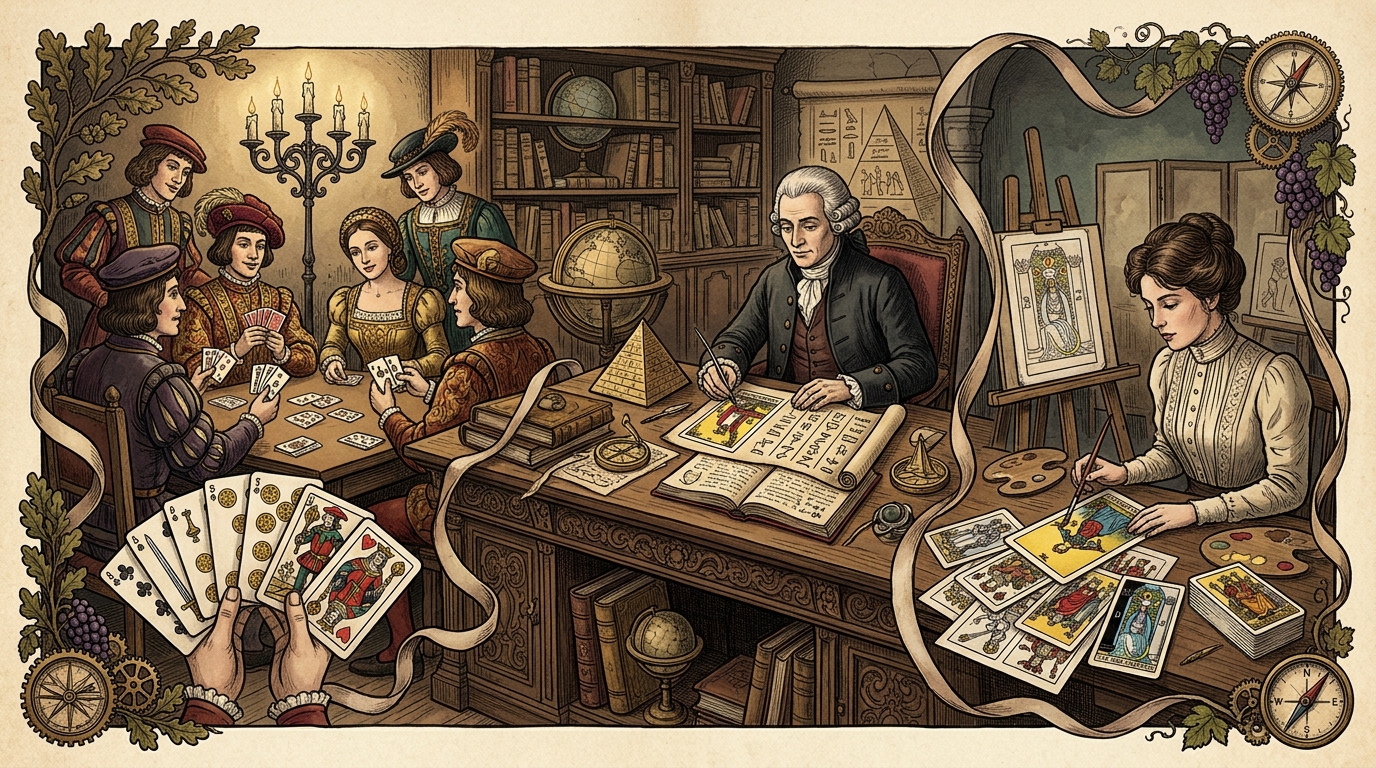
In short: Tarot cards (Italian tarocchi) appeared in northern Italy around 1440–1450 as a card game with four suits plus a set of picture trumps. The oldest surviving decks were made for the Visconti and Sforza families of Milan. In 1781 the French scholar Antoine Court de Gébelin claimed tarot preserved the wisdom of ancient Egypt; soon after, Etteilla published the first deck designed for fortune-telling. In 1909 the Rider-Waite-Smith deck, drawn by Pamela Colman Smith to A. E. Waite’s instructions, gave every card a picture and became the standard for modern readers.
How people experience it
People who read tarot rarely describe it as simple prediction. More often they speak of the cards as a mirror: a picture lands on the table and suddenly a situation they could not see clearly has a shape and a name. Some describe an uncanny sense that the “right” card always comes up. Others use tarot as a tool for reflection, journaling or creative work. We present the history and a basic method; how to interpret the cards is each reader’s own choice.
How the tradition explains it
- The game (15th century). Tarot decks added 21 numbered trumps and the Fool to the usual suits — cups, coins, swords and batons. The trumps showed familiar allegories of Renaissance culture: Love, Death, Fortune, the Pope, the Emperor. The game is still played in France, Austria and Italy.
- The Egyptian myth (1781). In his encyclopedia Le Monde primitif, Court de Gébelin claimed the trumps were the remains of the Egyptian Book of Thoth, hidden in a game by priests. There was no evidence, but the idea caught on.
- The first fortune-teller (1780s). The Parisian Jean-Baptiste Alliette, writing as “Etteilla”, published books and a deck specifically for divination.
- The occult revival (19th century). Éliphas Lévi linked the 22 trumps (the “Major Arcana”) to the 22 letters of the Hebrew alphabet and the Kabbalah. The Hermetic Order of the Golden Dawn in London built tarot into its system.
- Rider-Waite-Smith (1909). Golden Dawn members A. E. Waite and Pamela Colman Smith produced a deck in which even the 56 minor cards show scenes — which made intuitive reading much easier.
A simple three-card reading
A common modern method. For familiarization.
- Shuffle while holding one clear, open question in mind (not “yes or no”).
- Lay out three cards: situation, obstacle, advice.
- Look first at the picture: what is happening, what do you notice? Only then read the traditional meaning.
- Write down what the cards made you think about — that is the reading.
How science explains it — and where it stops
There is no scientific evidence that tarot predicts the future. Psychologists explain its persuasive power through the Barnum effect, confirmation bias and “cold reading” — a reader picking up cues from the client. At the same time, rich symbolic images are powerful prompts for reflection; some therapists and coaches use tarot-like picture cards as projective tools, much like the Rorschach test.
Where science stops: it explains how readings feel accurate. It does not explain the occasional striking “hits” people remember for years — or why a deck designed for a card game became a mirror for millions.
Known, disputed, open
- Known: tarot began as a 15th-century Italian card game; occult interpretation began in the 1780s; the Rider-Waite-Smith deck dates from 1909.
- Disputed: whether the original trumps had a hidden esoteric programme; historians mostly say no.
- Open: what happens in the mind when a randomly drawn picture feels like an answer.
Safety notes. Do not base medical, legal or financial decisions on tarot readings. Be wary of readers who predict curses or disasters and then offer paid “cleansing” — a classic scam. If you notice you cannot make everyday decisions without consulting the cards, it may be worth talking to someone you trust.
Frequently asked questions
Is tarot from ancient Egypt?
No. That idea was invented by Antoine Court de Gébelin in 1781. Tarot originated in 15th-century Italy.
How many cards are in a tarot deck?
78: 22 Major Arcana (trumps and the Fool) and 56 Minor Arcana in four suits.
Who drew the Rider-Waite tarot?
Pamela Colman Smith, an artist and Golden Dawn member, working with Arthur Edward Waite. It was published by William Rider & Son in 1909.
Where next
- Wax and lead pouring — folk divination
- The Prophecy of the Popes
Sources
- Dummett M. (1980). The Game of Tarot. London: Duckworth.
- Decker R., Depaulis T., Dummett M. (1996). A Wicked Pack of Cards: The Origins of the Occult Tarot. London: Duckworth.
- Farley H. (2009). A Cultural History of Tarot. London: I. B. Tauris.