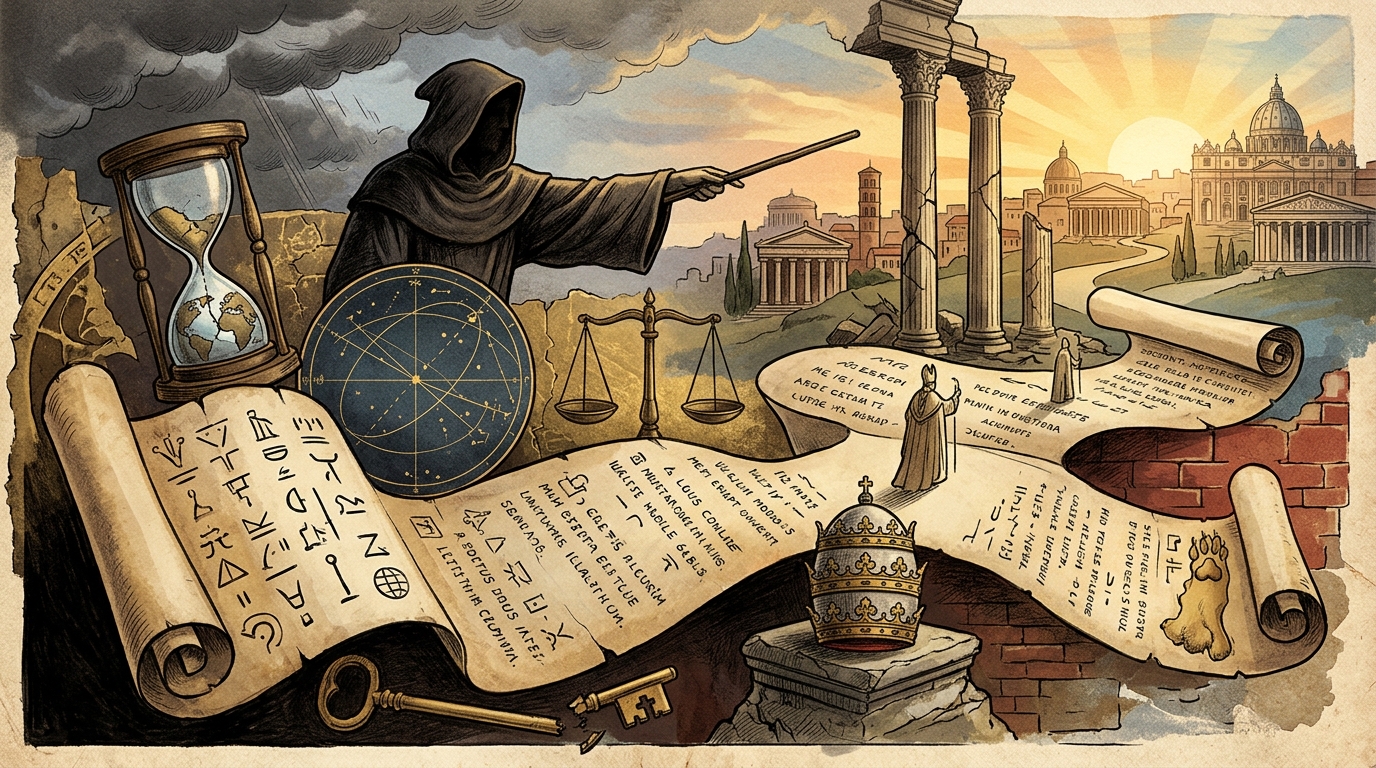
Predictions · Catholic mysticism & orders
Every time a pope dies, one old text returns to the headlines: a list of 112 short Latin phrases said to describe every pope until the end of the world. The last entry speaks of “Peter the Roman”, the destruction of the city of seven hills and the “dreadful Judge”. Here is what we can check.
Prediction record
- Prediction: after the pope of entry 111, “in the final persecution of the Holy Roman Church”, Peter the Roman will reign; then Rome will be destroyed and the Judge will judge his people.
- Attributed to: St Malachy of Armagh (1094–1148)
- First documented: 1595, Arnold Wion, Lignum Vitae, Venice
- Checkable? Partly: the order of popes, yes; the “end”, only by its date
- Status (November 2026): not fulfilled. The list has run out; the Church continues under Pope Leo XIV, elected 8 May 2025.
What the prophecy says
The text is a series of cryptic mottos, one per pope (and some antipopes), beginning with Celestine II, elected in 1143. Each motto is supposed to point to the pope’s name, family, coat of arms, birthplace or career. Entry 111 is Gloria olivae, “the glory of the olive”. Then comes a longer final passage:
“In the final persecution of the Holy Roman Church there will sit Peter the Roman, who will feed his sheep amid many tribulations; when they are over, the city of seven hills will be destroyed, and the dreadful Judge will judge his people. The End.”
How the tradition presents it
According to the story, Malachy, Archbishop of Armagh in Ireland, received the vision during a visit to Rome in 1139 and wrote it down for Pope Innocent II, who placed it in the archives, where it lay forgotten for four and a half centuries. Malachy was a real and holy man, canonised by Pope Clement III; his friend St Bernard of Clairvaux wrote his biography and praised his gift of prophecy — but Bernard says nothing about a list of popes.
What historians conclude
- No trace for 450 years. No source mentions the list before Wion’s book of 1595.
- Accurate until 1590, vague after. The mottos for popes before 1590 fit closely — often using details from a 16th-century history of the popes by Onofrio Panvinio, including its mistakes. After 1590 they become general and need creative interpretation.
- The 1590 conclave. The motto after Urban VII is Ex antiquitate Urbis, “from the old city”. Historians since the Jesuit Claude-François Menestrier (1689) have argued that the list was forged to support Cardinal Girolamo Simoncelli, who came from Orvieto — in Latin Urbs Vetus, “the old city”. He was not elected.
The Catholic Church has never approved the prophecy. Most Catholic and secular historians consider it a late-16th-century forgery.
The modern popes: checking the end of the list
| Entry | Motto | Pope | How supporters read it |
|---|---|---|---|
| 109 | De medietate lunae — “of the half of the moon” | John Paul I (1978) | His reign lasted about a month, “from one half-moon to the next” |
| 110 | De labore solis — “of the labour of the sun” | John Paul II (1978–2005) | Born and buried on days of solar eclipses |
| 111 | Gloria olivae — “the glory of the olive” | Benedict XVI (2005–2013) | His chosen name recalls the Benedictines, one of whose branches is the Olivetans |
| 112 | Petrus Romanus — “Peter the Roman” | Francis (2013–2025)? | Disputed: his name was Jorge, he was Argentine; supporters pointed to his Italian roots or to St Francis’s father, Pietro |
| — | (no entry) | Leo XIV (since 8 May 2025) | Beyond the end of the list |
Some readers argue that “Peter the Roman” is not a numbered pope at all, but an unknown figure who could come after an unspecified number of popes; others say the list counts antipopes and is “off by one”. Under these readings the end of the list has no fixed date to check against.
Result (November 2026)
Read literally, the prediction pointed to an end of the papacy and of Rome after the 112th entry. Francis died on 21 April 2025; a conclave met; Robert Francis Prevost, an Augustinian from Chicago, was elected and took the name Leo XIV. Rome stands. Status: not fulfilled in its literal sense. We will return to this record if anything changes.
Parallels: lists of the last kings
Medieval Europe loved such lists. The Vaticinia de summis pontificibus, illustrated “papal prophecies” from the 13th–14th centuries, also described a sequence of popes leading to an Angelic Pope. The Sibylline tradition foretold a Last Roman Emperor. In Russia, the monk Abel (18th–19th centuries) was credited with predicting the fates of the Romanovs. Such texts often appear at moments of crisis — and are often written backwards from the present.
Known, disputed, open
- Known: the text first appears in 1595; it fits pre-1590 popes far better than later ones; the list has ended and the papacy continues.
- Disputed: who wrote it and why; whether any post-1590 motto is a genuine hit.
- Open: nothing that the text itself allows us to test further.
Frequently asked questions
What is the Prophecy of the Popes?
A list of 112 short Latin mottos describing popes from 1143 onward, attributed to St Malachy and first published in 1595. It ends with “Peter the Roman” and the destruction of Rome.
Is Leo XIV the last pope according to St Malachy?
The list ends before Leo XIV. Depending on the reading, the last entry was Benedict XVI or Francis. The literal prediction of the end of the papacy has not come true.
Is the prophecy of St Malachy real?
Most historians consider it a forgery from around 1590, possibly linked to that year’s conclave. The Church has never endorsed it.
Where next
- All predictions and how we check them
- The November 17 cyberattack rumor, examined
- Catholic exorcism today: how the Vatican’s rite works
Sources
- Arnold Wion, Lignum Vitae, Venice, 1595.
- Claude-François Menestrier, Réfutation des prophéties faussement attribuées à S. Malachie, Paris, 1689.
- Bernard of Clairvaux, Life of St Malachy.
- “The end in 112 steps: counting down the popes”, Leiden Arts in Society Blog. Link.
- The Holy See, Pope Leo XIV: vatican.va.