Practice card · For familiarization · Folk Europe
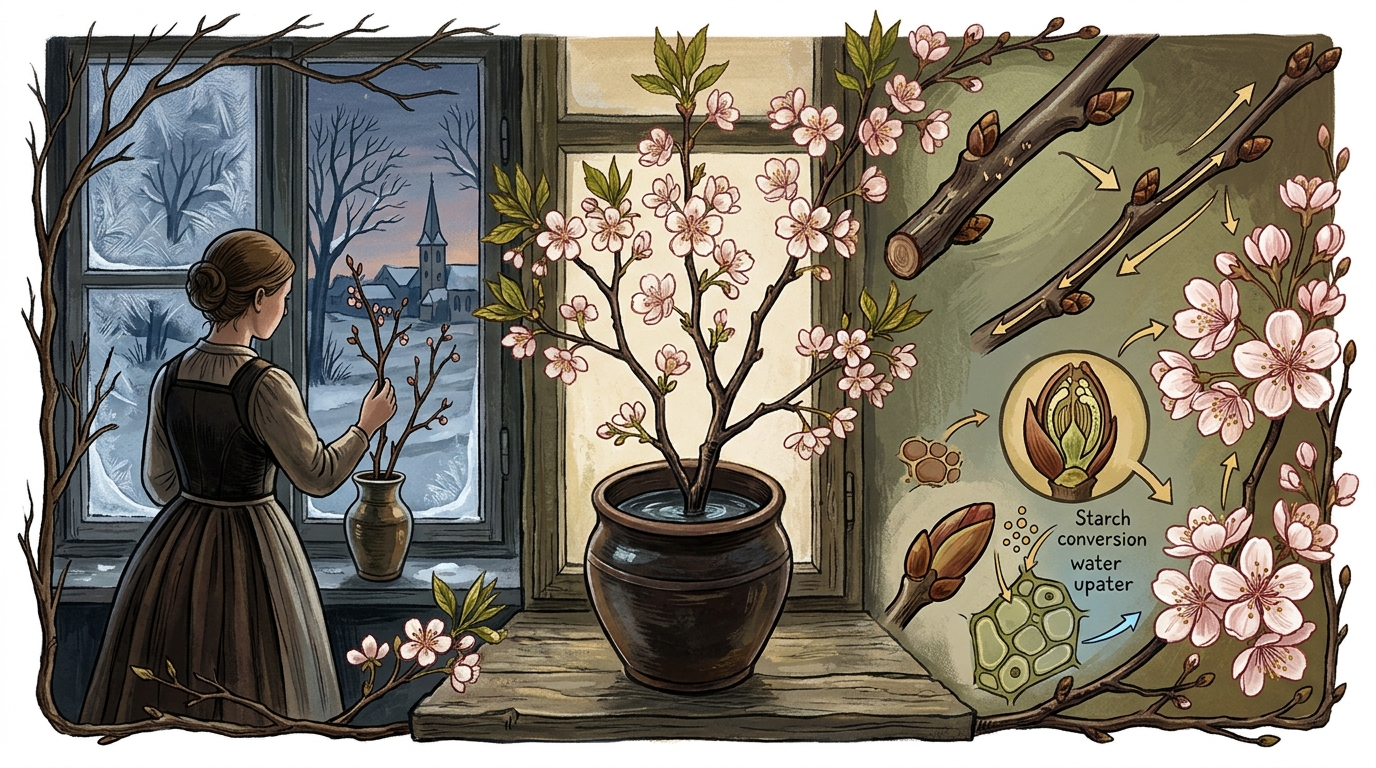
Outside it is grey and freezing; the garden is dead. But in a jar of water on the windowsill, a bare cherry twig cut three weeks earlier has suddenly opened white blossoms — exactly on Christmas Eve. For centuries in Central Europe this small miracle has been read as a message: love is coming, the year will be good. It is one of the simplest and most beautiful folk oracles of winter.
In short: On 4 December, the feast of St Barbara, people in Germany, Austria, Czechia and neighbouring countries cut branches from cherry (or apple, plum, forsythia) trees and put them in water indoors. If they bloom by Christmas, it is a sign of good luck — traditionally, for a young woman, of marriage in the coming year. The custom is linked to a legend about St Barbara in prison; botanically, it works because the twigs have already had their winter chill.
How people experience it
Those who keep the custom describe the three weeks of watching as a quiet meditation in the darkest part of the year: every morning checking the swelling buds, changing the water, hoping. When the blossoms open, even people who do not believe in oracles say they feel a lift of joy — spring has come early, at least on the windowsill.
How the tradition explains it
According to legend, Barbara was a young woman of the 3rd century whose pagan father locked her in a tower; when she became a Christian he handed her over to be killed and beheaded her himself — and was struck dead by lightning. One version says that on the way to prison a branch caught on her dress; she put it in water in her cell, and it bloomed on the day of her death. She became patron of miners, artillerymen and those in danger of sudden death. In 1969 she was removed from the general Catholic calendar because her story could not be historically verified, but her popular cult remains strong.
How to do it
As practised in Central Europe. For familiarization.
- On 4 December cut a few branches with plenty of fat buds from a cherry tree (with the owner’s permission). Traditionally this is done in silence, sometimes in the morning before sunrise.
- If it has not frozen yet, put the branches in a freezer or outside overnight — they need a cold “winter” first.
- Cut the ends diagonally, soak the branches in lukewarm water for a few hours, then place them in a vase in a cool, bright room.
- Change the water every few days. Some girls tie a name label to each branch: the one that blooms first names the future husband.
How science explains it — and where it stops
Fruit trees set their flower buds in summer but cannot open them until they have experienced a certain amount of cold — the “chilling requirement”. By early December most cherry twigs have had enough. Brought into a warm room and given water, they behave as if spring has come; about three weeks later the flowers open, which neatly matches the interval between 4 and 24 December. Gardeners call this “forcing”. Whether the twigs bloom depends on the weather of the autumn, the tree and the room — which is exactly what makes it an oracle.
Where science stops: it explains the blossoms. It does not decide whether the timing carries a message — that is left to the person at the window.
Known, disputed, open
- Known: the custom is widespread in Central Europe; the botany of chilling and forcing is well understood.
- Disputed: whether St Barbara existed; whether the custom is older than her cult.
- Open: why people across Europe linked blossoming in winter with love and fate.
Notes. Cut only from your own trees or with permission, using clean secateurs, and take a few branches so the tree is not harmed. Cherry leaves and stones contain cyanogenic compounds — keep twigs away from pets that chew plants.
Frequently asked questions
What are Barbara branches?
Branches, usually cherry, cut on St Barbara’s Day (4 December) and placed in water so they bloom at Christmas as a sign of luck.
What does it mean if Barbara branches bloom on Christmas?
Traditionally good luck for the coming year, and for an unmarried woman a wedding within the year.
Why didn’t my branches bloom?
Usually because they had not had enough cold before cutting, the room was too warm or dry, or the water was not changed.
Where next
- St John’s wort — the summer counterpart among plant oracles
- All practice cards
Sources
- “Saint Barbara”, Encyclopaedia Britannica.
- Bächtold-Stäubli H. (ed.). Handwörterbuch des deutschen Aberglaubens, article “Barbara”.
- Luedeling E. (2012). Climate change impacts on winter chill for temperate fruit and nut production: a review. Scientia Horticulturae 144: 218–229.