Tradition · Celtic & Norse · Plant lore
In winter, when the oak is bare, you can see them: round green balls high in the branches, growing out of the tree as if from nowhere, with pale berries like pearls. Mistletoe never touches the ground. To people of the past that made it a plant between worlds — neither of earth nor of sky. The druids revered it, the Norse made it a weapon of fate, and the English turned it into an excuse for a kiss.
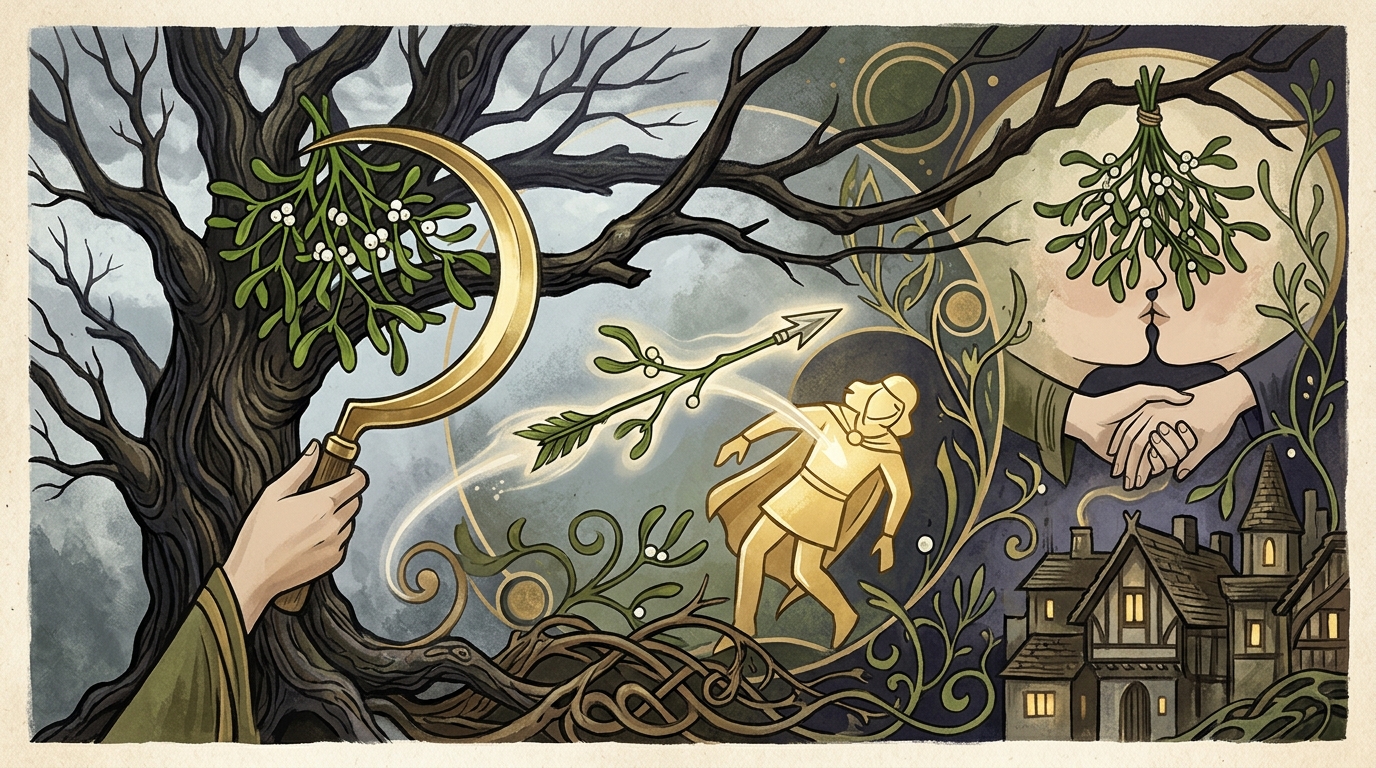
In short: European mistletoe (Viscum album) is a semi-parasitic evergreen that grows on trees. The Roman writer Pliny the Elder described Gaulish druids cutting it from an oak with a golden sickle and using it as a remedy and fertility charm. In Norse myth, a dart of mistletoe killed the god Baldr. Across Europe it was hung against witches, lightning and illness. The custom of kissing under the mistletoe is recorded in England from the 18th century. Its berries and leaves are toxic.
How people experience it
For most people mistletoe is a playful Christmas game. But those who go out to find it in the wild often describe a feeling of strangeness: a green, living thing glowing in the bare winter crown, seemingly self-born. It is easy to see why it became sacred.
How the tradition explains it
The druids
In his Natural History (book XVI), Pliny writes that the druids held nothing more sacred than mistletoe growing on an oak — which is rare. On the sixth day of the moon a priest in white climbed the tree and cut it with a golden sickle; it was caught in a white cloak, and two white bulls were sacrificed. They called it “all-heal” and gave a drink of it to barren animals to make them fertile. This is almost our only ancient account, and it was written by an outsider.
The death of Baldr
In Snorri Sturluson’s Prose Edda, the goddess Frigg makes every thing in the world swear never to harm her son Baldr — but overlooks the mistletoe, which seems too young to swear. Loki makes a dart of it and guides the hand of the blind god Höðr. Baldr dies, and his death foreshadows the end of the world. Later retellings added a happy ending in which mistletoe becomes a plant of love, but that is not in the medieval sources.
Folk uses
As recorded in European folklore. For familiarization.
- Hung over doors and in stables against witches, lightning and evil spirits.
- Kept from one Christmas to the next and burned when the new bunch was hung.
- In 18th-century England, a “kissing bough”: a man could kiss a girl beneath it and pluck a berry; when the berries were gone, the kissing stopped.
How science explains it — and where it stops
Mistletoe is spread by birds: sticky seeds are wiped or excreted onto branches, where they root into the host tree’s tissue. It photosynthesises itself but takes water and minerals from the tree — hence “half-parasite”. Extracts are used in some European countries as a complementary cancer therapy; systematic reviews have found no convincing evidence that they prolong survival, though some studies report better quality of life.
Where science stops: it explains how the plant lives between earth and sky. It does not explain why, of all plants, this one became the hinge of a god’s death and a druid’s most sacred rite.
Known, disputed, open
- Known: Pliny’s druid account; the Baldr myth in the Prose Edda; the English kissing custom from the 18th century.
- Disputed: how reliable Pliny’s description of the druids is; whether the kissing custom has ancient roots.
- Open: why a plant “between worlds” became a symbol of both death and love.
Safety notes. Mistletoe berries and leaves are poisonous and can cause vomiting, diarrhoea and, in large amounts, heart problems. Hang it out of reach of children and pets, collect fallen berries, and never make teas or tinctures at home. Do not use mistletoe extracts alongside cancer treatment without your oncologist’s agreement.
A winter doorway ritual with mistletoe symbolism
In parts of modern Europe and North America, hanging mistletoe at a doorway marks the festive season and an invitation to goodwill. This gentle home adaptation is not a reconstruction of Pliny’s druid ceremony: choose a non-toxic artificial sprig, hang it securely out of reach of children and animals, and pause beneath it to offer a kind wish or express gratitude. You may record the moment in a seasonal journal. Do not eat mistletoe or prepare homemade extracts: the plant can be poisonous. The rite’s meaning is personal, not a promise of protection or healing.
Frequently asked questions
Why do we kiss under the mistletoe?
The custom is first recorded in 18th-century England; it may draw on older ideas of mistletoe as a plant of fertility and peace.
Did the druids really use mistletoe?
Pliny the Elder says so in his Natural History. His is the only detailed ancient account, so historians treat it with caution.
Is mistletoe poisonous?
Yes. The berries and leaves are toxic, especially to children and pets.
Where next
- St John’s wort — the herb that “drives away demons”
- The Yule log
Sources
- Pliny the Elder. Natural History, XVI.95.
- Snorri Sturluson. Edda, “Gylfaginning” — the death of Baldr. Trans. A. Faulkes. London: Everyman, 1987.
- Freuding M. et al. (2019). Mistletoe in oncological treatment: a systematic review. Journal of Cancer Research and Clinical Oncology 145: 695–707 and 927–939.