Tradition · Norse & Germanic · World parallels
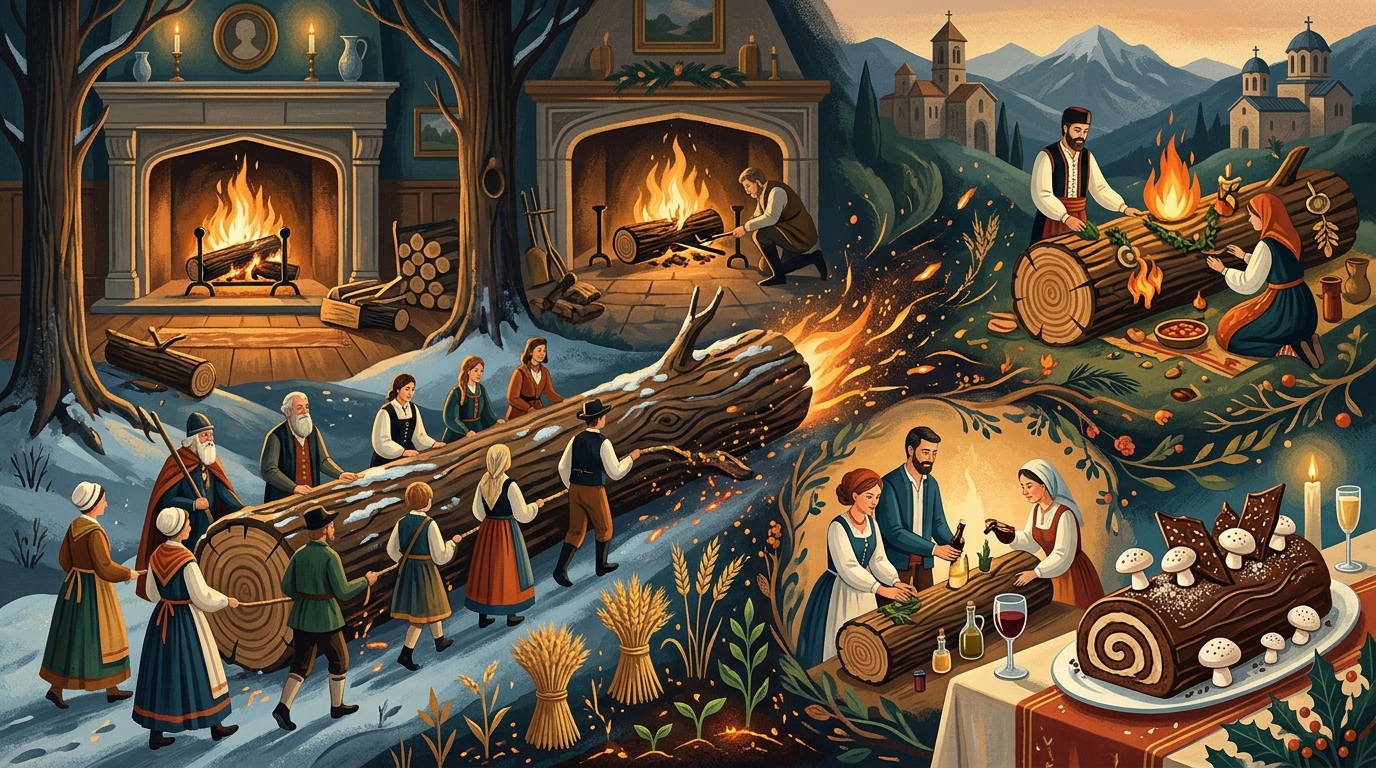
On Christmas Eve the men of the house went into the woods and chose a great log — oak, ash or fruitwood. They dragged it home with ropes while children rode on it, greeted it at the door, poured wine on it, and lit it with a charred piece kept from last year’s log. It had to burn through the long night, sometimes through all twelve days of Christmas. From England to Provence to Serbia, the fire at the heart of the house was the centre of midwinter.
In short: The Yule log was a large log ceremonially brought into the house and burned on the hearth at Christmas. The name comes from Yule (Old Norse jól), the Germanic midwinter feast. The custom is recorded in England from the 17th century, in France, Italy and the Balkans, where the Serbian badnjak — a young oak cut on Christmas Eve — is still a central rite. Remnants were kept to protect the house from fire and lightning, and ashes spread on fields for fertility. When large open hearths disappeared, the log survived as the French Christmas cake, the bûche de Noël.
How people experience it
Families who still burn a Yule log describe an evening organised around watching the fire: telling stories, remembering those who died during the year, waiting for the log to catch. In Serbia, the moment the badnjak is brought into the house with the greeting “Good evening and happy Badnji Dan” and straw spread on the floor is for many the emotional heart of Christmas.
How the tradition explains it
Customs as recorded in Europe. For familiarization.
- England. The poet Robert Herrick (17th century) wrote of bringing in the Yule log and lighting it with last year’s brand, kept all year under the bed to protect the house. Burning should not stop before Twelfth Night.
- Provence. The cacho-fiò: the oldest and youngest of the family carried the log three times around the table, the grandfather poured wine on it and blessed it, asking for a good year.
- Serbia and Montenegro. Early on Christmas Eve (Badnji dan) the head of the family cuts a young oak — the badnjak — with three strokes and brings it home in the evening; it is placed on the fire, sprinkled with wheat and wine, and sparks are struck from it with wishes for “as many sheep, as many cattle, as many children”. Today many churches burn a communal badnjak.
- Protective remains. Charred pieces kept against fire, storms and lightning; ashes mixed into seed or spread on fields and fed to animals.
Christian interpretations saw the log as warmth for the newborn Christ or as the wood of the cross; earlier, folklorists such as James Frazer read it as a solstice fire helping the sun to return.
A Yule log ritual you can try at home
Wondering what is a Yule log or how to celebrate Yule at home? Hearth customs differed across England, the Balkans and other parts of Europe. The following candle-free version is a contemporary symbolic adaptation, not a reconstructed Viking ceremony.
- Choose a small clean piece of fallen wood and place it on a stable table, away from pets and young children.
- At dusk, take a moment to notice the darkness outside and name one thing you are grateful for from the past year.
- Write one intention for the returning light on a separate piece of paper. Keep it in a journal rather than burning it.
- Share a story or meal with others, or sit quietly and observe how the season feels to you.
Symbolism: The log represents continuity, warmth and the turning of the year. No open flame is required. If you choose a traditional fireplace celebration, follow local fire regulations and never leave a fire unattended. The meaning of the ritual belongs to the participant.
How science explains it — and where it stops
Anthropologists see the Yule log as a ritual of continuity: lighting the new fire from the old one links the years, the dead and the living. Fire-gazing itself appears to have measurable effects: a study by Christopher Lynn found that watching a crackling fire lowered blood pressure in volunteers, especially over longer sessions and with sound — perhaps an echo of the hearth’s central place in human evolution.
Where science stops: it explains why the fire calms us. It does not explain what families mean when they say the house “feels protected” with last year’s brand under the bed.
Known, disputed, open
- Known: the Yule log is recorded in England from the 17th century and across Europe in folklore; the badnjak remains a living Serbian custom; the bûche de Noël cake dates from the 19th century.
- Disputed: whether the custom continues pre-Christian solstice fire rites.
- Open: why fire at the year’s darkest point means so much to so many peoples.
Safety notes. A large log in a modern fireplace can overheat the chimney. Use only dry wood, have the chimney swept, use a fireguard, never leave a fire burning overnight unattended, and keep a working carbon monoxide alarm. Pouring alcohol on a burning log can cause flare-ups.
Frequently asked questions
What is the meaning of the Yule log?
It brought light and warmth into the darkest time of year, linked one year to the next, and its remains were believed to protect the house and bring fertility.
What is a badnjak?
A young oak or oak branch cut by Serbian families on Christmas Eve and burned on the hearth or in a church bonfire.
Why is a Christmas cake called a Yule log?
When homes lost their big open hearths, French pastry chefs in the 19th century turned the log into a rolled sponge cake, the bûche de Noël.
Where next
Sources
- Frazer J. G. The Golden Bough, ch. 62, “The Fire-Festivals of Europe”.
- Hutton R. (1996). The Stations of the Sun: A History of the Ritual Year in Britain. Oxford: Oxford University Press.
- Lynn C. D. (2014). Hearth and campfire influences on arterial blood pressure: defraying the costs of the social brain through fireside relaxation. Evolutionary Psychology 12(5): 983–1003.