Tradition · Northern Europe · World parallels
A 17th-century traveller in Lapland described what he saw: the noaidi beat his drum and sang until he fell to the ground as if dead. No one was allowed to touch him. For an hour or more he lay motionless while, it was believed, his soul travelled to distant places and to the world of the dead. When he woke, he told where lost reindeer could be found, what had happened far away, and what the spirits demanded. Europe, too, had its shamans — and the last of them lived in the far North.
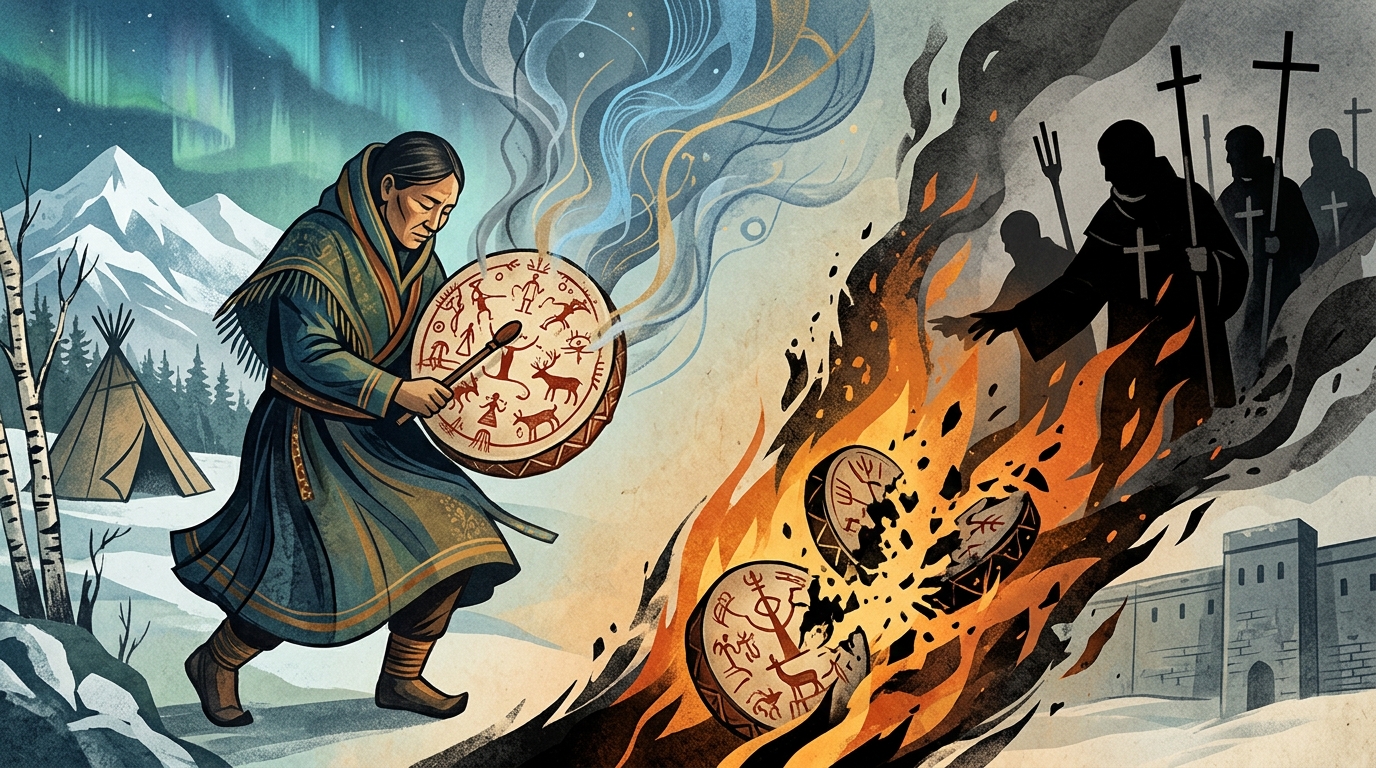
In short: The Sámi, the Indigenous people of northern Norway, Sweden, Finland and Russia’s Kola Peninsula, had ritual specialists called noaidi who entered trance to heal, find lost things, guide souls and mediate with spirits. Their main instrument was a frame drum painted with figures of gods, people, animals and the sun. In the 17th and 18th centuries Lutheran missionaries and Scandinavian authorities confiscated and burned hundreds of drums, and noaidi were persecuted. Around seventy historical drums survive, mostly in museums; some are now being returned to Sámi communities.
How people experience it
Historical sources describe the noaidi’s trance as a dangerous journey: his free soul left the body, sometimes in the shape of an animal — a reindeer, a bird, a fish — and could be attacked by hostile spirits or other noaidi. Today Sámi people who reconnect with this heritage often speak of the drum and the joik (traditional chant) as living ancestors rather than objects — and of the return of a drum to its community as the return of a family member.
How the tradition explains it
The drum
The Sámi drum was made of wood with a reindeer-skin head painted with red alder-bark dye. The figures on it formed a map of the world: sky gods above, humans and animals in the middle, the dead below, the sun often in the centre. For divination a small pointer — a ring or a piece of bone or brass — was placed on the skin; the drum was struck with a hammer of reindeer antler, and where the pointer moved and stopped gave the answer: where to hunt, whether a sick person would recover, which offering to make.
The journey
For deeper work — healing a soul stolen by spirits or guiding the dead — the noaidi drummed and joiked into a trance. Helpers continued singing to keep his body safe and to call his soul back. Offerings to the sieidi, sacred stones and places in the landscape, accompanied many rituals.
The persecution
From the late 1600s the Danish-Norwegian and Swedish authorities, with missionaries like Thomas von Westen, campaigned to convert the Sámi. Drums were confiscated and burned, sacred sites destroyed, and some noaidi tried and executed for witchcraft. Our best early description, Johannes Schefferus’s Lapponia (1673), was itself written from reports by clergy. In 2023 one confiscated drum, the Freavnantjahke gievrie, taken in 1723, was returned from Denmark to the South Sámi community.
How science explains it — and where it stops
Sámi shamanism shares its core with Siberian traditions: a frame drum, rhythmic sound, a motionless trance body and a soul journey. Brain-imaging studies of experienced practitioners of shamanic drumming trance show a shift towards internally directed thought and reduced processing of outside sound — consistent with a deep “inner journey”. The drum’s pointer works like other lot-based oracles: it introduces chance into a decision and gives it meaning within a shared worldview.
Where science stops: it describes the brain state, not what the noaidi met on the other side. It also cannot measure what was lost when hundreds of drums — and the knowledge to read them — were burned.
Known, disputed, open
- Known: noaidi and painted drums are documented from the 17th century; drums were systematically confiscated; about seventy survive.
- Disputed: how to read many of the drum figures, since most interpretations were recorded by outsiders.
- Open: what the noaidi experienced in trance.
Respect note. Sámi drums and noaidi practices are part of a living Indigenous heritage. Many Sámi ask outsiders not to copy drum designs or call themselves noaidi. If you are interested, learn from Sámi-led museums and cultural centres.
Frequently asked questions
What is a noaidi?
A Sámi ritual specialist — often compared to a shaman — who entered trance to heal, divine and mediate with spirits.
How was the Sámi drum used?
For divination, by watching where a pointer moved on the painted skin as the drum was struck, and for trance journeys accompanied by joik.
Why were Sámi drums burned?
In the 17th–18th centuries Scandinavian church and state authorities saw them as tools of idolatry and witchcraft and destroyed them during forced Christianisation.
Where next
- Seiðr and the völva — the Norse neighbour of Sámi trance
- Tuva shamans today — the Siberian parallel
- All World Parallels articles
Sources
- Schefferus J. (1673). Lapponia. Frankfurt.
- Rydving H. (1993). The End of Drum-Time: Religious Change among the Lule Saami, 1670s–1740s. Uppsala.
- Hove M. J. et al. (2016). Brain network reconfiguration and perceptual decoupling during an absorptive state of consciousness. Cerebral Cortex 26(7): 3116–3124.