Practice card · For familiarization · Norse & Germanic folk calendar
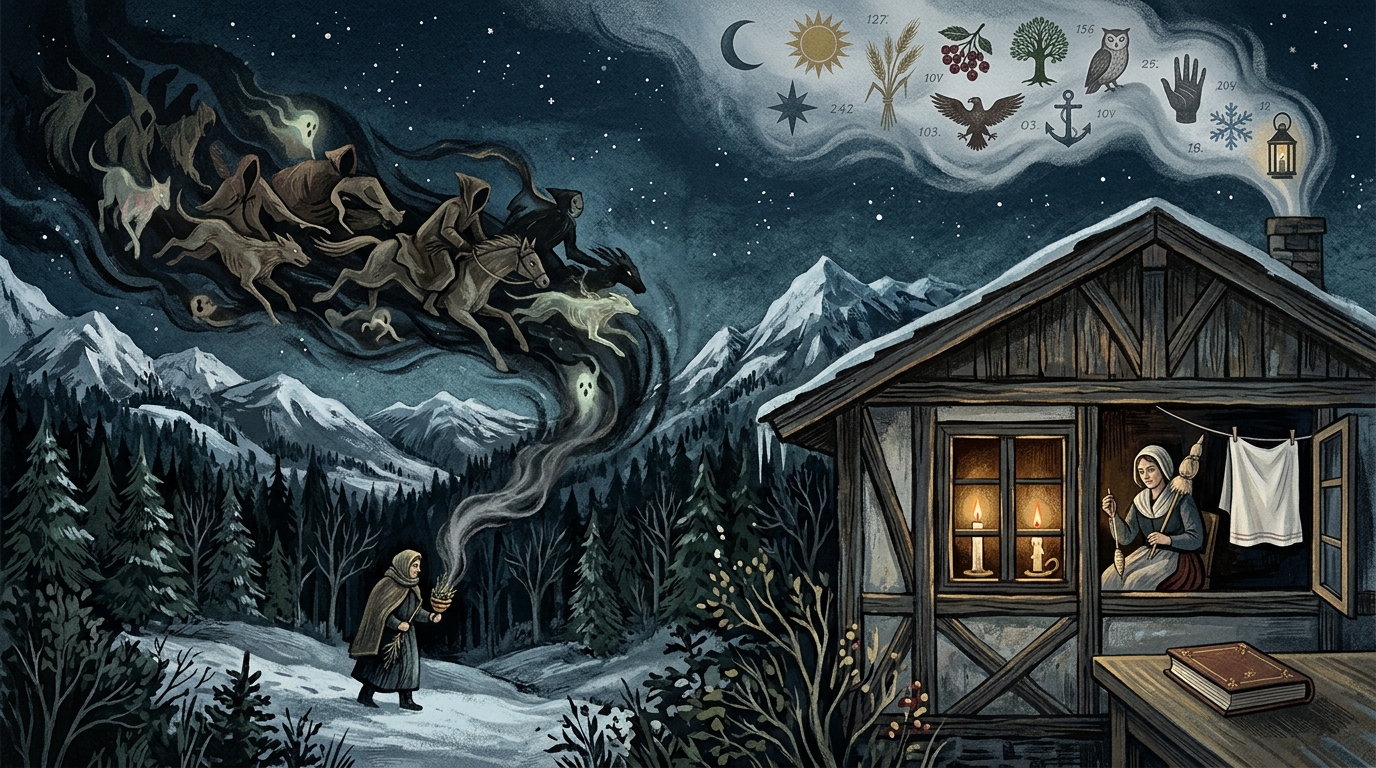
In a Bavarian farmhouse on Christmas Eve, the farmer walks from room to room with a pan of glowing embers and incense, then into the cowshed, then round the outside of the house, while the family follows praying. For the next twelve nights no laundry will be hung out, nobody will spin, and everyone will try to remember their dreams. The house is entering the Rauhnächte — a time when, people believed, the walls between worlds grow thin.
In short: The Rauhnächte (“rough nights”, also “smoke nights”) are the twelve nights between Christmas and Epiphany (25 December – 6 January) in German, Austrian and Swiss folk tradition. They were seen as a time “between the years” when spirits, the dead and the Wild Hunt roam. Customs include smoking the house with incense (Räuchern), avoiding washing and spinning, oracles about the new year and watching dreams, since each night was believed to foretell one month.
How people experience it
People who keep the Rauhnächte today — and the custom has seen a big revival in German-speaking countries — describe it as a pause in time: the year is over, the new one has not quite begun, work has stopped and the nights are long. They write down dreams, light incense, clear out old things and set intentions. Many say it gives the start of the year a depth that a single New Year’s Eve party never could.
How the tradition explains it
One popular explanation links the twelve nights to the gap between the lunar year (354 days) and the solar year (365 days): eleven days and twelve nights that belong to neither year, “dead days” outside the normal order. During this time Frau Perchta or Frau Holle inspects households, rewarding the diligent and punishing those who left flax unspun; the Wild Hunt sweeps the sky; animals in the stable speak at midnight.
The customs
As recorded in Alpine and German folk tradition. For familiarization.
- Smoking the house. On the main nights — usually Christmas Eve, New Year’s Eve and the eve of Epiphany — the head of the house carries incense or dried herbs (juniper, mugwort, frankincense) through every room and the stable, often with holy water and prayer.
- No washing. White laundry hung out could be “taken” by the Wild Hunt, or used as a shroud for someone in the house in the coming year.
- No spinning. Wheels had to stand still: turning wheels could anger Perchta or draw misfortune.
- Dreams and weather. Each of the twelve nights corresponds to a month of the coming year: the first night to January, the second to February, and so on. Dreams and weather on each night were read as omens.
- Epiphany blessing. On 6 January the initials C+M+B (Caspar, Melchior, Balthasar — or Christus mansionem benedicat, “May Christ bless this house”) are chalked above the door with the year.
How science explains it — and where it stops
Anthropologists see the twelve nights as a classic liminal period — a “time between” in which normal rules are suspended before a new order begins. Such periods are found in many cultures around the New Year. Psychologically, a deliberate pause with reflection and intention-setting at the turn of the year can support real change better than quick resolutions, and keeping a dream diary increases dream recall within days. Aromatic smoke from juniper and resins does have a mild antimicrobial effect in enclosed spaces.
Where science stops: it explains the value of a pause. It does not explain why so many peoples placed spirits and the dead exactly in the darkest days at the year’s turning — nor what people mean when they say a Rauhnacht dream “came true”.
Known, disputed, open
- Known: the Rauhnächte customs — house-smoking, laundry and spinning taboos, oracles — are well documented in 19th- and 20th-century folklore.
- Disputed: whether the twelve nights go back to a pre-Christian Germanic midwinter feast or developed within Christian Christmastide.
- Open: why “time between the years” feels different to so many people.
Safety notes. Use a fireproof bowl for embers and incense, keep it away from curtains and Christmas trees, ventilate rooms afterwards and keep smoke away from babies, pets and people with asthma. Never leave smouldering incense unattended.
Frequently asked questions
When are the Rauhnächte?
Most commonly the twelve nights from 25 December to 6 January. Some regions count from St Thomas’s night (21 December).
Why should you not wash clothes during the Rauhnächte?
Folk belief held that the Wild Hunt could catch in laundry hung out to dry, or that washed linen would serve as a shroud in the coming year.
What does each Rauhnacht mean?
Each night was linked to one month of the new year; dreams and weather on that night were read as signs for that month.
Where next
- Saining with juniper smoke — the Scottish parallel
- Wax and lead pouring — New Year’s oracles
Sources
- Bächtold-Stäubli H. (ed.). Handwörterbuch des deutschen Aberglaubens, articles “Zwölften” and “Rauchnächte”. Berlin: de Gruyter, 1927–1942.
- Grimm J. Deutsche Mythologie (1835) — on Holda and Berchta.
- Turner V. (1969). The Ritual Process: Structure and Anti-Structure. Chicago: Aldine.