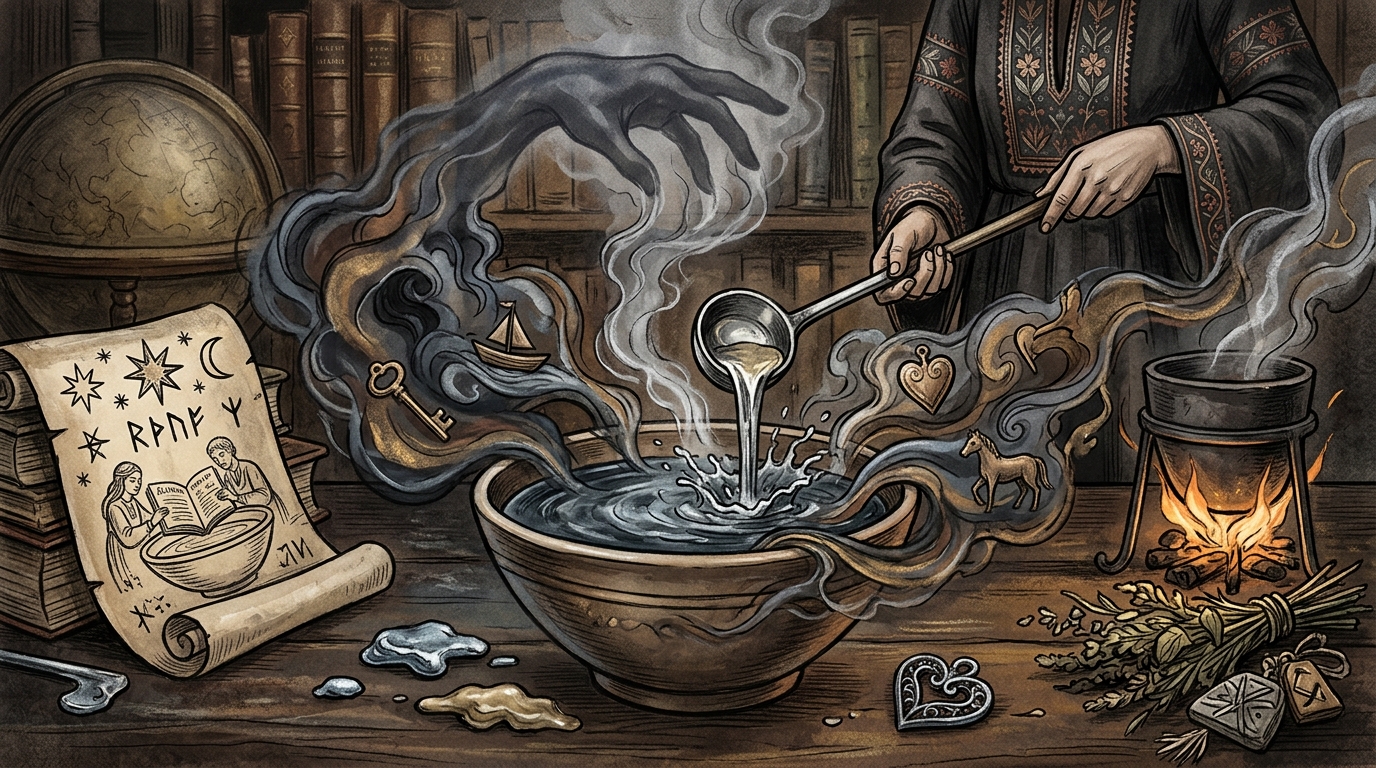
Practice card · For familiarization · Folk Europe · Germanic
On New Year’s Eve, millions of Germans and Finns melt a small piece of metal over a candle, tip it into cold water and hold the hissing shape up to the light: a ship means travel, a heart means love. Further east, a village healer pours wax over a frightened child’s head to “pour out” the fear. Same gesture — two different purposes.
The tradition: two branches
Divination: Bleigießen and uudenvuodentina
Reading molten lead in water is called molybdomancy; reading wax, ceromancy. In Germany, Austria and Switzerland the New Year’s Eve custom of Bleigießen (“lead pouring”) was a family game for generations. In Finland, uudenvuodentina, New Year’s tin, is cast the same way — and Finns also read the shadow the shape throws on the wall by candlelight. Similar customs were known in Denmark, Norway, Estonia and the Baltic countries, often on Christmas Eve or St Andrew’s Eve (29–30 November), when girls asked about future husbands.
Healing: pouring out fright and the evil eye
In Russian, Ukrainian and Belarusian folk healing, wax pouring (vylivanie voskom) treated ispug, “fright” — the restlessness, stammering, bed-wetting or nightmares that were believed to follow a shock. Molten wax was poured into a bowl of water held over the person’s head or chest while a prayer or charm was said; the shape showed what had frightened them — a dog, a figure, a fire. In Turkey, kurşun dökme (“lead pouring”) over a person’s head is still used against the evil eye; in Lithuania and among Ashkenazi Jews similar rites were known.
How it was done
As recorded in folk practice. Given for familiarization.
- Prepare. A bowl of cold water (in Slavic practice preferably “silent water”, drawn without speaking, or melt-water), a candle, a spoon or small ladle, a piece of clean beeswax or metal.
- Melt. Hold the spoon over the flame until the wax or metal is liquid.
- Pour. For divination: tip it in one quick movement into the water and say what you want to know. For the healing rite: the bowl is held over the person’s head (or a photograph is placed under it) and the wax is poured in a thin stream while a prayer is said, usually three times.
- Read. Lift out the cooled shape, turn it, look at its shadow.
- Dispose. In the healing rite the wax is not kept: it is buried or thrown away far from the house, and the water poured out where people do not walk.
How shapes are read
Common New Year meanings in German and Finnish tradition:
- Ship or boat — travel; house — security, a move;
- Heart or ring — love, engagement;
- Coins, drops, many small pieces — money;
- Tree, flower — growth and health; bird — good news;
- Broken, crumbling shape — trouble or loss; cross or coffin — illness or death (traditionally softened today).
In the healing rite, a smooth, clean cast is a good sign: the fear has gone. A bumpy, “hairy” or spiky cast means more work is needed, and the rite is repeated.
Why lead was banned
Traditional Bleigießen sets contained lead, and heating lead releases fumes; the leftovers end up in homes and household waste. Under EU chemicals rules restricting lead in consumer products, such sets have no longer been allowed for sale since 1 March 2018. Germans switched to Wachsgießen (wax pouring) and lead-free tin; Finland moved to lead-free tin and wax as well.
How science explains it — and where it stops
The shapes are random: they depend on temperature, how fast the material is poured, the height and the water. A spiky “frightened” wax cast is what you get when hot wax hits cold water fast. The meaning is supplied by the human eye, which is built to see faces and figures in chaos.
Yet the healing rite contains things that do help a frightened child: a calm adult, a ritual that names the fear and then visibly removes it, a sense of closure. Psychologists call this giving a shapeless anxiety a form — and then letting it go.
Where science stops: it cannot say whether the shape ever “knows” anything. Many families keep stories of casts that turned out to be uncannily right. Those stories are part of the experience, and we record them.
Safety notes
- Do not use lead. Use beeswax or certified lead-free tin.
- Never pour molten metal or very hot wax over a person directly, and keep children’s hands away; a drop of water in molten metal can make it spit.
- A child who stays frightened, stops speaking, wets the bed or has night terrors for weeks needs a doctor or child psychologist.
Frequently asked questions
What is Bleigießen?
A German New Year’s Eve custom of melting lead over a candle, dropping it into cold water and reading the shape as a prediction for the year. Since 2018 lead sets are banned in the EU; wax is used instead.
What does a ship mean in wax pouring?
Traditionally, travel or a journey in the coming year.
What is the Slavic wax rite for fright?
A folk healing rite in which wax is poured into water over a frightened person’s head while prayers are said, to “pour out” the fear and see its cause in the shape.
Where next
Sources
- Stiftung Warentest, “Bleigießen: Besser bleifrei ins Neue Jahr”. test.de.
- Öko-Test, “EU-Gesetz: Bleigießen ist jetzt verboten”. oekotest.de.
- Hanns Bächtold-Stäubli (ed.), Handwörterbuch des deutschen Aberglaubens, articles “Blei” and “Gießen”.
- W. F. Ryan, The Bathhouse at Midnight: Magic in Russia, 1999.