Norse & Germanic · Trance · Prophecy
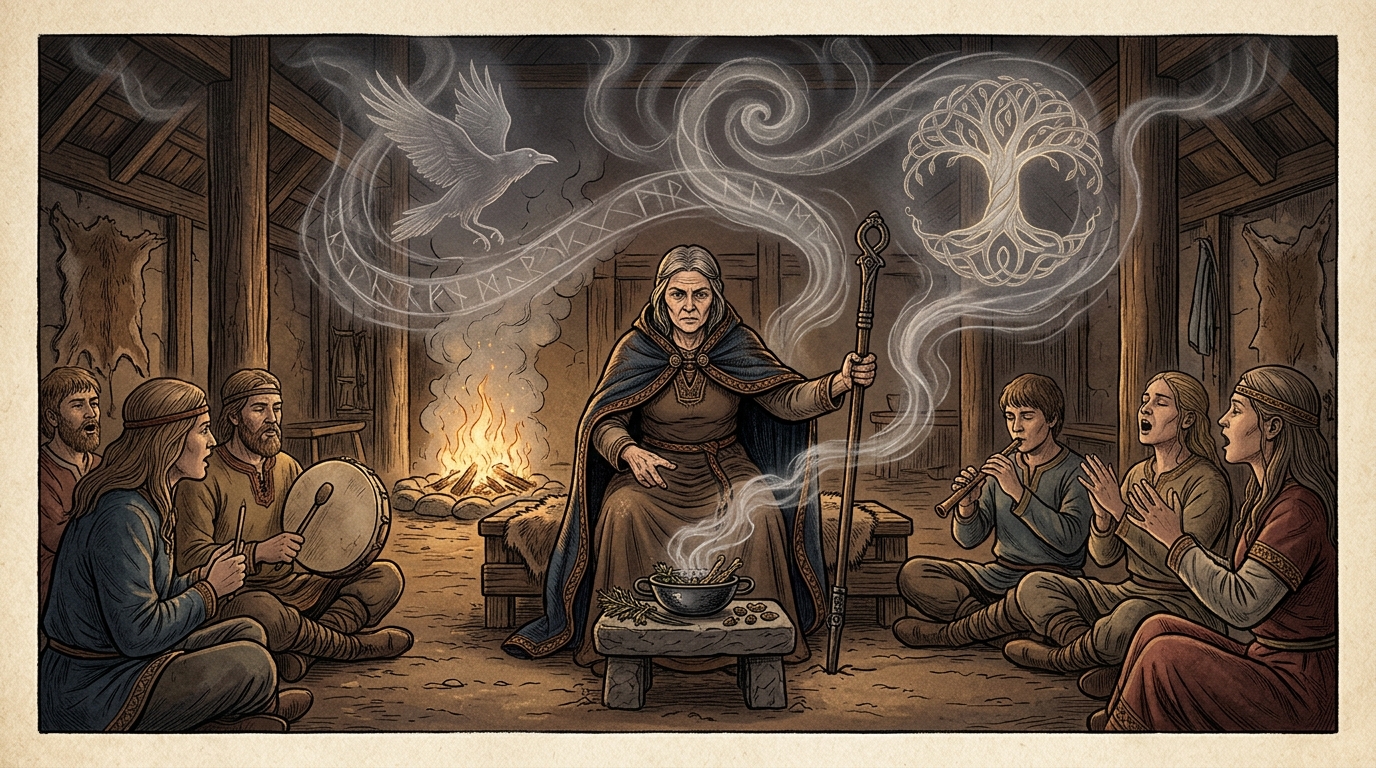
A winter of famine in Viking-age Greenland. A woman in a blue cloak and a black lambskin hood is led to a high seat. A girl sings an old chant, the seeress falls silent, and then she speaks of the future. This is the most detailed description of seiðr that survives — and it raises more questions than it answers.
What seiðr and the völva were
Seiðr (pronounced roughly “SAY-thr”) is an Old Norse word for a kind of magic practised in pre-Christian Scandinavia. In the sources it is used for very different aims: to see the future, to find lost things, to bring good seasons — but also to confuse an enemy, call storms or cause death.
A völva (plural völur) was a seeress — literally “staff-bearer”, from völr, a staff. She travelled from farm to farm, was received with honour, fed, and asked to tell what the coming year would bring. The most famous völva of all is the one who speaks in Völuspá, “The Prophecy of the Seeress”, the opening poem of the Poetic Edda: summoned by Odin, she tells of the creation of the world and its end at Ragnarök.
How it was experienced: the Greenland séance
Chapter 4 of the Saga of Erik the Red (written down in Iceland in the 13th century, describing events around the year 1000) gives the only step-by-step account of a seiðr ritual. Retold briefly:
- The seeress. Þorbjörg, called lítilvölva, “the little seeress”, the last of nine sisters who were all seeresses.
- Her costume. A blue cloak set with stones, a hood of black lambskin lined with white catskin, catskin gloves, calfskin shoes, a pouch of charms at her belt and a staff with a brass knob.
- The preparation. She is given a high seat with a cushion of hen feathers, and a meal of goat’s-milk porridge and the hearts of all the kinds of animals available. She spends the night at the farm.
- The chant. The next day she needs women who know the varðlokkur — the “warding songs” or “spirit-lures”. Only one woman, Guðríðr, knows them, learned from her foster mother; she is a Christian and reluctant, but agrees. She sings so beautifully that, the völva says, many spirits came who had wanted to turn away before.
- The prophecy. The famine will end with the spring. Then each person comes to ask her what they want to know. To Guðríðr she foretells a great marriage in Iceland and a bright line of descendants.
Notice what the text actually says about the experience: the singing draws “powers” or spirits, and after that “many things are revealed” to the seeress. The saga does not describe her inner state. The image of a völva “leaving her body” or “travelling in spirit” comes from other sources and from modern interpretation.
How the tradition explained it
A gift of the Vanir
In Ynglinga saga, Snorri Sturluson writes that the goddess Freyja was the first to teach seiðr to the Æsir. Odin himself mastered it: he could learn the fate of men and things to come, cause death, misfortune or illness, and take strength or wit from one person and give it to another.
“Unmanly” magic
Snorri adds a striking detail: practising seiðr brought so much ergi — shameful unmanliness — that men thought it disgraceful, so it was taught to priestesses. In the poem Lokasenna, Loki mocks Odin for having practised it. Seiðr was a women’s art, and a man who used it risked his honour. Why this was so is still debated: the posture (sitting, receiving, being “entered” by spirits) may have been the reason.
Respected and feared
The sagas show both sides. Þorbjörg is a welcome guest. Other practitioners of seiðr are stoned, drowned or burned as dangerous. After Christianisation, Norwegian law codes treated “sitting out” for prophecy and consulting seeresses as offences.
What archaeology has found
Archaeologists have identified dozens of Viking-age graves, mostly of women, containing iron staffs — some with a basket-like knob near the top, strikingly similar to the staff in the saga. The archaeologist Neil Price, who has studied them in The Viking Way, connects them with völur.
- Fyrkat, Denmark. A richly furnished 10th-century woman’s grave contained, among other things, a pouch with seeds of henbane, a powerful plant that can cause hallucinations, and other unusual objects. Many scholars read her as a seeress.
- Oseberg, Norway. The famous ship burial of two women (834 AD) contained a small leather pouch with cannabis seeds — their use is unknown.
Caution: a staff in a grave does not prove that its owner practised seiðr, and seeds in a pouch do not prove a drug was used in ritual. These are strong hints, not proof.
How science explains it — and where it stops
Researchers of altered states point to the components that the Greenland ritual combines: a night of preparation, special food, an elevated seat, a costume that separates the seeress from everyday life, a crowd of expectant listeners and — above all — a rhythmic chant. Repetitive sound, focused attention and strong expectation are known to help some people enter trance-like states, in which images and “answers” seem to arise by themselves.
Henbane, if it was used, contains alkaloids (scopolamine, hyoscyamine) that can produce delirium and vivid hallucinations. It is also highly poisonous — which may be one reason why such knowledge was guarded.
Where science stops: it can describe the conditions of a trance, but it cannot say whether anything is “seen” there beyond the seeress’s own mind. Whether any völva’s prophecies came true more often than chance is something no surviving source lets us check.
Parallels in other traditions
The völva had neighbours. Sami noaidi used drums and song to send their spirit on journeys, and Norse sources mention “Finnish” (Sami) sorcerers with respect and fear. The Pythia at Delphi also prophesied from a raised seat, in a special state, for those who came to ask. Siberian shamans combine costume, rhythm and helpers who sing — the same structure as Greenland. Whether these are one “door” or several is exactly the kind of question AVAVEDMAK compares rather than answers too early.
How it lives today
Since the late 20th century, Heathen and Ásatrú groups in Europe and North America have reconstructed “oracular seiðr”. The best-known form, developed in the United States by Diana Paxson and the Hrafnar group in the 1990s, follows the saga closely: a seeress on a high seat, a group song, a guided journey and questions from the audience. It is a modern reconstruction, not an unbroken tradition — and its practitioners usually say so.
Known, disputed, open
- Known: seiðr and travelling seeresses existed in the Norse world; the sagas describe their costume, payment and social standing; graves with staffs exist.
- Disputed: how far the 13th-century saga reflects real 10th-century practice; whether plants such as henbane were used in ritual.
- Open: what the völva experienced inside, and what — if anything — she perceived.
Frequently asked questions
What is seiðr in Norse mythology?
Seiðr is a form of Old Norse magic linked with trance, prophecy and influencing fate. In myth it was taught by Freyja and practised by Odin; in the sagas it is mostly practised by women called völur.
What is a völva?
A völva was a Norse seeress, literally a “staff-bearer”. She travelled between farms and foretold the future at gatherings, usually from a raised seat, helped by a chant sung by others.
Why was seiðr considered shameful for men?
Snorri Sturluson writes that it brought ergi, “unmanliness”. The exact reason is debated; one common explanation is the passive, receptive role of the practitioner.
Did Viking seeresses use drugs?
Henbane seeds were found in a possible seeress’s grave at Fyrkat, Denmark. That is a hint, not proof of ritual use. Henbane is dangerously poisonous.
Where next
Sources
- Eiríks saga rauða (Saga of Erik the Red), ch. 4. English text: Hurstwic.
- Snorri Sturluson, Ynglinga saga, ch. 4 and 7 (Heimskringla).
- Völuspá and Lokasenna, Poetic Edda.
- Neil Price, The Viking Way: Magic and Mind in Late Iron Age Scandinavia, 2nd ed., Oxbow, 2019.
- Leszek Gardeła, studies of Viking-age staffs and “magic” in graves.
- Jenny Blain, Nine Worlds of Seid-Magic, Routledge, 2002 — on modern revival.