Sleep and borderline states · Norse & Germanic
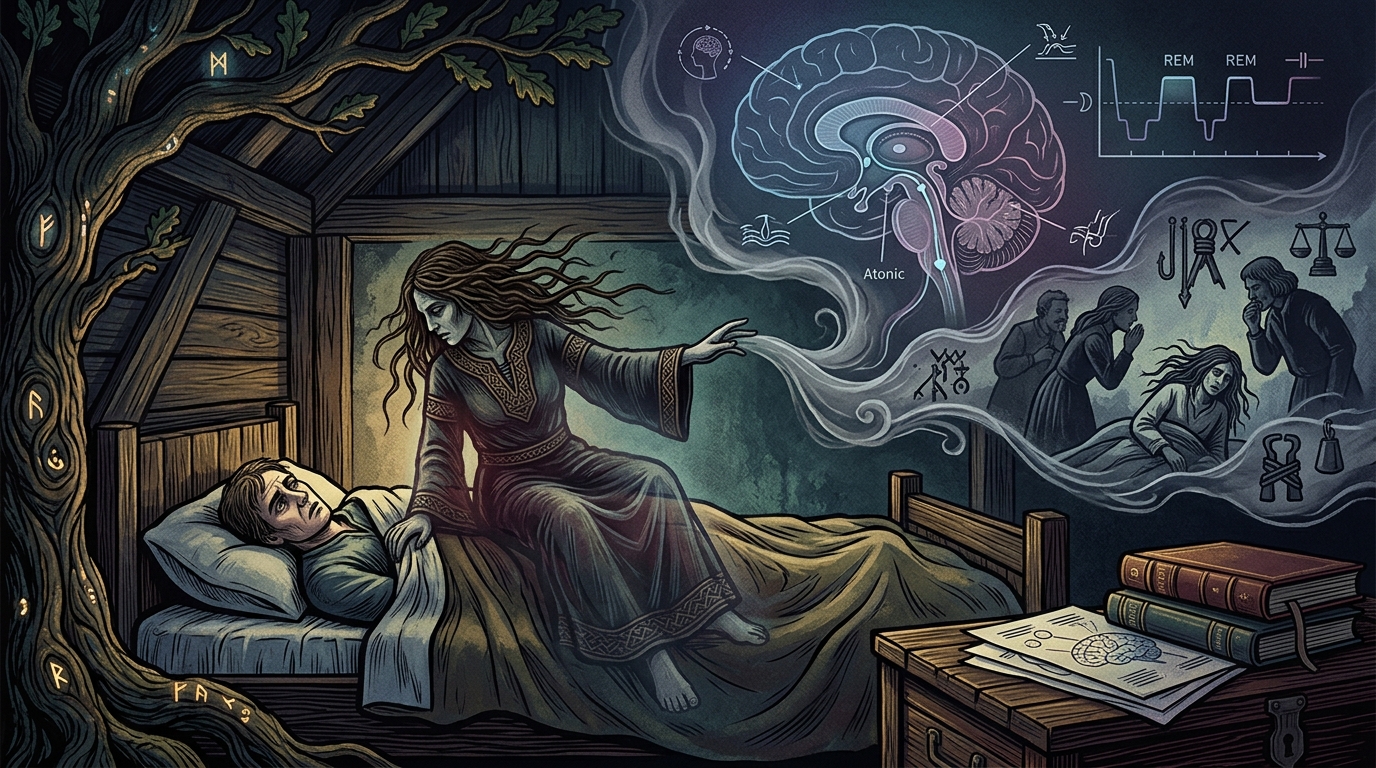
You wake in the dark. Your eyes are open, but your body will not move. There is a weight on your chest and a presence in the room — sometimes a shape, sometimes only a certainty that someone is there. In Scandinavia, people had a name for it: the mara.
How people experience it
Descriptions from very different countries and centuries are remarkably similar:
- being fully aware but unable to move or speak;
- pressure on the chest, difficulty breathing;
- a strong sense of an evil presence, often at the foot of the bed or on the chest;
- seeing a dark figure, an old woman, an animal; hearing steps, whispers, buzzing;
- sometimes a feeling of floating, falling or leaving the body;
- intense fear, which usually ends after seconds or a few minutes when movement returns.
The mara in Norse tradition
A king killed in his sleep
The oldest Scandinavian story of the mara is in Snorri Sturluson’s Ynglinga saga (13th century). King Vanlandi of Sweden broke his promise to return to his wife Drífa. She paid the witch Huld to draw him back or kill him. Vanlandi became sleepy, lay down, and soon cried out that the mara was treading on him. His men held his head — and she trod on his legs; they held his legs — and she pressed on his head until he died.
Who the mara was
In later Scandinavian folklore the mara is often a living woman whose spirit leaves her body at night, slips through the keyhole and “rides” sleepers — people, but also horses and cattle. Horses found sweating in the morning with tangled manes had been “ridden by the mare”. Some stories say a woman became a mara because of a curse, or because her mother had broken a taboo in pregnancy.
The word that stayed
The same creature is the Old English mære — and so the English word night-mare did not originally mean a bad dream, but the spirit that sits on a sleeper. The Danish mareridt and the Swedish mardröm keep the same root, as do French cauchemar and the Slavic mora.
Folk protection
Given for familiarization, as recorded in folklore.
- Steel in the bed — a knife or scissors under the pillow or mattress (a historical belief, not a safe practice to reproduce).
- Shoes placed at the bedside with toes pointing away from the bed.
- Blocking the keyhole, or calling the mara by name — it was believed she would then be found out.
- A “mare-stone” — a stone with a natural hole — hung in the stable to protect horses.
How science explains it — and where it stops
Sleep medicine calls this sleep paralysis. During REM sleep — the stage of vivid dreams — the brain switches off almost all voluntary muscles so we do not act out our dreams. In sleep paralysis, consciousness wakes up while this “off switch” is still on, and dream imagery can pour into the waking room.
Researchers (Cheyne and colleagues) group the hallucinations into three kinds: the intruder (a presence, steps, a figure), the incubus (pressure on the chest, choking — the mara proper) and vestibular-motor experiences (floating, flying, leaving the body).
It is common. A 2011 review of studies with more than 36,000 people (Sharpless and Barber) estimated that about 7.6% of the general population has had at least one episode, around 28% of students and about 32% of psychiatric patients. Lack of sleep, irregular schedules, stress and sleeping on the back make episodes more likely.
Where science stops: it explains why the body cannot move and why the brain produces images. It does not fully explain why so many people, in cultures that never met, see such similar figures — the old woman, the dark shape at the foot of the bed. The folklorist David Hufford, who studied the “Old Hag” tradition of Newfoundland, argued that the experience comes first and shapes the beliefs, not the other way round.
Parallels in other traditions
Newfoundland has the “Old Hag”, medieval Europe the incubus and succubus, Turkey the karabasan (“the dark presser”), Japan kanashibari (“bound by metal”), Russia and Ukraine the domovoi or mora who “presses” the sleeper. Different cultural names and interpretations, with overlapping reported sensations; that does not establish identical beliefs or causes.
Rituals and protective customs: history versus practice
Why did people place iron near the bed, turn their shoes around, or hang a naturally holed stone in the stable? These were protective customs associated with the mara in some European folk accounts, not clinically established treatments. Details varied by place and period; they should not be presented as a single ancient Norse ritual. Never place blades or sharp metal in bedding.
A modern, non-supernatural night ritual
- Before sleep, place a notebook by the bed and write down one worry you can set aside until morning.
- Choose a regular bedtime and a comfortable position, preferably on your side if back-sleeping seems to trigger episodes.
- If you wake unable to move, remind yourself that sleep paralysis is temporary. Notice your natural breathing and try a small movement without straining.
- Afterward, record what you sensed separately from what you think it meant: pressure, a shadow figure, fear, a remembered story, or something else.
This contemporary reflection exercise is not an attested historical rite and does not prevent every episode. Its purpose is to reduce alarm and help distinguish a powerful experience from its interpretation. If episodes are frequent or disruptive, seek medical advice.
If it happens to you
- Remind yourself what it is: frightening, but in itself harmless, and it will pass.
- Do not fight the whole body. Try to move one small thing — a finger, a toe, your eyes — or slow your breathing.
- Sleep enough and at regular times; try sleeping on your side.
- See a doctor if episodes are frequent, if you also fall asleep suddenly during the day or lose muscle strength when laughing or angry (possible signs of narcolepsy), or if fear of sleep is affecting your life.
Known, disputed, open
- Known: the physiological mechanism (REM atonia during waking), how common it is, what makes it more likely.
- Disputed: why the content of the visions is so similar across cultures.
- Open: how individual expectations, sleep physiology and cultural narratives interact to shape the felt presence. There is no reliable evidence that the perceived figure is an external entity.
Frequently asked questions
What is a mara in Norse folklore?
A mara is a night spirit, often thought to be the wandering soul of a living woman, that sits on sleepers’ chests and “rides” them. It appears in the Ynglinga saga and in Scandinavian folklore up to modern times.
Where does the word “nightmare” come from?
From Old English mære, the same night spirit as the Scandinavian mara. Originally a nightmare was the creature, not the dream.
Is sleep paralysis dangerous?
An episode itself is not physically dangerous and passes within minutes. Frequent episodes, daytime sleep attacks or strong fear of sleep are reasons to consult a doctor.
Why do people see a figure during sleep paralysis?
Dream imagery from REM sleep mixes with the real room while you are awake. Why the figures are so similar across cultures is still debated.
Where next
Sources
- Snorri Sturluson, Ynglinga saga, ch. 13 (Heimskringla).
- Sharpless B.A., Barber J.P. (2011). Lifetime prevalence rates of sleep paralysis: a systematic review. Sleep Medicine Reviews 15(5): 311–315. Penn State summary.
- Cheyne J.A., Rueffer S.D., Newby-Clark I.R. (1999). Hypnagogic and hypnopompic hallucinations during sleep paralysis. Consciousness and Cognition 8(3): 319–337.
- David J. Hufford, The Terror That Comes in the Night, University of Pennsylvania Press, 1982.
- Sharpless B.A. (2016). A clinician’s guide to recurrent isolated sleep paralysis. Neuropsychiatric Disease and Treatment 12: 1761–1767. Full text.