Folk Europe · Experience · Christmas lore
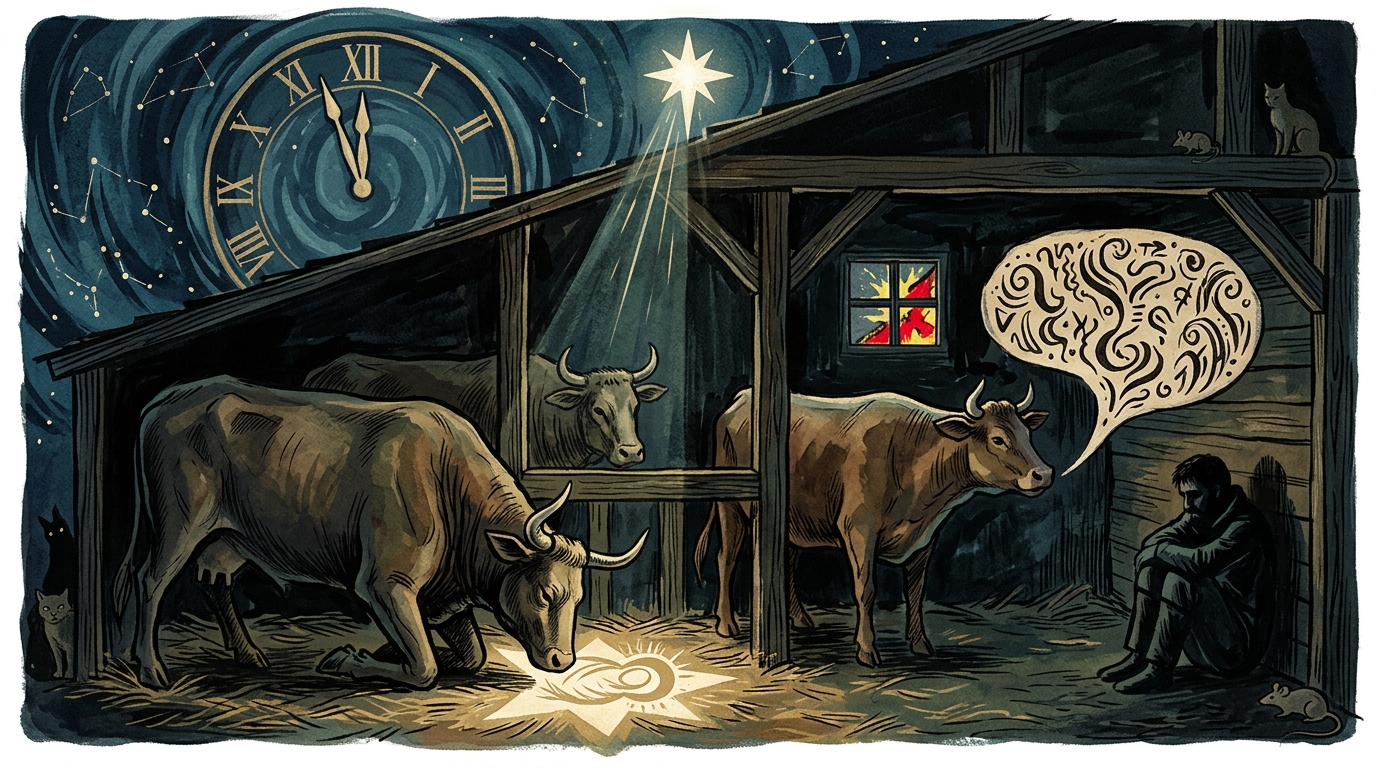
It is Christmas Eve, the clock is about to strike midnight, and an old man by the fire tells the children that right now, in every barn, the cattle are kneeling. Thomas Hardy built his 1915 poem “The Oxen” around that moment. Hardy, a sceptic, admits that if someone asked him to go out to the barn at midnight to see, he would go — still hoping it might be true. Across Europe, generations of children and adults have felt the same pull.
In short: A widespread European folk belief held that at midnight on Christmas Eve, the hour of Christ’s birth, animals receive the gift of speech for a moment, and cattle kneel in honour of the newborn. Animals were given extra food that night. But overhearing them was dangerous: in many tales the eavesdropper hears the animals talk about his own approaching death. The belief draws on the ox and ass of the Nativity scene and on the old idea of Christmas night as a time when the ordinary order of the world is suspended.
How people experience it
Older people in rural Europe remember being told, as children, not to go to the stable on Christmas night — and the temptation to do it anyway. Farmers who still keep animals sometimes speak of an unusual quiet in the barn on that night. Whether or not anyone has ever heard a cow speak, the story keeps alive a feeling that animals take part in the sacred, and that on one night a year the line between humans and other creatures thins.
How the tradition explains it
- The ox and the ass. The Gospels do not mention animals at the manger. They entered the Nativity through Isaiah 1:3 (“The ox knows its owner, and the ass its master’s crib”) and the apocryphal Gospel of Pseudo-Matthew, where the ox and ass adore the child. Their presence made Christmas a feast for animals too.
- Kneeling cattle. In England and elsewhere it was said that cattle knelt at midnight — some said on Old Christmas Eve (5 January), since the animals did not accept the calendar reform of 1752.
- Speaking animals. In Brittany, the Alps, Scandinavia and Central Europe animals were believed to speak at midnight. A typical tale: a greedy or curious farmer hides in the stable and hears the ox say, “We shall carry our master to the churchyard this year.”
- Feeding the animals. Cattle and horses received extra hay or bread blessed at Christmas; in Scandinavia a sheaf was put out for the birds.
How science explains it — and where it stops
Cattle do kneel — it is how they lie down and get up — so anyone who visited a barn at night might well see “kneeling” oxen. The warning about overheard death fits a common pattern in folk tales: forbidden knowledge brings misfortune. And the custom of special feeding reflects the real dependence of rural families on their animals through the winter. Psychologists studying human-animal bonds note that people who live closely with animals routinely attribute thoughts and feelings to them — often more accurately than sceptics assumed.
Where science stops: it explains the kneeling. It does not explain the persistence of the hope Hardy described — that on one night of the year, the world might speak.
Known, disputed, open
- Known: the belief is recorded in many European countries; the ox and ass come from Isaiah and Pseudo-Matthew.
- Disputed: whether the belief has pre-Christian roots in midwinter animal rites.
- Open: what animals experience — a question science is only beginning to ask seriously.
Notes. If you want to give animals a Christmas treat, stick to food that is safe for them: no chocolate, onions, grapes or salty leftovers for pets, and no sudden diet changes for farm animals. Do not disturb sleeping livestock at night.
A Christmas Eve listening practice
Stories of animals speaking at midnight belong to Christmas folklore in several European regions. If you want to explore the atmosphere of the legend, try a quiet listening ritual: before bedtime, sit indoors for five minutes, notice the ordinary sounds around you, and write down any memories or associations the story evokes. The next morning, compare what you heard with what you imagined. This is a modern reflective exercise, not a historical ceremony or a claim that animals speak human language. Do not disturb livestock, enter barns at night, or expose animals to loud noises.
Frequently asked questions
Do animals talk on Christmas Eve?
According to European folklore, yes — at midnight, for a moment. Overhearing them was believed to bring bad luck.
Why are the ox and donkey in the Nativity scene?
They come from Isaiah 1:3 and the Gospel of Pseudo-Matthew, not from the canonical Gospels.
What is Thomas Hardy’s poem “The Oxen” about?
The legend of cattle kneeling on Christmas Eve, and the poet’s wish — despite his doubt — that it might be true.
Where next
Sources
- Hardy T. (1915). “The Oxen”. In: Moments of Vision (1917).
- Gospel of Pseudo-Matthew, ch. 14.
- Miles C. A. (1912). Christmas in Ritual and Tradition, Christian and Pagan. London: T. Fisher Unwin.