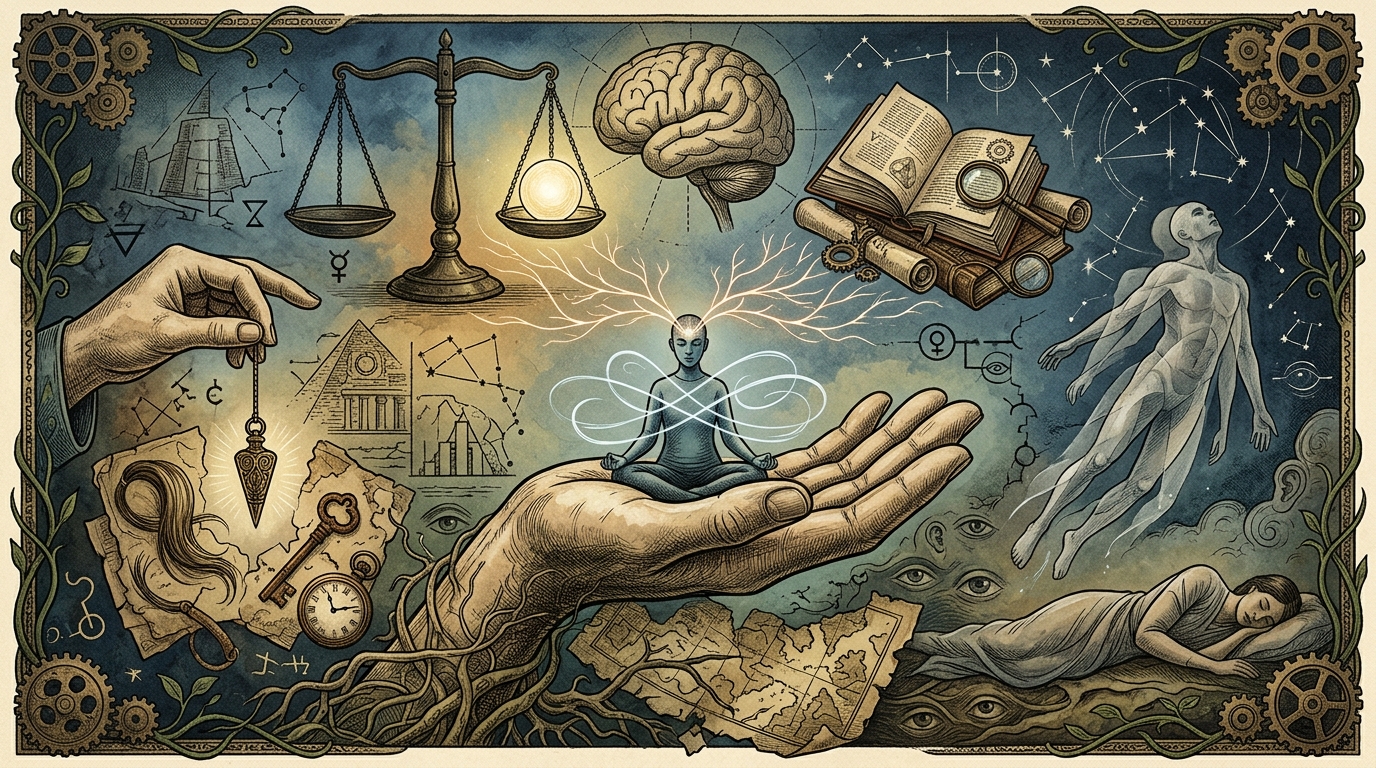
Yury Mikhailovich Ivanov’s How to Become a Psychic is a revealing document of early-1990s Russian esoteric culture. Its chapters combine yoga, attention training, ideas about biofields, telepathy, object reading, and out-of-body projection. We examine what the book actually proposes, without mistaking its explanations for established facts.
In brief: The most accessible components are relaxation, focused attention, imaginative rehearsal, and a diary of observations. Ivanov also makes extraordinary claims about telepathy, clairvoyance, energy bodies, and healing. Those claims have not been established by reliable scientific evidence.
A historical book, not a scientific manual
Ivanov describes the human being as a physical organism surrounded or accompanied by several nonphysical bodies and energetic structures. He presents those structures as a possible explanation for striking experiences. The text is valuable for understanding a period of Russian interest in parapsychology, but the proposed anatomy is not a demonstrated physiological model.
1. Yoga-inspired concentration and meditation
Drawing on the vocabulary of pratyahara, dharana, and dhyana, Ivanov asks the reader to reduce distractions, concentrate on a chosen object, and sustain attention. For a cautious modern exploration, sit comfortably for five minutes and observe natural breathing without striving to eliminate all thought. Note changes in mood and focus rather than expecting paranormal effects.
2. Breathing, prana, and chakras
The book discusses yogic breathing and views of prana and chakras. Attention to breathing can influence subjective calm and awareness, but there is no established measurement of Ivanov’s proposed energetic channels as a physical system. Avoid copying intense breathing sequences, forced breath-holding, or long retentions from a historical guide.
3. Telepathy and sending impressions
Ivanov proposes that a sender concentrate on an image or message and a receiver attempt to perceive it. A felt success may reflect cues, expectations, or coincidence. A better test randomly selects the image, prevents communication and feedback, collects the recipient’s prediction in advance, and records every trial, not only the apparent hits.
4. Psychometry and sealed envelopes
In psychometry, a person tries to learn something about an object, owner, or concealed target by holding an item or concentrating on it. Ivanov describes attempts to identify shapes or colours hidden in otherwise similar envelopes. This claim is testable only if sensory cues are excluded and the number of attempts and scoring rules are chosen before opening anything.
5. Clairvoyance and out-of-body experiences
His theory attributes unusual perceptions to a subtle body capable of separating from the physical body. He offers practice with the sensation of falling and imaginary walks, as well as a different approach involving sleep and intention. These methods are explained in the separate guide Yury Ivanov’s Astral Projection Methods in this cluster.
6. Pendulums, dowsing and energetic healing
Other passages discuss pendulums and alleged energy-based diagnosis or treatment. Small, unconscious muscular movements can move a pendulum even when its operator does not intend to do so; this is the ideomotor effect. A pendulum or a claimed biofield reading must never replace a medical diagnosis or effective treatment.
Three recurring methodological problems
Interpretation becomes an assumed fact: feeling something unusual does not establish the proposed mechanism. Confirmation bias: remembering successes while forgetting errors misrepresents results. Risky preparation: fasting, inducing anger and disrupting sleep are not needed for responsible observation and may harm well-being.
A simple one-week observational exercise
- Spend 5–10 minutes on quiet attention in a safe setting.
- Beforehand, rate fatigue, alertness and emotional state.
- Notice images, bodily sensations and wandering attention without forcing anything.
- Write what happened in concrete terms; separately record your interpretation.
- At the end of a week, compare recurring patterns and the influence of expectations.
Research perspective
Neuroscience offers explanations for several experiences once labelled paranormal, including illusory body location, perceptual ambiguity and unconscious movement. This does not mean researchers have explained every individual episode; it means a historical author’s extraordinary conclusion remains a hypothesis until tested.
AVAVEDMAK practice journal: what to record
For any calm, voluntary experiment, record the date, recent sleep, starting mood, technique, length, vivid sensations, interpretation, and any claim that could be independently tested. Write down the experience before checking it against reality; keep your original record unchanged. A vivid feeling is a genuine subjective event, but not by itself evidence that consciousness travelled outside the body.
Safety and limitations
Do not use sleep deprivation, fasting, forced breathing, prolonged breath-holding, or emotionally distressing methods to induce unusual states. Stop if the practice produces fear, disorientation, persistent derealisation, or disrupted sleep. Do not substitute esoteric claims for medical advice, especially claims about diagnosis or healing.
Sources and further reading
- Y. M. Ivanov, How to Become a Psychic — Russian source text (PDF)
- Blanke et al. (2002), Stimulating illusory own-body perceptions, Nature
Original Russian-language AVAVEDMAK edition
Editorial approach: the author’s interpretation, the reported experience, and scientific evidence are treated separately.