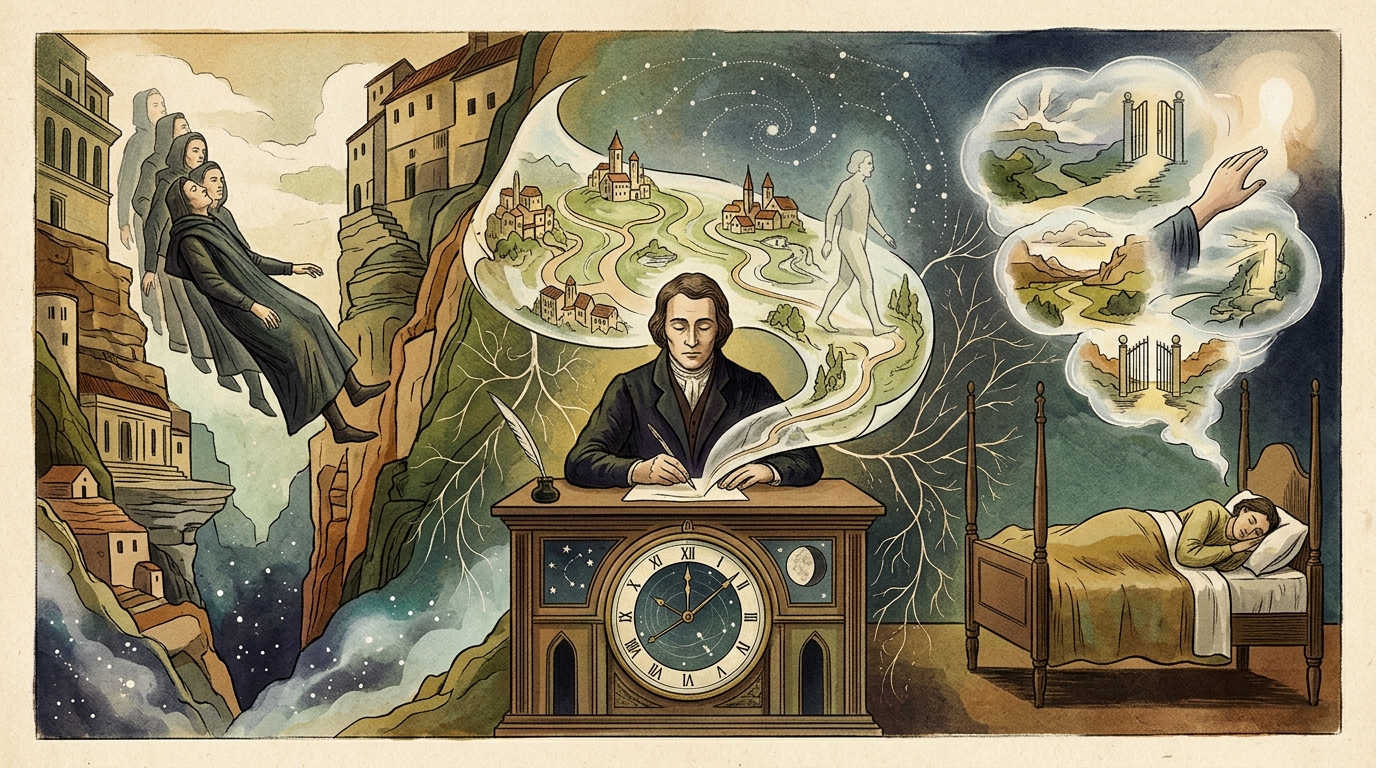
In How to Become a Psychic, Yury Ivanov describes a series of exercises intended, in his worldview, to help a person separate an ‘astral body’ from the physical body. The original passages are easier to follow when read as a sequence of imagined bodily sensations and sleep-related impressions.
In brief: Ivanov suggests weeks of brief practice imagining falling and walking outside one’s physical body, followed by a relaxation manoeuvre. He also describes a dream-based approach using advance intention. Neither proves literal separation of consciousness from the body.
What did Ivanov mean by an ‘astral body’?
The author posits a subtle, information-bearing body that can move independently of its physical counterpart. That is part of an esoteric system, not an established anatomical or neurological entity. The subjective feeling of separation is known in modern research as an out-of-body experience (OBE).
Method one: learning the sensation of falling
Preparation over several weeks
Ivanov recommends brief daily exercises, around five or six minutes, in which the practitioner vividly recalls or imagines the bodily feeling of falling. No actual falling or movement is intended. The purpose is to rehearse an internal sensation and make it easier to bring to mind voluntarily.
Imaginary walking
His next exercise begins with lying down and closing the eyes. Imagine standing up, walking around the room, noticing furniture and observing the resting physical body from another viewpoint. The imagined walk can then extend to a familiar place outside the room. In ordinary language, this is a demanding spatial-imagery exercise.
The proposed separation manoeuvre
After relaxing and focusing on one’s sense of self, Ivanov describes briefly tightening the body’s muscles for around three or four seconds, then releasing the tension while recalling the feeling of falling. He interprets any resulting illusion of moving away from the body as a potential separation. Do not strain, hold your breath, or deliberately intensify frightening sensations.
What the author expects
Ivanov suggests initially exploring the imagined nearby room and later observing places or people at a distance. He also speculates about moving physical objects. No reliable evidence establishes that such imagined travel yields information unavailable through the senses or can move real objects.
Method two: intention before a chosen night
The author advises choosing a night in advance, repeatedly thinking about it and deciding on an imagined route. He then asks the practitioner to recall the night’s impressions after waking. However, he also recommends deliberately going hungry and generating strong irritation beforehand. We do not recommend or reproduce those elements as a practice: their benefits are unproven and they can disturb sleep and well-being.
A safer way to investigate dream imagery
- Keep your normal sleep schedule.
- Before bed, calmly recall a familiar place without forcing a result.
- On waking, record whatever you remember before checking messages or discussing the dream.
- Distinguish ordinary dreaming, awareness that you are dreaming, a false awakening, and the specific sensation of viewing yourself from outside.
- Retain the first written record even if later details or interpretations change.
Can claimed perceptions be tested?
Describing one’s own bedroom from an unusual perspective proves little if its details were already familiar. A stronger volunteer experiment uses a concealed, randomly selected target that a participant cannot see and records a precise prediction before the target is revealed. Multiple attempts and predeclared scoring criteria are essential. This is an AVAVEDMAK research suggestion, not Ivanov’s exact protocol.
Scientific commentary
Changes in how vision, balance and body position signals combine can create a compelling impression of self-location outside the body. Sleep onset, lucid dreams and sleep paralysis may overlap with some OBE reports, but they are not identical experiences. The strength of an impression does not settle the question of its external reality.
Claims requiring particular caution
Ivanov also proposes hazards concerning a supposed energetic connection to the body and contact with grounded metal. There is no verified physical mechanism for those claims. Such warnings should not be presented as established dangers.
AVAVEDMAK practice journal: what to record
For any calm, voluntary experiment, record the date, recent sleep, starting mood, technique, length, vivid sensations, interpretation, and any claim that could be independently tested. Write down the experience before checking it against reality; keep your original record unchanged. A vivid feeling is a genuine subjective event, but not by itself evidence that consciousness travelled outside the body.
Safety and limitations
Do not use sleep deprivation, fasting, forced breathing, prolonged breath-holding, or emotionally distressing methods to induce unusual states. Stop if the practice produces fear, disorientation, persistent derealisation, or disrupted sleep. Do not substitute esoteric claims for medical advice, especially claims about diagnosis or healing.
Sources and further reading
- Yury Ivanov, How to Become a Psychic, astral-body chapter (Russian PDF)
- Blanke et al., Nature (2002)
- Blanke and Mohr, Out-of-body experience and body representation (2005)
Original Russian-language AVAVEDMAK edition
Editorial approach: the author’s interpretation, the reported experience, and scientific evidence are treated separately.