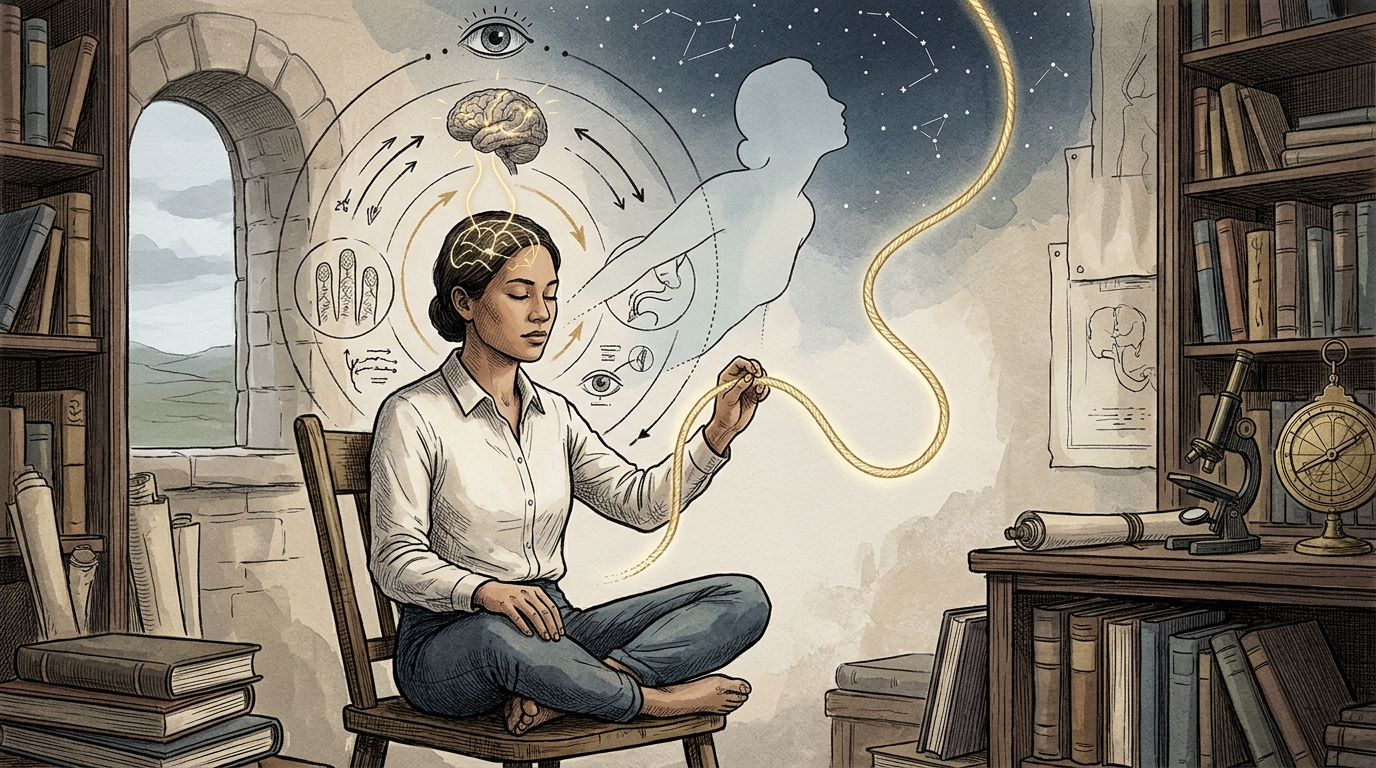
The ROPE method, developed and popularised by Australian author Robert Bruce, is one of the best-known modern approaches to attempted astral projection. Instead of concentrating on a picture of an object, it encourages the practitioner to imagine the feeling of grabbing and climbing a rope.
In brief: ROPE uses imagined tactile and motor movements while the physical body remains still. Bruce interprets the resulting sensations as the activation or separation of an ‘astral body’. That interpretation has not been scientifically demonstrated.
Where did ROPE originate?
Bruce described his approach in the online Treatise on Astral Projection and later in Astral Dynamics. He also developed a wider set of mental tactile exercises known as New Energy Ways. His system is best understood as a historical source for claims about an energy body and as a set of body-imagination practices.
The technique in plain English
- Get comfortable: sit or lie in a relaxed position, with no physical exertion.
- Imagine a rope: picture one hanging above you, but do not worry about making the image visually perfect.
- Focus on touch: imagine one hand gripping the rope, then the other, as if climbing hand over hand.
- Feel the movement: attend to the imagined sensation of reaching, pulling and rising. Your real muscles stay relaxed.
- Observe: note any impression of sway, movement, lightness, body-position change or ordinary distraction, without deciding beforehand what it proves.
Bruce presents this as a way to ‘pull’ an astral body out of its physical location. Nothing in the physical act of imagination demonstrates that such a separate body exists.
What might someone experience?
People report sensations of rocking, floating, buzzing, vibration or a momentary loss of the usual body boundary. Others experience nothing unusual. These may be vivid and meaningful internal experiences, but cannot alone verify travel to an external location.
How does it differ from Ivanov’s method?
Ivanov begins with the remembered sensation of falling and imagines walking around the room. Bruce focuses on repeated climbing movements with imaginary hands. Both use sensory imagination, but emphasise different forms of movement.
A short, cautious observation exercise
For a five-minute daytime exercise, imagine two or three slow hand-over-hand movements, then return attention to the actual position of your arms, back and breath. Record the difference between what you imagined and what you physically felt. Do not attempt to induce sleep paralysis.
Scientific perspective
Motor imagery can engage systems involved in planning and sensing movement without moving the muscles. Research on bodily self-location gives a plausible context for the vividness of such sensations, while leaving Bruce’s proposed astral mechanism unsupported.
AVAVEDMAK practice journal: what to record
For any calm, voluntary experiment, record the date, recent sleep, starting mood, technique, length, vivid sensations, interpretation, and any claim that could be independently tested. Write down the experience before checking it against reality; keep your original record unchanged. A vivid feeling is a genuine subjective event, but not by itself evidence that consciousness travelled outside the body.
Safety and limitations
Do not use sleep deprivation, fasting, forced breathing, prolonged breath-holding, or emotionally distressing methods to induce unusual states. Stop if the practice produces fear, disorientation, persistent derealisation, or disrupted sleep. Do not substitute esoteric claims for medical advice, especially claims about diagnosis or healing.
Sources and further reading
- Robert Bruce, Treatise on Astral Projection
- Robert Bruce, New Energy Ways — Llewellyn journal
- Blanke et al., Stimulating illusory own-body perceptions, Nature (2002)
Original Russian-language AVAVEDMAK edition
Editorial approach: the author’s interpretation, the reported experience, and scientific evidence are treated separately.