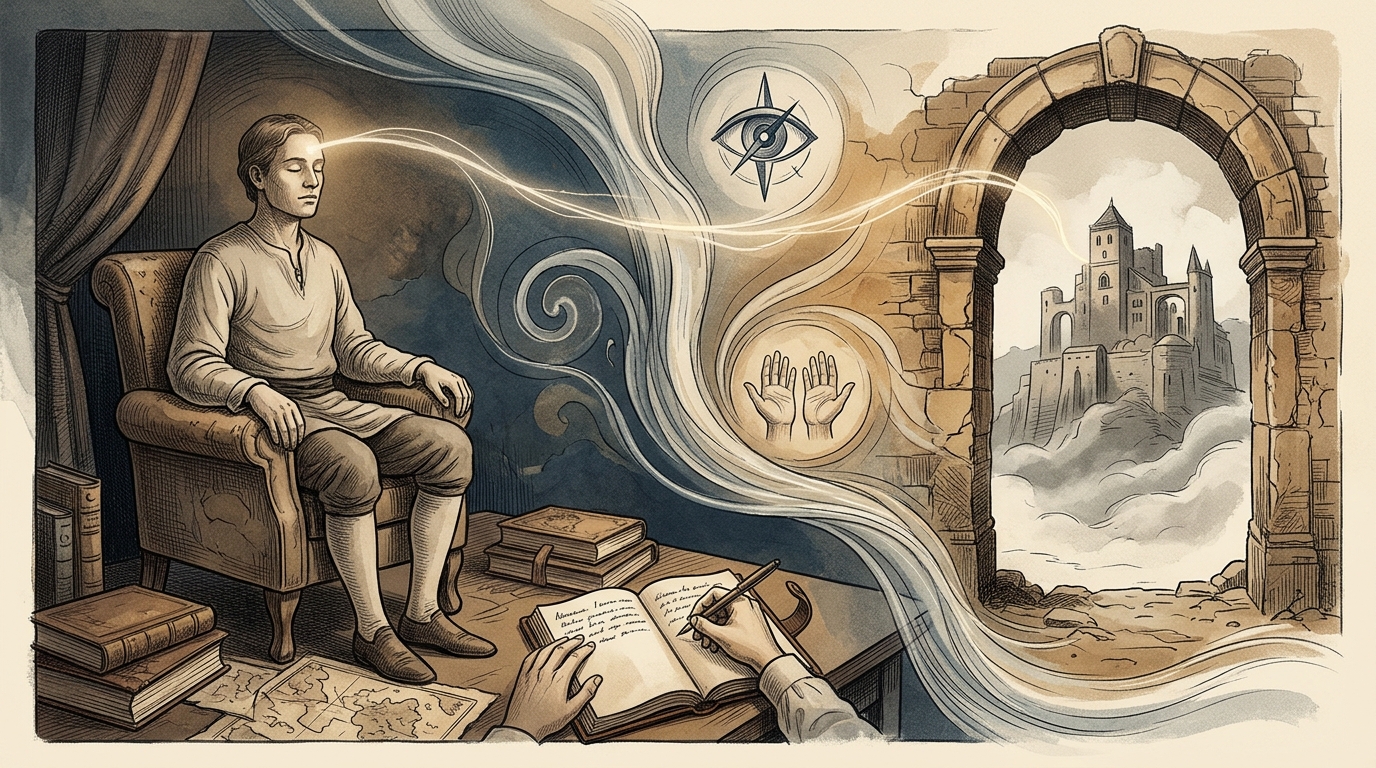
William Buhlman is an American out-of-body experience author known for techniques that emphasise intention and a clear destination. In the Target Technique, the practitioner selects a familiar place and mentally rehearses being there.
In brief: The method combines a chosen target, sensory details, intention and a practice journal. Buhlman considers these steps preparation for an out-of-body journey; independent evidence that consciousness travels to the selected location is lacking.
What does Buhlman actually recommend?
His OBE Action Plan, published through the Monroe Institute, discusses affirmations, target visualisation, imagined movement, tactile exercises, meditation and approaches involving dreams. The Target Technique is one member of this wider family, not a single guaranteed formula.
The Target Technique in straightforward terms
- Choose a location. Begin with a familiar room or a safe imaginary landscape, not someone else’s private space.
- Rehearse the details. Imagine the layout, light, floor, walls and position from which you seem to look.
- State an intention. In the author’s approach, this helps concentrate attention on the chosen location. It does not guarantee an extraordinary experience.
- Observe the result. When the session ends, record the image, the sense of presence, emotions and details remembered.
What does Buhlman say people feel?
Accounts include a change of visual perspective, impressions of movement or vibration and a strong sense of being elsewhere. His interpretation is that awareness has moved outside the body. Such descriptions are personal reports; they should not be treated as laboratory confirmation of a separate consciousness.
How could a claim be checked?
If someone believes they saw an unknown target, an independent volunteer can randomly select a concealed image. The person making the claim writes down what they perceived before the image is revealed. A series of properly controlled trials is much more informative than one anecdotal match.
Comparison with Ivanov and Bruce
Ivanov emphasises imagined falling; Bruce emphasises simulated tactile climbing. Buhlman’s Target Technique chiefly anchors attention to a destination. In practice, all three rely partly on imagination, yet differ in the form and timing of the mental cue.
Safety and sleep
Some OBE guides recommend interrupted sleep, and Buhlman’s larger method collection includes sleep-related options. Preserve normal rest and do not use drugs or risky induction methods. A meaningful journal does not require an extraordinary result.
AVAVEDMAK practice journal: what to record
For any calm, voluntary experiment, record the date, recent sleep, starting mood, technique, length, vivid sensations, interpretation, and any claim that could be independently tested. Write down the experience before checking it against reality; keep your original record unchanged. A vivid feeling is a genuine subjective event, but not by itself evidence that consciousness travelled outside the body.
Safety and limitations
Do not use sleep deprivation, fasting, forced breathing, prolonged breath-holding, or emotionally distressing methods to induce unusual states. Stop if the practice produces fear, disorientation, persistent derealisation, or disrupted sleep. Do not substitute esoteric claims for medical advice, especially claims about diagnosis or healing.
Sources and further reading
- William Buhlman’s OBE Action Plan, Monroe Institute
- Monroe Institute UK — Out of Body Techniques
- International Lucid Dream Induction Study (2020)
Original Russian-language AVAVEDMAK edition
Editorial approach: the author’s interpretation, the reported experience, and scientific evidence are treated separately.