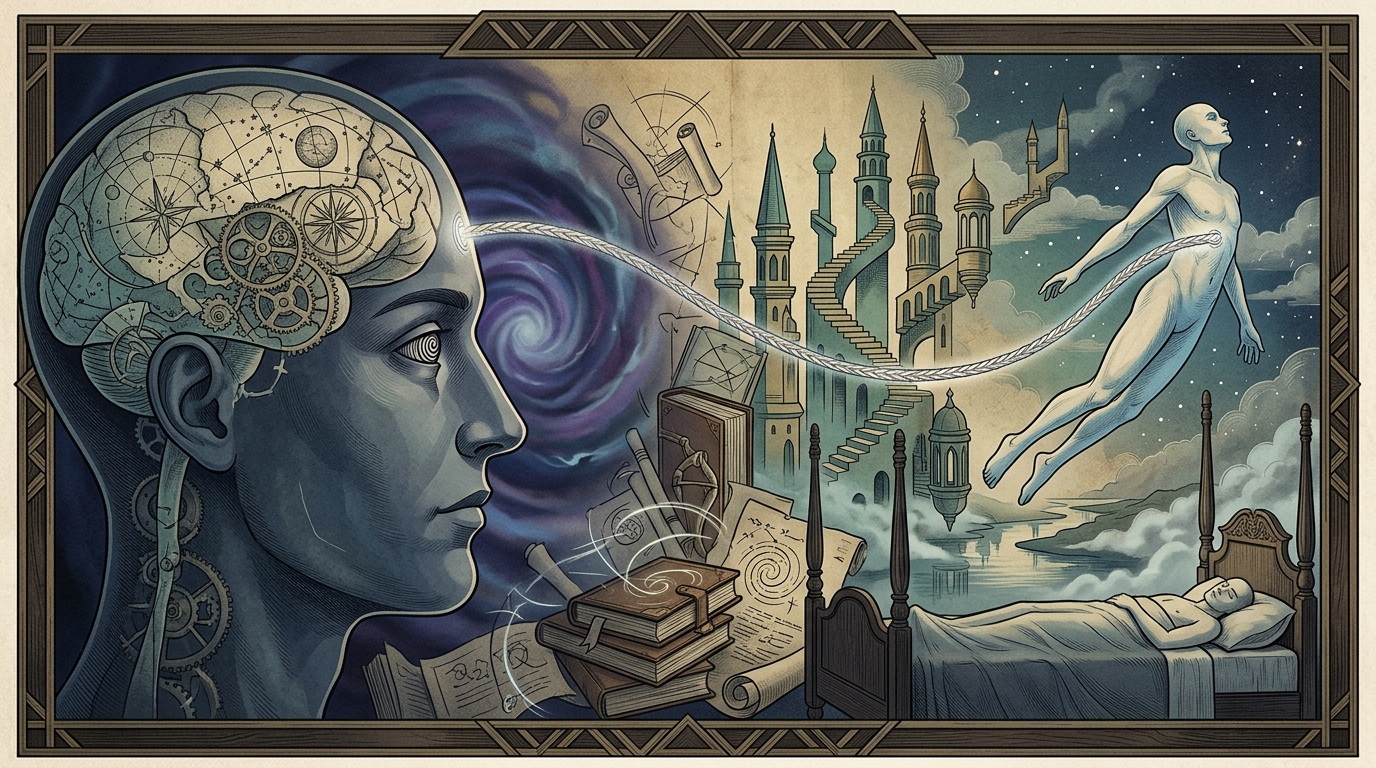
Sylvan Joseph Muldoon helped popularise ‘astral projection’ in the early twentieth century. With psychical researcher Hereward Carrington, he published The Projection of the Astral Body in 1929, describing feeling suspended, floating, immobile and sometimes outside his physical body.
In brief: A notable theme is ‘dream control’: forming an image of rising, swinging or flying in the hope of experiencing movement while dreaming. Muldoon interpreted certain dream and waking-boundary events as astral projection. His claims do not establish a separate astral body.
Why is the 1929 book important?
Muldoon’s first-person accounts gave later readers a vocabulary of vibrations, bodily immobility, floating, the ‘silver cord’ and re-entry into the physical body. The book is historically significant, though its central claims rest heavily on individual testimony and an esoteric framework.
Dream control in plain English
The basic notion is to prepare a recurring feeling of motion before sleep, hoping that the same theme appears within a dream.
- Before a normal night’s sleep, briefly imagine a familiar sensation such as a gentle swing or a smooth rise.
- Let the image remain relaxed rather than trying to force a trance.
- Sleep on your usual schedule.
- On waking, record whether movement, flight or unusual body perspective appeared in a dream.
- Separate the remembered experience from the claim that something travelled in the physical world.
This is a cautious modern retelling of one part of Muldoon’s approach; it deliberately does not reproduce historical advice that could disturb sleep.
Sleep paralysis and the ‘silver cord’
Muldoon described episodes of paralysis and apparent separation, sometimes with an imagined connection to the body. Sleep paralysis is a recognised state in which temporary muscle immobility persists as awareness returns. The imagery of a silver cord is part of astral literature, not a verified physical structure.
What can modern science explain?
Dreams routinely create motion, flight and shifts of perspective without corresponding movement in the outside world. Body-ownership and multisensory integration research helps explain how convincing such impressions can be. One striking narrative cannot determine whether a nonphysical body exists.
Why include Muldoon in the AVAVEDMAK collection?
He is a historical bridge between occult theories and the modern practical literature on out-of-body experiences. His descriptions can be compared with Oliver Fox’s awareness in dreams, Ivanov’s falling imagery, and Raduga’s awakening-related approach without treating these experiences as identical.
AVAVEDMAK practice journal: what to record
For any calm, voluntary experiment, record the date, recent sleep, starting mood, technique, length, vivid sensations, interpretation, and any claim that could be independently tested. Write down the experience before checking it against reality; keep your original record unchanged. A vivid feeling is a genuine subjective event, but not by itself evidence that consciousness travelled outside the body.
Safety and limitations
Do not use sleep deprivation, fasting, forced breathing, prolonged breath-holding, or emotionally distressing methods to induce unusual states. Stop if the practice produces fear, disorientation, persistent derealisation, or disrupted sleep. Do not substitute esoteric claims for medical advice, especially claims about diagnosis or healing.
Sources and further reading
- Muldoon and Carrington, The Projection of the Astral Body (1929), bibliographic record
- Society for Psychical Research — Sylvan Muldoon
- Research overview of lucid-dream induction
Original Russian-language AVAVEDMAK edition
Editorial approach: the author’s interpretation, the reported experience, and scientific evidence are treated separately.