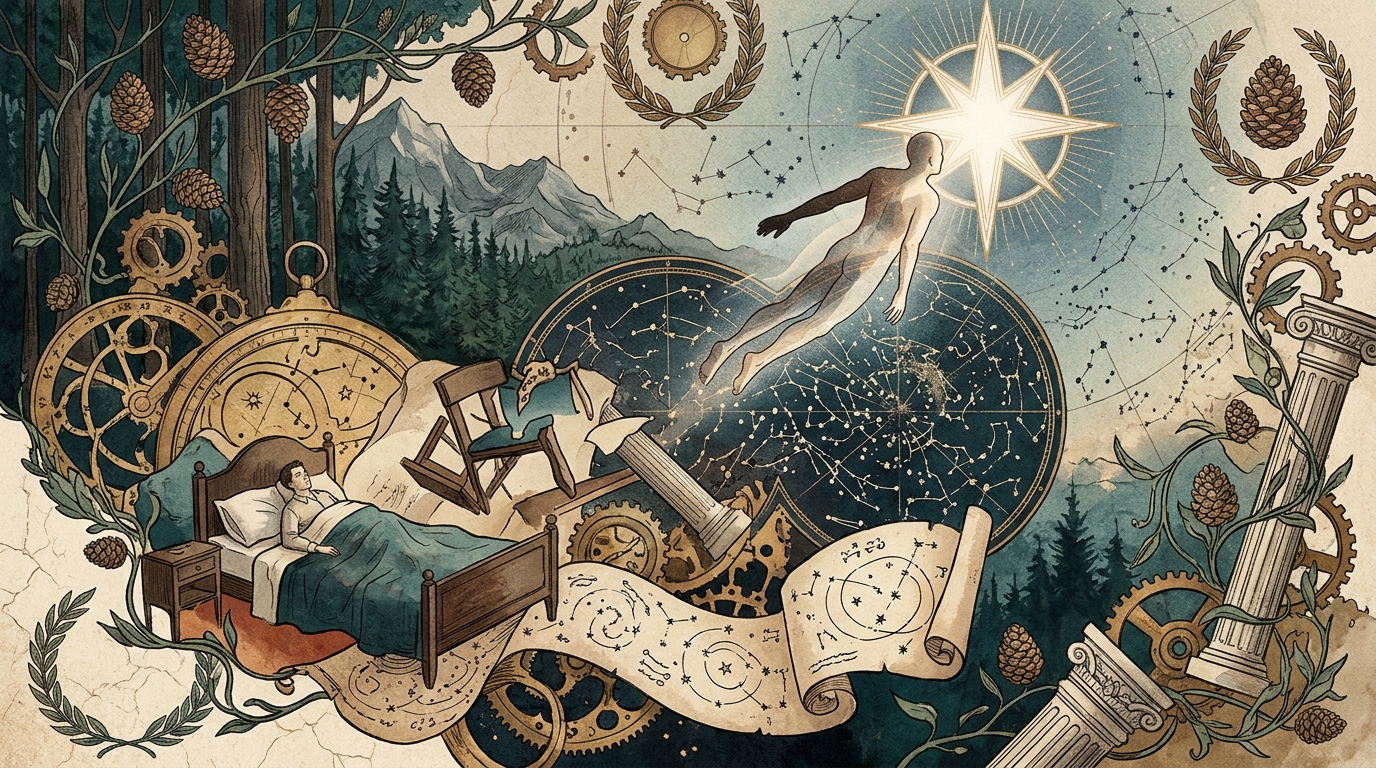
Before lucid dreaming became a laboratory research topic, British writer Oliver Fox described the startling moment he realised he was dreaming and remained aware inside the dream. He took some of those experiences to indicate that perception could travel beyond the physical body.
In brief: Fox’s ‘dreams of knowledge’ centred on recognising an impossible detail in a dream and retaining awareness. His ‘pineal doorway’ was an esoteric interpretation, not an established mechanism of the pineal gland.
Oliver Fox and the early lucid-dream literature
Oliver Fox was the pen name of Hugh George Callaway. His work appeared in Occult Review around 1920, and his book Astral Projection: A Record of Out-of-the-Body Experiences followed in 1939. His records are useful precisely because they describe experiences in detail, even where modern science does not accept the interpretations.
What is a ‘dream of knowledge’?
Imagine walking through a familiar street when a building seems impossible, or noticing a detail that cannot happen in waking life. Instead of merely feeling surprise, you realise: I am dreaming. The dream may continue while you know its nature. Today this is called a lucid dream.
A cautious way to explore the idea
- During the day, make a habit of noticing details of ordinary surroundings without questioning the reality of waking life.
- Before sleeping, recall a distinctive oddity from a previous dream.
- Think about recognising a similar oddity next time, then sleep as usual.
- On waking, note whether awareness arose in the dream and what followed.
This is a modern diary-oriented adaptation, not a literal reconstruction of every historical instruction from Fox.
False awakening: dreaming that you woke up
Fox also discussed episodes that seemed like ordinary waking mornings but turned out to be dreams. In a false awakening, a person may dream of getting out of bed or walking around their room. Such episodes are not evidence that the person actually moved through the physical environment.
The ‘pineal doorway’
Fox associated a distinct inward sensation with a transition into another state. He used an esoteric explanation involving the pineal gland. There is no demonstrated physiological doorway by which consciousness exits the head; the pineal gland’s established role concerns melatonin and circadian regulation.
Fox versus LaBerge
Fox contributed unusually detailed early descriptions of discovering one was dreaming. Stephen LaBerge later developed the more structured MILD method and helped establish lucid dreaming experimentally. Both concern awareness during dreams, but they frame the experience differently.
Scientific perspective
Lucid dreams have been studied in sleep laboratories, and false awakenings are a recognised type of dream experience. Fox’s metaphysical explanation remains distinct from these observations.
Practice: an observation journal
Record your starting state, normal sleep duration, method used, sensations, emotions and any verifiable details. Write your first account before checking or discussing events. Keep observed experience separate from interpretation; don’t edit the initial account after the fact.
Risks and limits
Do not reduce sleep, intentionally induce frightening paralysis, fast, perform forced breathing, or use unprescribed substances to change consciousness. Stop if anxiety, confusion or disrupted sleep develops. Extraordinary external-world claims require independent testing.
Sources
- Oliver Fox, Astral Projection (historical text listing)
- Lucidity Studies: historical lucid-dream induction
- International Lucid Dream Induction Study (2020)
Original Russian-language AVAVEDMAK article
AVAVEDMAK separates traditional claims, lived experience and research evidence.