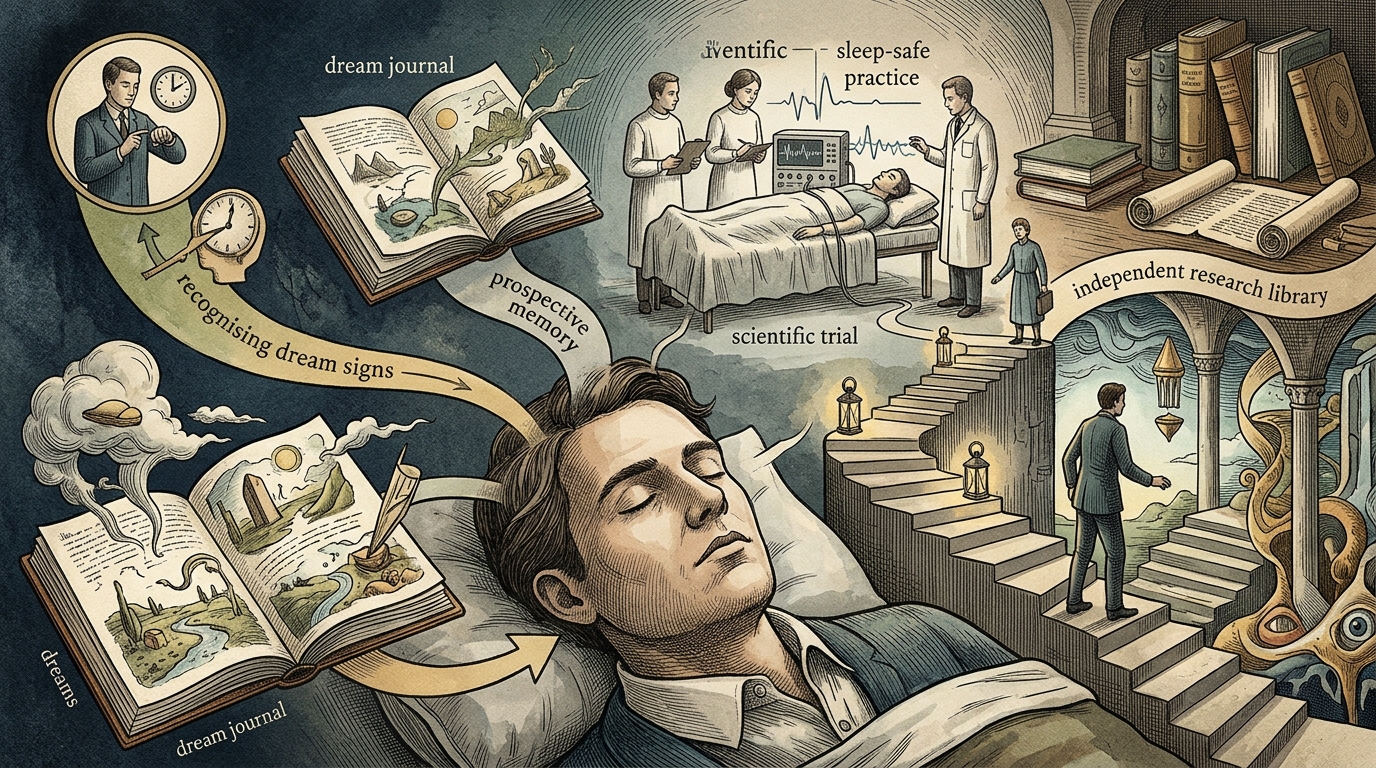
Stephen LaBerge developed the Mnemonic Induction of Lucid Dreams (MILD), a structured approach to realising that you are dreaming while a dream continues. It is a useful scientific comparison point for out-of-body techniques, but it does not claim to demonstrate an astral body.
In brief: MILD trains prospective memory: the intention to remember, during a later dream, that the experience is a dream. Lucid dreaming is an experimentally studied phenomenon; success varies and is not guaranteed.
Why does MILD belong in an astral-methods cluster?
Reports of ‘astral travel’ often mention floating, looking down at oneself, false awakenings and unusual control of dream images. A lucid-dream method provides a comparison without assuming literal separation from the body. Similar descriptions do not mean all these states are identical.
The principle: remembering to remember
We use prospective memory throughout waking life when we remember to perform an intended action later. MILD applies that skill to a dream: the goal is to recognise a dream sign at the relevant moment.
MILD in simple steps
- After a natural awakening, remember a recent dream in as much detail as possible.
- Find an impossible or unusual element that could have alerted you to the fact that you were dreaming.
- Mentally replay the dream, now imagining that you recognise the unusual element and become lucid.
- Calmly form an intention to notice a dream the next time it occurs.
- Return to sleep naturally if you are still sleepy, without pressure to achieve anything.
Laboratory protocols sometimes pair MILD with Wake Back to Bed (WBTB), in which sleep is intentionally interrupted. The above is a sleep-conserving adaptation for curious readers; it should not be mistaken for an exact reproduction of a research protocol.
What does research show?
The International Lucid Dream Induction Study investigated multiple approaches, including MILD and SSILD, with hundreds of participants. Both appeared promising in the study setting, but not every participant succeeded. Outcomes can be affected by how well participants remember dreams and how quickly they return to sleep. These are results about dreaming, not paranormal travel.
What to put in a journal
Track dream recall, nights of attempted practice, instances of lucid awareness, sleep quality, emotions and any adverse effects. Don’t count one vivid dream as proof of an external journey.
How does this differ from other authors?
Oliver Fox wrote about spontaneous awareness within dreams; Raduga places several unusual dream-like states under the label ‘phase’; LaBerge’s method specifically seeks awareness that one is dreaming and has been investigated in sleep research.
Science and safety
Lucid dreaming is a real subject of laboratory investigation. That is not evidence that the dreamer visits a physical place outside their body. Prioritise uninterrupted sleep; no drugs or sleep deprivation are required to keep a dream diary.
Practice: an observation journal
Record your starting state, normal sleep duration, method used, sensations, emotions and any verifiable details. Write your first account before checking or discussing events. Keep observed experience separate from interpretation; don’t edit the initial account after the fact.
Risks and limits
Do not reduce sleep, intentionally induce frightening paralysis, fast, perform forced breathing, or use unprescribed substances to change consciousness. Stop if anxiety, confusion or disrupted sleep develops. Extraordinary external-world claims require independent testing.
Sources
- Lucidity Institute: Stephen LaBerge and MILD FAQ
- Aspy (2020), Findings From the International Lucid Dream Induction Study
- Systematic review of induction methods
Original Russian-language AVAVEDMAK article
AVAVEDMAK separates traditional claims, lived experience and research evidence.