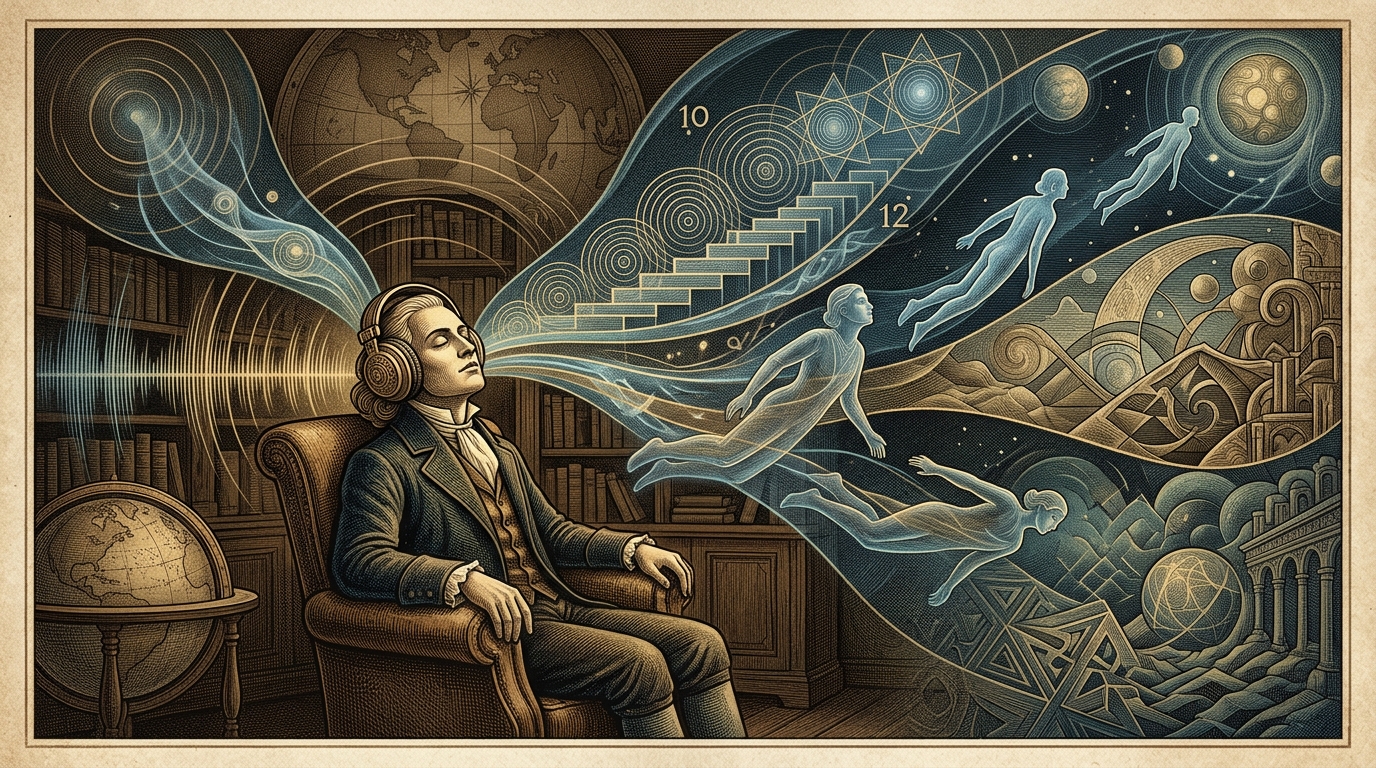
Robert Monroe’s name shaped modern out-of-body literature. An American radio producer who began reporting unusual floating and body-separation sensations in the late 1950s, Monroe went on to write influential books and develop sound-based programmes designed to change subjective states of consciousness.
In brief: Monroe (1915–1995) authored Journeys Out of the Body (1971) and established the Monroe Institute. His Hemi-Sync and Gateway programmes organise experiences using ‘Focus’ levels. Reports of vivid altered states should not be confused with independent proof of nonphysical travel.
Who was Robert Monroe?
Monroe was a US media entrepreneur before becoming a leading author of out-of-body accounts. His 1971 book Journeys Out of the Body describes feeling detached from his resting physical body and apparently moving through familiar and unfamiliar places. The account helped popularise the term ‘out-of-body experience’ for a broad audience.
How did his journeys begin?
Monroe described episodes of unusual vibrations, floating and looking at his body from another vantage point. He interpreted them as nonphysical travel and began experimenting with circumstances that appeared to precede the events. They remain first-person narratives, not verified remote observations.
Hemi-Sync and the Gateway Experience
Monroe developed Hemi-Sync audio material, incorporating binaural beats: when slightly different frequencies are presented separately to the ears, a listener may perceive a rhythmic beat. Gateway is a structured audio and relaxation programme using such sound technologies alongside guided attention.
Focus 10 and Focus 12
In Monroe’s vocabulary, Focus 10 is often described as ‘mind awake, body asleep’ — a deep relaxation state while maintaining awareness. Focus 12 refers to an ‘expanded awareness’ condition in the programme’s own terminology. These are training labels for subjective states, not independently established anatomical stages.
What about the well-known US Army document?
A US Army-related analysis of the Gateway Process is frequently circulated online. Its existence shows institutional interest and a speculative assessment, not official proof of astral travel or the truth of every hypothesis in the document. Read it critically alongside independent sleep and perception research.
A practical approach without extraordinary claims
- Use ordinary, comfortable guided relaxation at a reasonable volume.
- Allow the body to rest without fighting natural sleepiness.
- Notice sensations, thoughts and changes in perspective.
- Stop the audio and return to ordinary awareness when desired.
- Write a short account, separating feeling and interpretation.
What does science establish?
Music, relaxation and sound can affect attention and mood, but research on binaural beats has mixed results and does not establish out-of-body travel. The experience of altered self-location can be investigated through brain and sensory-integration studies. Monroe’s labels should be treated as author-defined practice categories.
Legacy
Monroe’s enduring influence includes a vocabulary for altered states, an institution, audio programmes and a community of researchers and enthusiasts. His approach is central to comparisons with Ivanov, Bruce and Buhlman because it emphasises sound-supported relaxation rather than only mental movement imagery.
Practice: an observation journal
Record your starting state, normal sleep duration, method used, sensations, emotions and any verifiable details. Write your first account before checking or discussing events. Keep observed experience separate from interpretation; don’t edit the initial account after the fact.
Risks and limits
Do not reduce sleep, intentionally induce frightening paralysis, fast, perform forced breathing, or use unprescribed substances to change consciousness. Stop if anxiety, confusion or disrupted sleep develops. Extraordinary external-world claims require independent testing.
Sources
- Monroe Institute: Gateway Experience
- The Gateway Process — historical US document (CIA Reading Room)
- Blanke et al. (2002), Nature
Original Russian-language AVAVEDMAK article
AVAVEDMAK separates traditional claims, lived experience and research evidence.