Tradition · Celtic & Folk Europe · Experience
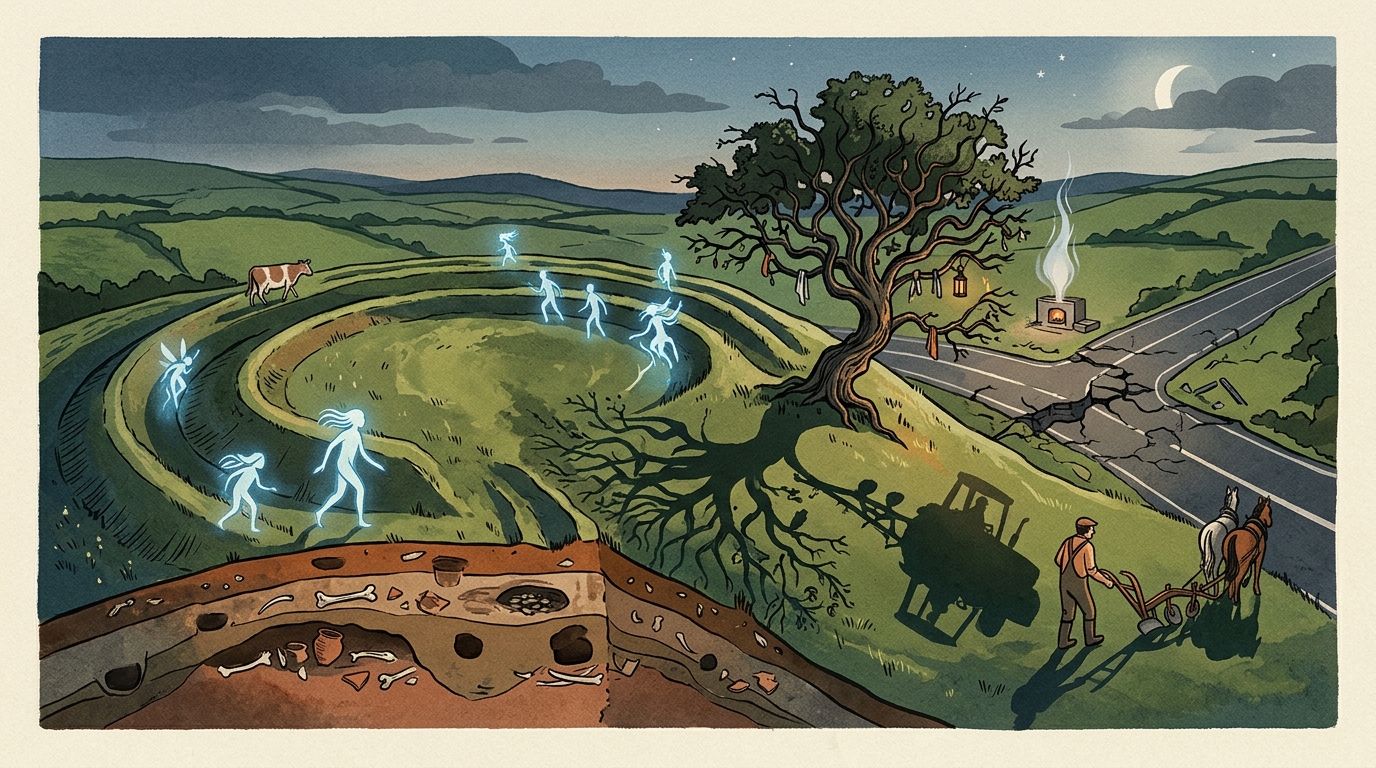
In the middle of a ploughed Irish field there is a circle of grass and trees that nobody touches. The tractor goes round it every year. Ask the farmer why, and he may smile and say it is “a fort”, or he may say nothing at all. A lone hawthorn standing in a pasture gets the same treatment. In 1999, a single such bush in County Clare made the Irish road authority adjust the route of a new motorway.
In short: Ireland has tens of thousands of ringforts — circular earthen banks known as raths or “fairy forts”. Archaeologists date most of them to roughly AD 500–1000, when they were enclosed farmsteads. In folk belief they became homes of the aos sí, the “people of the mounds” or fairies, and damaging them, like cutting a lone “fairy thorn”, was believed to bring illness, death or ruin. The belief is still strong enough to influence building projects today.
How people experience it
Many Irish people say they “don’t believe in fairies — but wouldn’t touch a fort”. Stories are passed down in families: a man who cut a thorn and lost his cattle, a house built across a “fairy path” where nobody could sleep, lights seen at night on a rath, music heard from the ground. Those who have walked into a fort at dusk often describe a sudden hush and the feeling of being watched.
How the tradition explains it
In Irish myth the Tuatha Dé Danann, defeated by the ancestors of the Irish, withdrew into the hills and mounds — the síde — and became the aos sí. Folk tradition is careful with names: they are “the good people”, “the gentry”, “themselves”. They travel along invisible paths between forts, and a house built across such a path will suffer.
Traditional rules, as recorded by folklorists. For familiarization.
- Do not plough, dig or build on a fort, and do not take stones or wood from it.
- Never cut a lone hawthorn (a “fairy thorn”), especially one growing in a field or on a fort.
- Do not throw water out at night without warning: “Seachain!” (“Beware!”).
- Leave the first milk or a little food for the good people on certain nights, such as Samhain and May Eve.
The Latoon fairy bush
In 1999 the folklorist and storyteller Eddie Lenihan warned that building the Ennis bypass through a hawthorn at Latoon, County Clare, would anger the fairies, who were believed to gather there before battles with the fairies of Kerry. After national and international press coverage, the road plan was adjusted so the bush was spared. It still stands beside the motorway.
The dark side: Bridget Cleary
Fairy belief also had a terrible side. In 1895 in County Tipperary, Bridget Cleary fell ill; her husband Michael became convinced she had been taken by the fairies and replaced with a changeling. After days of “cures”, he burned her to death. He was convicted of manslaughter. The case, studied by historian Angela Bourke, shows how a folk explanation for illness could become fatal.
How science explains it — and where it stops
Archaeology shows that ringforts were homes of farming families in early medieval Ireland, with houses and souterrains (underground passages) inside the banks. Once abandoned, they became mysterious ruins, and later generations explained them as fairy dwellings. Taboos against disturbing them have had a side effect that archaeologists value: they protected thousands of sites from destruction. Psychologically, being in a place charged with stories increases attention to faint sounds and shadows, which can feel like a presence.
Where science stops: it explains who built the forts. It does not explain the consistency of the experiences people report there, or why the taboo has survived so strongly in a modern, educated society.
Known, disputed, open
- Known: most ringforts are early medieval farmsteads; fairy belief about them is recorded in detail by folklorists; the Latoon bush was spared in 1999.
- Disputed: how far the aos sí reflect pre-Christian gods or ancestor cults.
- Open: what people actually sense in these places.
Safety notes. Most forts are on private farmland and are protected national monuments: ask permission before entering, and never dig or remove anything. Any sudden change in a person’s behaviour or health needs medical care — never folk “cures”.
Frequently asked questions
What is a fairy fort?
An ancient circular enclosure — usually an early medieval ringfort — believed in Irish folklore to be home to the fairies.
Is it bad luck to cut a hawthorn tree in Ireland?
According to tradition, yes — especially a lone hawthorn in a field, known as a fairy thorn. Many Irish people still avoid cutting them.
Who are the aos sí?
The “people of the mounds”, the fairy folk of Irish tradition, often linked to the Tuatha Dé Danann of mythology.
Where next
Sources
- Bourke A. (1999). The Burning of Bridget Cleary. London: Pimlico.
- Lenihan E., Green C. E. (2003). Meeting the Other Crowd: The Fairy Stories of Hidden Ireland. New York: Tarcher.
- Stout M. (1997). The Irish Ringfort. Dublin: Four Courts Press.