Experience · Catholic mysticism · Carmelites
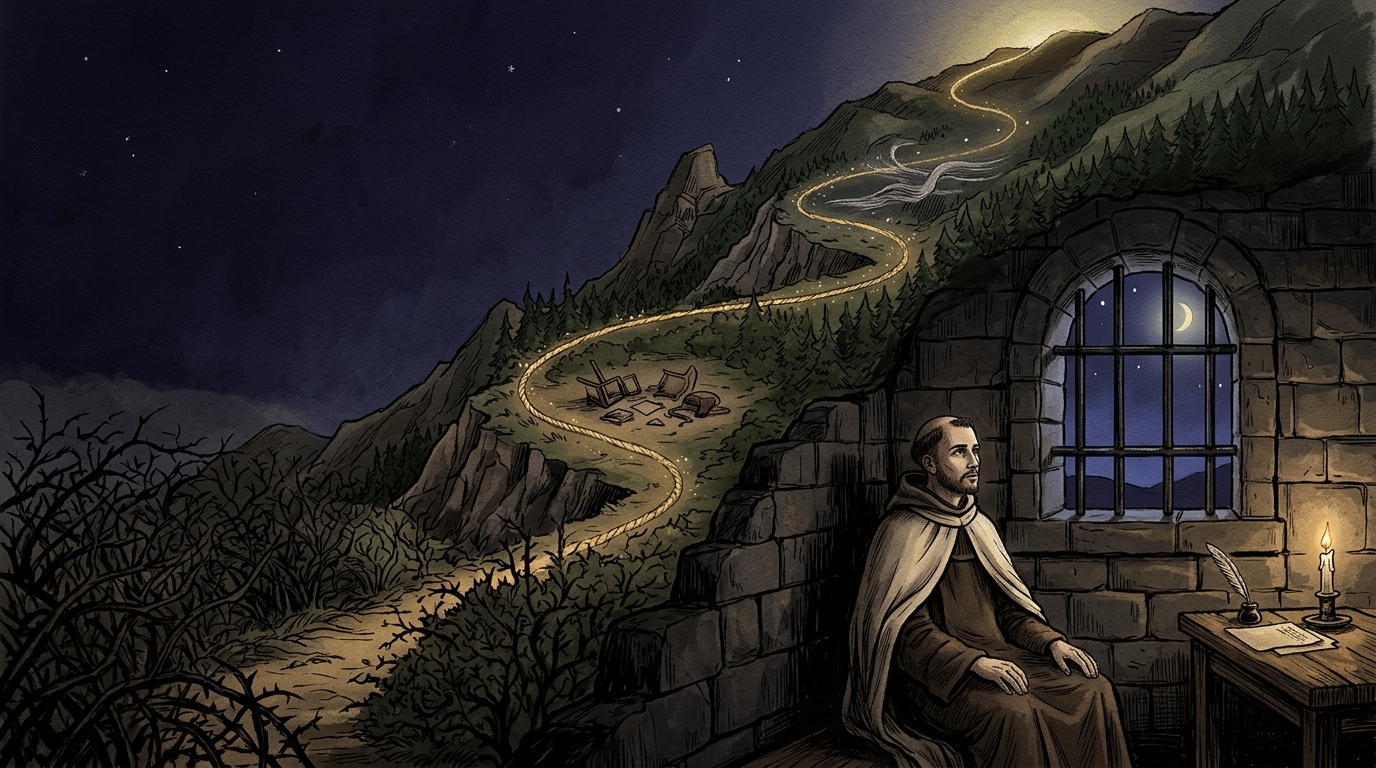
In December 1577 a small, thin Carmelite friar was kidnapped by his own brothers and locked in a cell in Toledo barely big enough to lie down in. For nine months he was fed bread and water and flogged in public. In that darkness, with no books and no light except a narrow slit high in the wall, he composed some of the most beautiful poems in the Spanish language. One of them begins with a night in which a soul slips out of a sleeping house, unseen, to meet its Beloved. That is where “the dark night of the soul” comes from.
In short: “The dark night of the soul” comes from St John of the Cross (1542–1591), a Spanish Carmelite mystic and reformer with St Teresa of Ávila. In his commentaries on the poem Noche oscura he describes how a person who has begun to pray seriously passes through a “night of the senses”, when prayer loses all sweetness, and later a deeper “night of the spirit”, when God seems completely absent. He saw this not as punishment but as purification leading to union with God. Today the phrase is often used for any crisis, and spiritual dryness is sometimes confused with depression — though the two can also overlap.
How people experience it
Those who describe a “dark night” in John’s sense usually speak of the loss of something that used to work: prayer that once brought warmth now feels empty; religious feelings disappear; God seems silent or absent. Yet they keep turning towards him, with a quiet longing they cannot explain. Many say that only later did they understand the darkness as a passage — a stripping away of attachments, including attachment to spiritual consolation itself. Mother Teresa of Calcutta, according to her letters, lived with such darkness for nearly fifty years.
How the tradition explains it
- The night of the senses. The beginner loses the pleasure of prayer and devotion. John lists signs: no comfort in God or in creatures; a painful care to serve God despite this; inability to meditate in the old way with images and reasoning.
- The night of the spirit. Rarer and deeper. The person feels rejected by God, sees their own poverty with terrible clarity, and suffers what John compares to purgatory — while being drawn into a dark, loving knowledge he calls “infused contemplation”.
- The dawn. The poem ends in union and rest, “among the lilies”. For John, the night is dark only because God’s light is too bright for the soul to bear.
John escaped from prison in August 1578 by lowering himself from a window on strips of blanket. He was canonised in 1726 and declared a Doctor of the Church in 1926.
How science explains it — and where it stops
Psychologists and psychiatrists who have studied this experience — notably the psychiatrist Gerald May — distinguish it from clinical depression. In depression a person typically loses interest in everything, feels worthless, sleeps and eats badly, and may think of death. In John’s dark night, ordinary life may go on, while what disappears is spiritual consolation; the person often keeps a quiet, stubborn desire for God. But the two can coexist, and a spiritual explanation should never stop someone from getting medical help. From the point of view of meditation research, long-term contemplatives sometimes report difficult phases — loss of meaning, emptiness, fear — that teachers in many traditions describe as normal stages of practice.
Where science stops: it can describe symptoms and tell illness from non-illness. It cannot judge John’s claim that the darkness is the light of God, too bright to see.
Known, disputed, open
- Known: John of the Cross wrote the poem and its commentaries; he described two “nights” with specific signs; he was imprisoned in Toledo in 1577–78.
- Disputed: how far modern popular use of the phrase still has anything to do with John’s meaning.
- Open: why, across traditions, deep spiritual growth seems to pass through a phase of emptiness.
Important. If you feel hopeless, cannot sleep or eat, have lost interest in everything, or have thoughts of harming yourself, please see a doctor — this may be depression, which is treatable, whatever its spiritual meaning for you. A trusted spiritual guide and medical care are not alternatives; many people need both.
Frequently asked questions
Who wrote “The Dark Night of the Soul”?
St John of the Cross, a 16th-century Spanish Carmelite friar and poet, as a commentary on his poem Noche oscura.
Is the dark night of the soul the same as depression?
Not in John’s sense: it is the loss of spiritual consolation, often with an ongoing desire for God. But the two can overlap, and symptoms of depression always deserve medical attention.
How long does the dark night last?
John gives no fixed time. Some accounts describe months; others, like Mother Teresa’s letters, describe decades.
Where next
- Teresa of Ávila’s Interior Castle — John’s fellow reformer
- The Cloud of Unknowing
Sources
- John of the Cross. The Collected Works. Trans. K. Kavanaugh and O. Rodriguez. Washington: ICS Publications, 1991.
- May G. G. (2004). The Dark Night of the Soul: A Psychiatrist Explores the Connection Between Darkness and Spiritual Growth. San Francisco: HarperSanFrancisco.
- Mother Teresa. Come Be My Light. Ed. B. Kolodiejchuk. New York: Doubleday, 2007.