Experience · Research overview
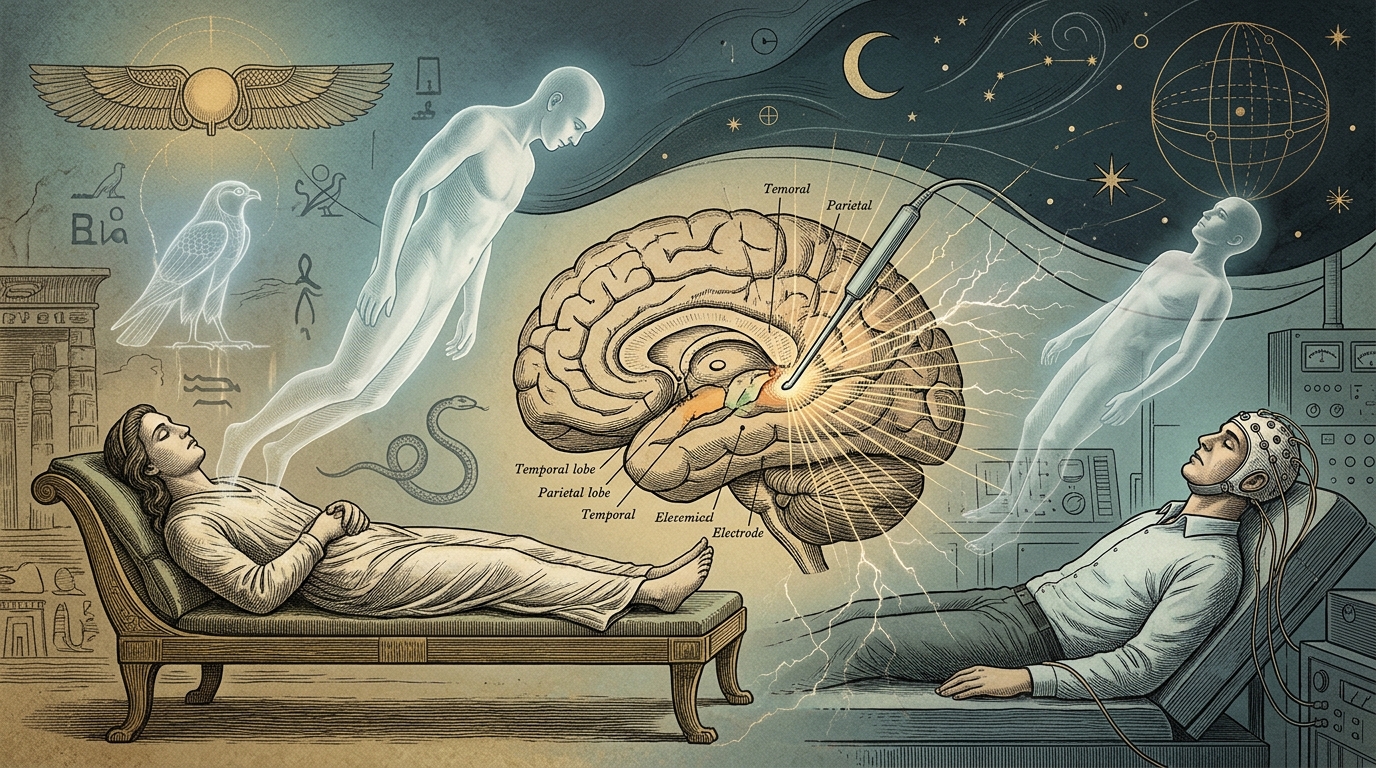
In 2002 a 43-year-old woman with epilepsy lay in a Geneva hospital while doctors mapped her brain with electrodes before surgery. When they stimulated one particular spot, she suddenly said she was floating near the ceiling, looking down at her own legs on the bed. The doctors had switched on an out-of-body experience. For neuroscience it was a breakthrough. For the millions who have had such experiences on their own, it raised as many questions as it answered.
In short: An out-of-body experience (OBE) is the feeling of being located outside one’s physical body, often seeing it from above. Surveys suggest that roughly 5–10% of people have had at least one. OBEs happen spontaneously at sleep onset, in near-death situations, under anaesthesia, in meditation and with some drugs. Traditions interpreted them as the soul or “astral body” travelling. Neuroscience has shown that stimulating the brain’s temporo-parietal junction can trigger OBE-like states, and virtual-reality experiments can create similar illusions. Whether all OBEs are explained this way is still debated.
How people experience it
People describe a sudden shift: a buzzing or vibration, a sense of lifting or rolling out, and then seeing the room — and their own body — from another point, usually above. Perception can feel extremely clear. Some feel joy and freedom, others panic. Many say that afterwards they were convinced, sometimes for life, that they are more than their body.
How traditions explain it
Ancient Egyptians spoke of the ba, a part of the person that could leave the body; Plato told of Er, who returned from the dead to describe the afterlife. Shamans across the world journey out of the body in trance. In Western esotericism of the 19th and 20th centuries, Theosophists and occultists described an “astral body” capable of travelling, and authors such as Sylvan Muldoon (1929) and later Robert Monroe (1971) published detailed practical accounts of “astral projection”.
How science explains it — and where it stops
- Brain stimulation. Olaf Blanke and colleagues (Nature, 2002) triggered repeated OBE-like sensations by stimulating the right angular gyrus, part of the temporo-parietal junction, which integrates vision, touch and balance into a sense of where “I” am.
- Virtual reality. In 2007 Henrik Ehrsson (Science) used cameras and VR goggles to make volunteers feel located behind their own bodies — showing how easily the brain’s sense of self-location can be shifted.
- Sleep. Many spontaneous OBEs occur at sleep onset or during sleep paralysis, when the brain’s body map is in flux.
- Verification. Attempts to test whether people out of the body can see hidden targets — from Charles Tart’s experiment in the 1960s to hidden images in hospitals — have produced no convincing, replicated success.
Where science stops: it has shown how the brain builds our sense of being “here”, and how that sense can be moved. It has not explained every report — especially those in which people claim accurate perception from a vantage point their body could not have had. And it cannot tell us whether being “somewhere else” is always an illusion.
Known, disputed, open
- Known: OBEs are fairly common; they can be induced by brain stimulation and VR; they often occur near sleep.
- Disputed: whether any OBE has ever involved verified perception from outside the body.
- Open: what “I” is, if the brain can place it outside the body.
Safety notes. Spontaneous OBEs are usually harmless, but if they come with seizures, loss of time, unusual smells or tastes, or a persistent feeling of unreality, consult a doctor: they can be linked to epilepsy, migraine or dissociation. Never use drugs, breath-holding or sleep deprivation to induce them.
Practice: a journal for out-of-body sensations
Some people describe floating, seeing their room from above, or sensing a second body during sleep transitions. To explore your own memories without forcing an episode, keep a notebook by the bed. After waking, write what you sensed, how long it seemed to last, your sleep position and any dream imagery. In a separate line, note what you think it meant. Compare entries over time without assuming every sensation has the same cause. Do not attempt sleep deprivation, breath-holding, drugs or other risky methods to induce an out-of-body experience. This is a modern observation practice rather than a traditional initiation rite.
Frequently asked questions
How common are out-of-body experiences?
Population surveys suggest about 5–10% of people have had at least one.
What part of the brain causes out-of-body experiences?
Research points to the temporo-parietal junction, especially on the right side, which integrates bodily signals into a sense of self-location.
Is astral projection the same as an OBE?
“Astral projection” is the esoteric name for deliberately inducing an OBE, interpreted as travel in a subtle body.
Where next
Sources
- Blanke O. et al. (2002). Stimulating illusory own-body perceptions. Nature 419: 269–270.
- Ehrsson H. H. (2007). The experimental induction of out-of-body experiences. Science 317: 1048.
- Blackmore S. (1982). Beyond the Body: An Investigation of Out-of-the-Body Experiences. London: Heinemann.