Practice card · For familiarization · Norse & Germanic
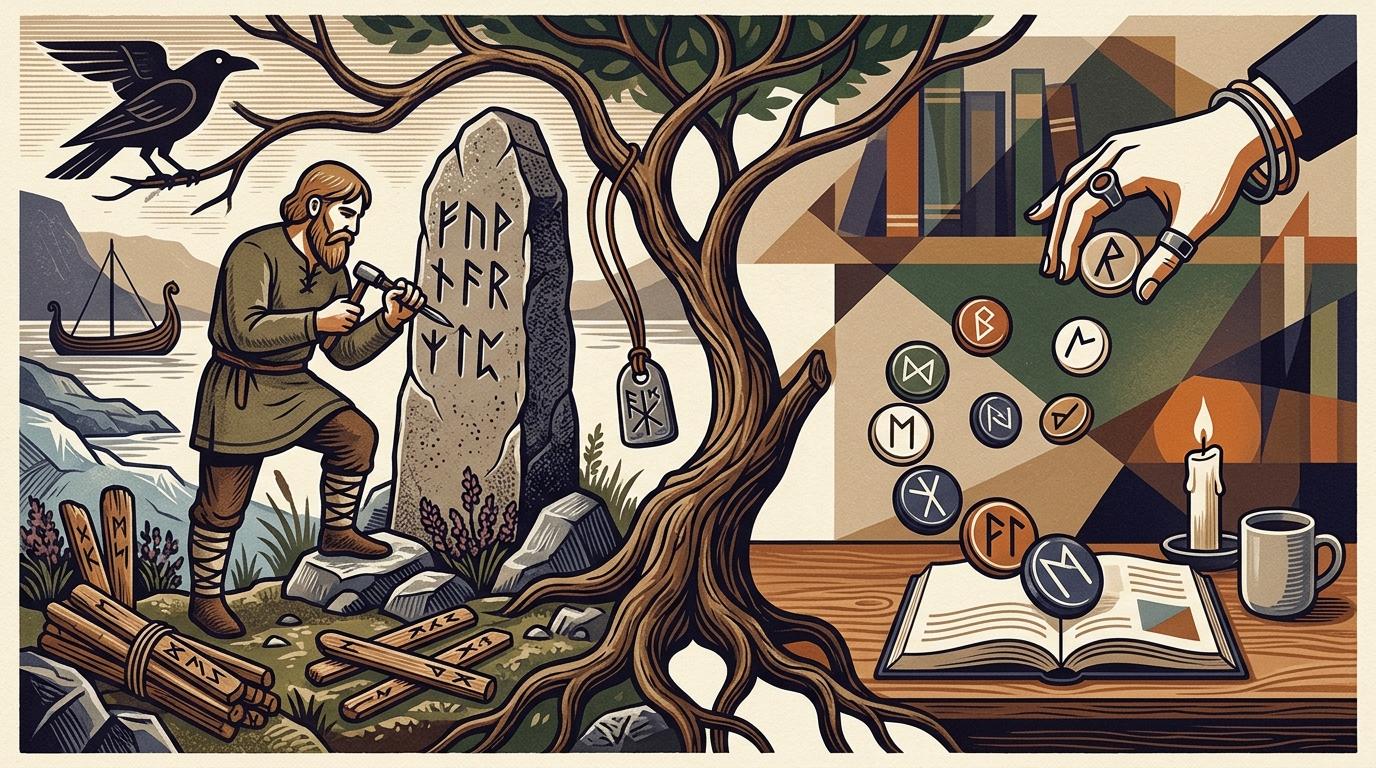
“I know that I hung on a windy tree nine long nights, wounded with a spear, given to Odin, myself to myself… I took up the runes, screaming I took them.” In the Old Norse poem Hávamál the god Odin wins the runes through a self-sacrifice that looks a lot like a shamanic ordeal. Today millions of people draw runes from a bag to ask about their future. The distance between those two pictures is the story of this article.
In short: Runes were the alphabets of Germanic peoples, used from about the 2nd century AD. The Elder Futhark had 24 signs; the Viking-age Younger Futhark had 16. They were used mainly for everyday writing, memorial stones and ownership marks — but also in charms, curses and healing. Each rune had a name and meaning recorded in medieval rune poems. There is no direct evidence that Vikings “read” runes as a fortune-telling system; most modern rune divination, including the “blank rune”, comes from the 20th century, especially Ralph Blum’s The Book of Runes (1982).
How people experience it
People who work with runes often say the signs feel “alive” in a way letters do not: carving or drawing them slowly, saying their names, they feel a link to their ancestors or to the old gods. Those who draw runes for guidance describe it less as prediction than as a mirror — the rune names a question they had not yet put into words. We describe the history; how you relate to the runes is up to you.
How the tradition explains it
What the sources say
- Tacitus, Germania (AD 98), ch. 10. Germanic tribes cut a branch into slips, marked them with signs, scattered them on a white cloth; a priest or father of the family picked up three and interpreted them. It is the closest ancient description of something like a rune casting — though Tacitus does not say the signs were runes, and runic writing may not yet have existed.
- Hávamál. Odin’s nine nights on the tree and his “taking up” of the runes; the poem then lists eighteen charms he knows — to heal, to blunt weapons, to calm storms.
- Egil’s Saga. The poet Egill finds a sick girl whose illness was caused by runes carved wrongly on a whalebone by a local youth. He scrapes them off, burns the bone, carves the right runes, and she recovers — a story about the danger of misused runes.
- Rune poems. Old English, Norwegian and Icelandic poems give each rune a short verse: fé (wealth) causes strife among kinsmen; hagall (hail) is the coldest of grains.
- Charm inscriptions. Real objects carry words like alu and laukaz (“leek”, a symbol of growth) — magic formulas whose exact meaning is debated.
The modern practice
A common modern method. For familiarization — not attested in Viking sources.
- Put the 24 Elder Futhark runes (on stones, wood or cards) into a bag.
- Formulate one clear question and hold it in mind.
- Draw one rune for a short answer, or three — situation, challenge, outcome — echoing Tacitus’s three slips.
- Read the rune’s name and traditional verse, and ask what it points to in your own life.
The “blank rune” (Odin’s rune) and the reversed meanings used in many books were introduced by Ralph Blum in 1982. Before him, in the early 1900s, the Austrian occultist Guido von List created his own “Armanen” rune system, later misused by the Nazis. Many rune symbols are still abused by extremist groups — another reason to know the real history.
How science explains it — and where it stops
Psychologists explain the “accuracy” of rune readings through the Barnum effect — broad statements feel personal — and through projection: an open symbol invites us to fill it with our own concerns. That is not necessarily a weakness; therapists use projective tools in the same way. Archaeologically, about 3,000 rune stones survive in Sweden alone, and most say things like “X raised this stone in memory of Y, his father”.
Where science stops: it shows how readings work psychologically. It cannot tell us what Odin’s ordeal meant to those who first told it, or why a symbol drawn at random sometimes seems to answer exactly.
Known, disputed, open
- Known: runes were a writing system, also used in charms; the Hávamál links them with Odin; most modern divination methods are 20th-century.
- Disputed: whether runes were ever cast for divination in the Viking age; the meaning of words like alu.
- Open: why a randomly drawn sign can feel like a direct answer.
Safety notes. Do not make major health, money or legal decisions based on a rune reading. Be aware that some runic symbols (for example the Odal rune with “wings” or the sig rune doubled) are used by extremist groups and are banned in some countries.
Frequently asked questions
Did the Vikings use runes for fortune-telling?
There is no clear evidence. Runes were used for writing and magic charms; Tacitus describes casting marked lots, but much earlier and not necessarily with runes.
How many runes are there?
The Elder Futhark has 24, the Viking-age Younger Futhark 16, and the Anglo-Saxon Futhorc up to 33.
What is the blank rune?
A modern addition introduced in Ralph Blum’s The Book of Runes (1982). It does not exist in any historical rune row.
Where next
Sources
- Tacitus. Germania, ch. 10.
- Hávamál, stanzas 138–163. In: The Poetic Edda, trans. C. Larrington. Oxford World’s Classics, 2014.
- Page R. I. (1987). Runes. London: British Museum Publications.
- Blum R. (1982). The Book of Runes. New York: St Martin’s Press.