Tradition · Alpine & Germanic folk calendar
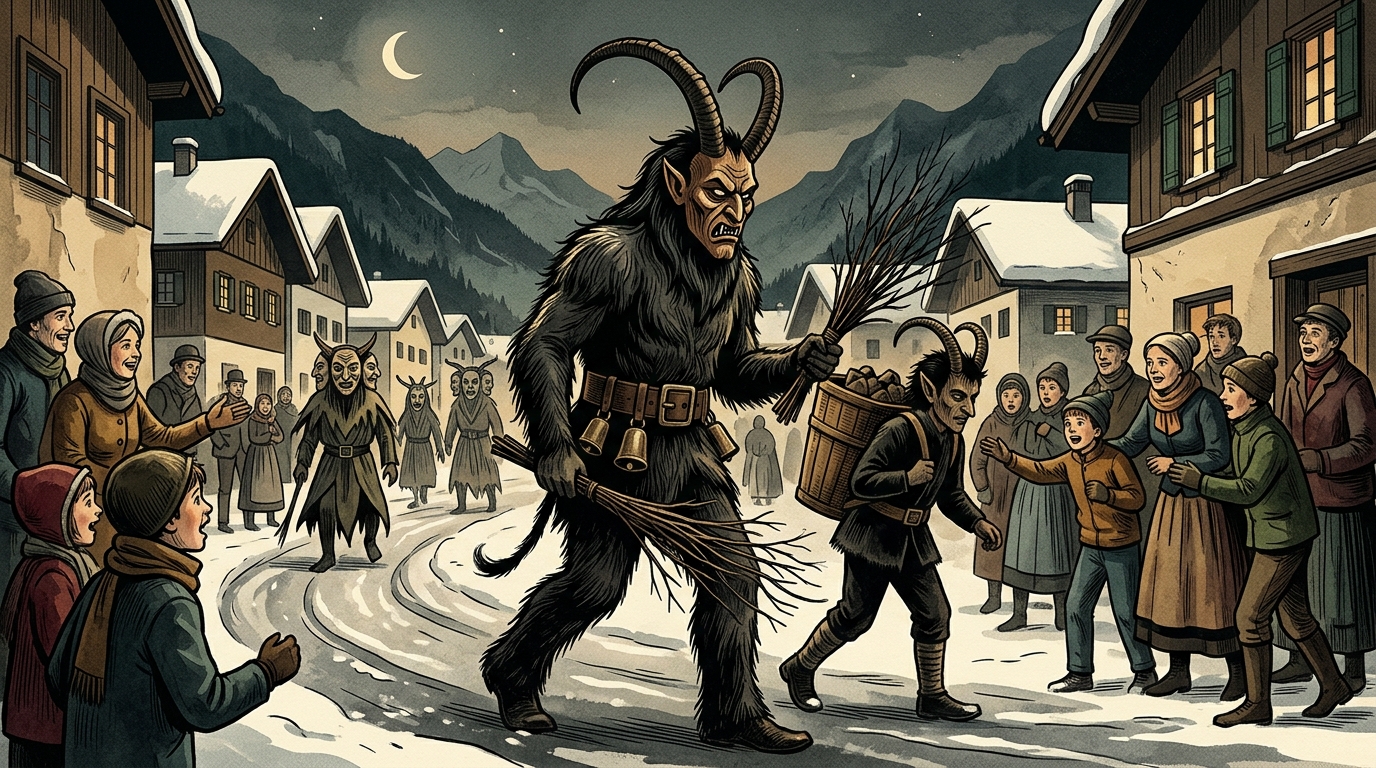
First you hear the bells: a heavy, irregular clanging coming up the street in the dark. Then they appear — dozens of shaggy figures with carved faces, long tongues, curling horns, swinging bundles of birch. Children scream and hide behind their parents; the parents laugh nervously. This is a Krampuslauf, the “Krampus run”, and every December thousands of people in Austria and Bavaria come out to be frightened on purpose.
In short: Krampus is a horned, hairy companion of St Nicholas in the folk traditions of Austria, Bavaria, South Tyrol, Slovenia and Croatia. On the evening of 5 December — Krampusnacht, the eve of St Nicholas’s Day — he accompanies the saint from house to house: Nicholas rewards good children, Krampus threatens the naughty with his birch switch. Today the custom lives mostly in public Krampus runs. His origin is debated: he may continue older midwinter mask customs or may be a figure of the Christian “devil play”.
How people experience it
Those who have stood at a Krampus run describe a strange mix of fear and joy. The bells and the masks work on something older than reason; your heart pounds even though you know there is a local carpenter under the fur. The men (and increasingly women) who wear the costume often speak of a change in themselves too: behind the mask, in a heavy suit, with the bells shaking at every step, they feel like someone else.
How the tradition explains it
Nicholas and his dark shadow
St Nicholas, a fourth-century bishop of Myra, became the patron of children, and in Central Europe he visits homes on the eve of his feast (6 December). In many regions he does not come alone: in Germany he is followed by Knecht Ruprecht, in the Netherlands by Zwarte Piet, in the Alps by Krampus. The name is usually linked to the Bavarian word Krampen, “claw”. The pairing makes the moral visible: reward and punishment walk side by side.
The costume and its meaning
As practised in Austria and Bavaria. For familiarization.
- The mask (Larve). Hand-carved from Swiss pine or lime wood, with real goat or ram horns. Good masks are made by specialist carvers and handed down.
- The fur. Sheep or goat skins sewn into a full suit that can weigh twenty kilograms or more.
- The bells. Large cowbells on a belt. Their noise is said to drive away evil — the “devil” scaring off the devils.
- The birch switch (Rute). A light swat on the legs was meant as a warning — and in older belief, a touch of fresh birch also brought health and fertility.
Krampus and the Perchten
Krampus is often confused with the Perchten, who run later, during the Rauhnächte — the twelve “rough nights” between Christmas and Epiphany. Perchten come in two kinds: the “beautiful” ones that bless the fields and the “ugly” ones that chase away winter. In many towns today the two traditions have merged into one big December show.
How science explains it — and where it stops
Researchers who study “recreational fear” — haunted houses, horror films — find that being frightened in a safe frame raises arousal and then leaves people feeling more energised and closer to those around them. Masks also change behaviour: anonymity and a new face loosen everyday inhibitions, which is why carnival and mask festivals often feel like a temporary world turned upside down. Krampus gives a whole community a controlled dose of terror once a year.
Where science stops: it explains the thrill. It does not explain why so many European peoples imagined midwinter as a time when wild, horned beings walk among us, nor what mask-wearers mean when they say the mask “takes over”.
Known, disputed, open
- Known: Krampus accompanies St Nicholas on 5 December in Alpine regions; Krampus postcards were hugely popular from the late 19th century; in the 1930s the Austrian authorities tried to suppress the custom.
- Disputed: whether Krampus descends from pre-Christian winter spirits or from the devil of medieval Nicholas plays.
- Open: what actually happens to a person who “becomes” Krampus for a night.
Safety notes. Krampus runs can be rough: people do get hit hard with switches, and crowds push. Keep small children at a distance or skip the run entirely if they are very scared, stay behind barriers, and follow the organisers’ rules. Masked participants should never drink alcohol before a run — visibility in a mask is poor and falls are common.
Frequently asked questions
When is Krampus Night?
On the evening of 5 December, the eve of St Nicholas’s Day. Many towns hold Krampus runs on several evenings in late November and early December.
Is Krampus the devil?
In the folk tradition he is a devil-like figure, but one who works for St Nicholas — a servant of order rather than its enemy.
What is the difference between Krampus and Perchten?
Krampus belongs to St Nicholas’s Eve (5 December). Perchten run during the Rauhnächte between Christmas and Epiphany and are linked to the figure of Frau Perchta.
Where next
- St Nicholas Day traditions across Europe
- The Rauhnächte: rites of the Twelve Nights
- Perchta and Frau Holle — the other masked winter figure of the Alps
- All Norse & Germanic articles
Sources
- Ridenour A. (2016). The Krampus and the Old, Dark Christmas. Port Townsend: Feral House.
- Kerr M., Siegle G. J., Orsini J. (2019). Voluntary arousing negative experiences (VANE): why we like to be scared. Emotion 19(4): 682–698.
- “Krampus”, Encyclopaedia Britannica.