Tradition · Norse & Germanic · Folk calendar
Before dawn on 13 December, in schools, churches and offices all over Sweden, the lights go out. A slow song begins, and a girl in a long white gown walks in with a crown of burning candles on her head, followed by a line of children holding candles. It is one of the most beautiful rituals in Europe. It is also much younger — and its roots much darker — than most people realise.
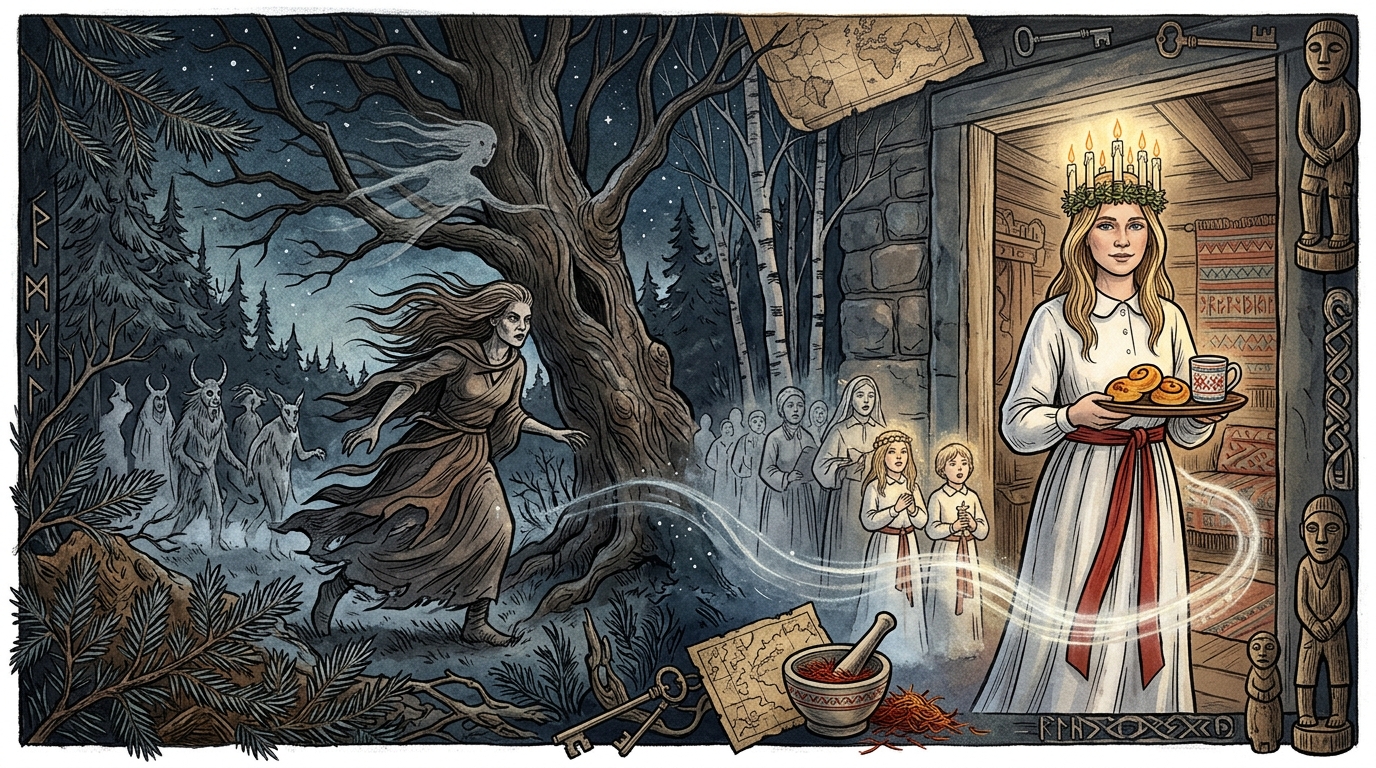
In short: St Lucia’s Day falls on 13 December. It honours Lucy of Syracuse, a Christian martyr who died around 304. In Sweden it is celebrated with a candlelit procession, the song “Sankta Lucia”, saffron buns (lussekatter) and gingerbread. The modern public procession dates from 1927, but behind it stands an older folk belief: in the old calendar Lucia night was the longest night of the year, when a dangerous being called Lussi and her retinue roamed.
How people experience it
Swedes often say that Lucia is the moment they “feel” Christmas coming. The combination of total darkness, a single slow melody and a moving circle of light seems to touch even people who are not religious at all. Many adults remember their own first time as Lucia or as a candle-bearer as a kind of initiation — nervous, solemn and proud at once.
How the tradition explains it
The saint of light
Lucia (Lucy) of Syracuse was martyred in Sicily under Diocletian. Her name comes from the Latin lux, “light”, and she became a patron of the eyes and of the blind. A later legend says she carried food to Christians hiding in the catacombs, wearing candles on her head to keep her hands free — the story most Swedes give for the crown.
Lussi and the longest night
Under the Julian calendar, 13 December fell close to the winter solstice, so Lussinatten was counted as the longest night of the year. In Norwegian and Swedish folk belief this was a dangerous night. Lussi, a female demon, rode out with her lussiferda, a host of trolls and spirits; children who misbehaved could be carried off through the chimney. Farm work had to be finished, and people stayed awake — lussevaka, “Lussi watch” — to protect home and animals. Folklorists debate whether Lussi is a demonised form of the saint or an older figure who borrowed her name.
The customs today
As practised in Sweden, Norway and Finland. For familiarization.
- The procession. Lucia in a white gown with a red sash and a crown of lingonberry leaves and candles; maids (tärnor) with candles; “star boys” in tall cones; sometimes gingerbread children. They sing “Sankta Lucia”, a Neapolitan boat song given Swedish words.
- Breakfast in bed. At home the eldest daughter traditionally wakes the family with coffee, saffron buns and gingerbread — a custom recorded among wealthier families in western Sweden in the 1700s.
- Lussekatter. S-shaped saffron buns with raisins, “Lucia cats”. One theory connects them with the devil, who appeared as a cat; the golden saffron was meant to drive him away.
- The national Lucia. In 1927 the newspaper Stockholms Dagblad chose a “Lucia of Stockholm”, and from there the public procession spread through the country.
How science explains it — and where it stops
In Stockholm the sun rises after 8.30 a.m. in mid-December and sets before 3 p.m.; further north it barely rises at all. Light-deprivation lowers mood in many people, and Scandinavia has long developed rituals that literally bring light into the darkest days. Shared singing synchronises breathing and has been shown to increase feelings of social closeness. Lucia combines all three: light, song and community.
Where science stops: it explains why light and song comfort us. It does not explain why our ancestors filled the longest night with Lussi and her host — what they actually felt in that darkness — or why it still feels as if “something” passes through the room when the singing begins.
Known, disputed, open
- Known: Lucy of Syracuse was a 4th-century martyr; 13 December was the longest night in the old calendar; the modern public Lucia procession spread after 1927.
- Disputed: whether Lussi is pre-Christian or a folk inversion of the saint; the origin of the lussekatt shape.
- Open: why so many cultures place dangerous night-riders at midwinter.
Safety notes. Real candles on the head are dangerous: hair and the dry lingonberry wreath can catch fire. Schools and churches use battery candles for children for good reason. If real candles are used, the wearer must be an adult, hair must be wet or tightly covered, and someone must stand by with a damp towel.
Frequently asked questions
When is St Lucia’s Day?
On 13 December every year. In 2026 it falls on a Sunday.
Why does Lucia wear candles on her head?
The popular story says Lucy wore candles to light her way while carrying food to persecuted Christians. Symbolically, the crown is light in the darkest time of the year.
Who was Lussi?
A dangerous female figure of Scandinavian folk belief who rode out with a host of spirits on Lucia night, then counted as the longest night of the year.
Where next
- House spirits of the North — the tomte who also wanted his porridge at midwinter
- Norse Yule and the Yule goat
- All Norse & Germanic articles
Sources
- “Lucia in Sweden”, sweden.se — official Swedish site.
- “Saint Lucy”, Encyclopaedia Britannica.
- Pearce E., Launay J., Dunbar R. I. M. (2015). The ice-breaker effect: singing mediates fast social bonding. Royal Society Open Science 2: 150221.