Tradition · Folk Europe · World parallels
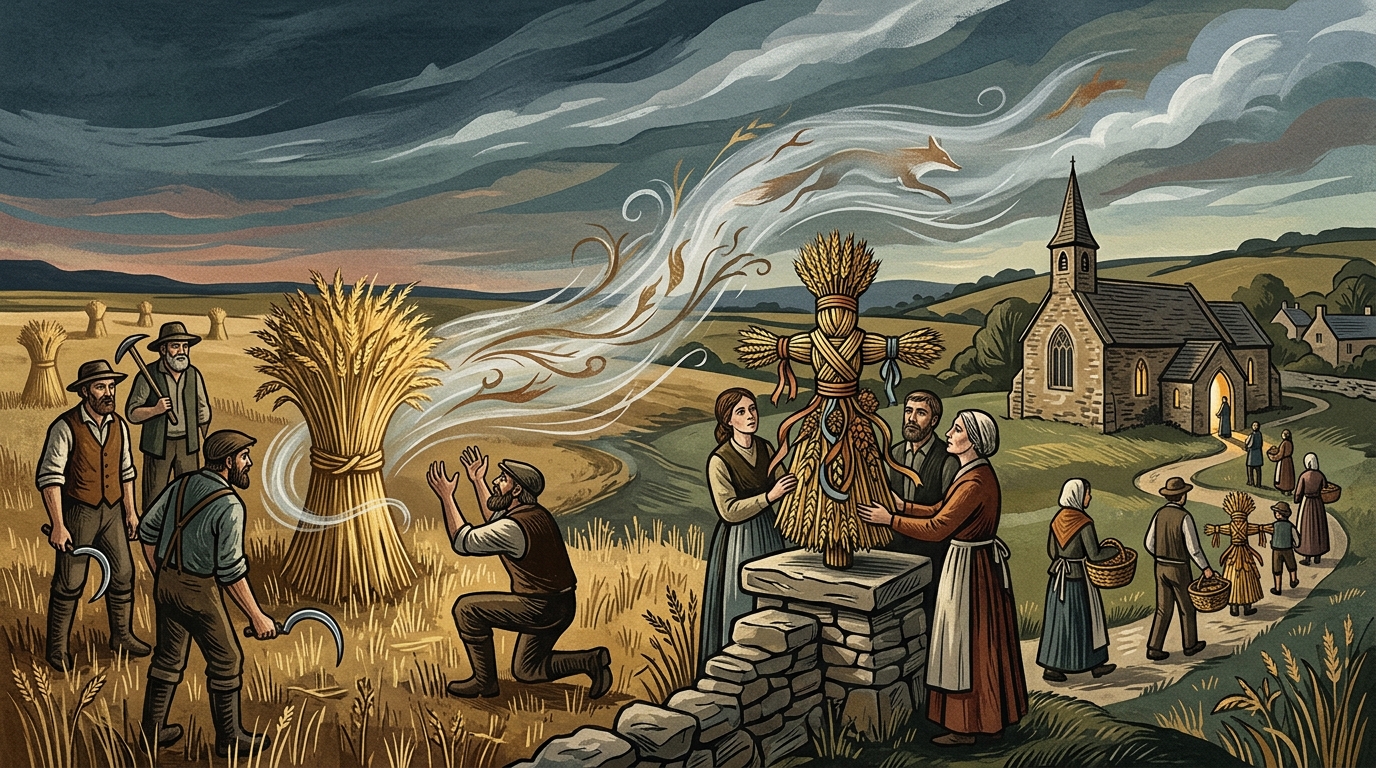
The field is almost bare. One small patch of wheat still stands. The reapers gather round it and nobody wants to strike the last blow. Finally they throw their sickles at it together, so no one can say who cut it. An old man lifts the bundle high and shouts: “I have ‘en! I have ‘en!” The others answer: “What have ‘ee?” — “A neck! A neck!” This was “crying the neck” in Devon and Cornwall, and versions of it were performed across Europe at the end of every harvest.
In short: In European farming communities, the last sheaf of the harvest was treated as special: it was believed to contain the “spirit” or life of the grain. It was cut with ceremony, sometimes by all reapers at once, and plaited into a figure — a corn dolly, “kern baby”, “harvest maiden” or “neck” — which was kept through the winter and returned to the soil at ploughing or sowing. The harvest ended with a feast called Harvest Home. In 1843 the Cornish vicar Robert Hawker held the first church Harvest Festival, and German-speaking churches celebrate Erntedank. American Thanksgiving grew from a related tradition of giving thanks for the harvest.
How people experience it
Older farmers who remember these customs describe the end of harvest as an emotional moment: relief, exhaustion, joy and a strange reluctance to finish. The last sheaf was not just grain but the end of a year’s work and worry. Today people who make corn dollies by hand often say the slow plaiting of straw feels like a meditation and a connection with their ancestors.
How the tradition explains it
Customs as recorded by 19th- and 20th-century folklorists. For familiarization.
- The corn spirit. Folk belief held that as the field was cut, the spirit of the grain retreated into the last standing stalks. Whoever cut the last sheaf could be lucky — or unlucky — and in some regions was teased as “the old woman” or “the hare”.
- Crying the neck. In Devon and Cornwall the last bundle was raised and shouted over; the “neck” was hung in the farmhouse until the next harvest.
- The corn dolly. Plaited from the last straw into spirals, lanterns, bells or human shapes, it stood over the hearth through winter. In spring it was ploughed into the first furrow or fed to the animals, returning the spirit to the land.
- Harvest Home. A great supper given by the farmer for the workers, with songs, drinking and dancing.
- Church festivals. In 1843 Robert Hawker invited his parishioners at Morwenstow to receive bread made from the first corn; harvest festivals with decorated churches spread across Britain. In Germany, Erntedankfest is held on the first Sunday of October.
Slavic peoples had close parallels: the last sheaf, the dozhinki harvest festival and the “beard” of uncut stalks left in the field for the spirits or for Volos/St Elijah.
How science explains it — and where it stops
The 19th-century scholar Wilhelm Mannhardt collected hundreds of last-sheaf customs and proposed the idea of a “corn spirit”, which James Frazer popularised in The Golden Bough. Later folklorists criticised them for forcing many local practices into one theory. Anthropologists today see harvest rites as ways to mark the end of an anxious, collective effort, to share out reward and to express gratitude — functions that research on gratitude shows support well-being and social bonds.
Where science stops: it explains the community function. It does not explain why farmers so widely felt that something alive retreated into the last stalks — or what they felt when they cut it.
Known, disputed, open
- Known: last-sheaf customs and corn dollies are widely recorded in Europe; Hawker’s harvest festival dates from 1843.
- Disputed: Mannhardt’s and Frazer’s “corn spirit” theory as a single ancient belief.
- Open: what it means for a community to thank the land.
Notes. Dry straw decorations are highly flammable — keep corn dollies away from candles and fireplaces, despite the old custom of hanging them over the hearth.
Frequently asked questions
What is a corn dolly?
A figure or shape plaited from the last straw of the harvest, kept through winter as a home for the “spirit of the corn”.
What is “crying the neck”?
A harvest custom from Devon and Cornwall in which the last bundle of corn is raised and shouted over by the reapers. It has been revived in some Cornish villages.
Is Thanksgiving related to European harvest festivals?
Yes, in a broad sense: it grew out of English traditions of giving thanks after the harvest, though its form is distinctly American.
Where next
- St Martin’s Day — the feast that closed the farming year
- Wassailing the apple trees — the midwinter orchard rite
- All Celtic & Folk Europe articles
Sources
- Frazer J. G. The Golden Bough, chs. 45–48 on the corn spirit.
- Hutton R. (1996). The Stations of the Sun: A History of the Ritual Year in Britain. Oxford: Oxford University Press.
- Emmons R. A., McCullough M. E. (2003). Counting blessings versus burdens. Journal of Personality and Social Psychology 84(2): 377–389.