Predictions · Viral rumors
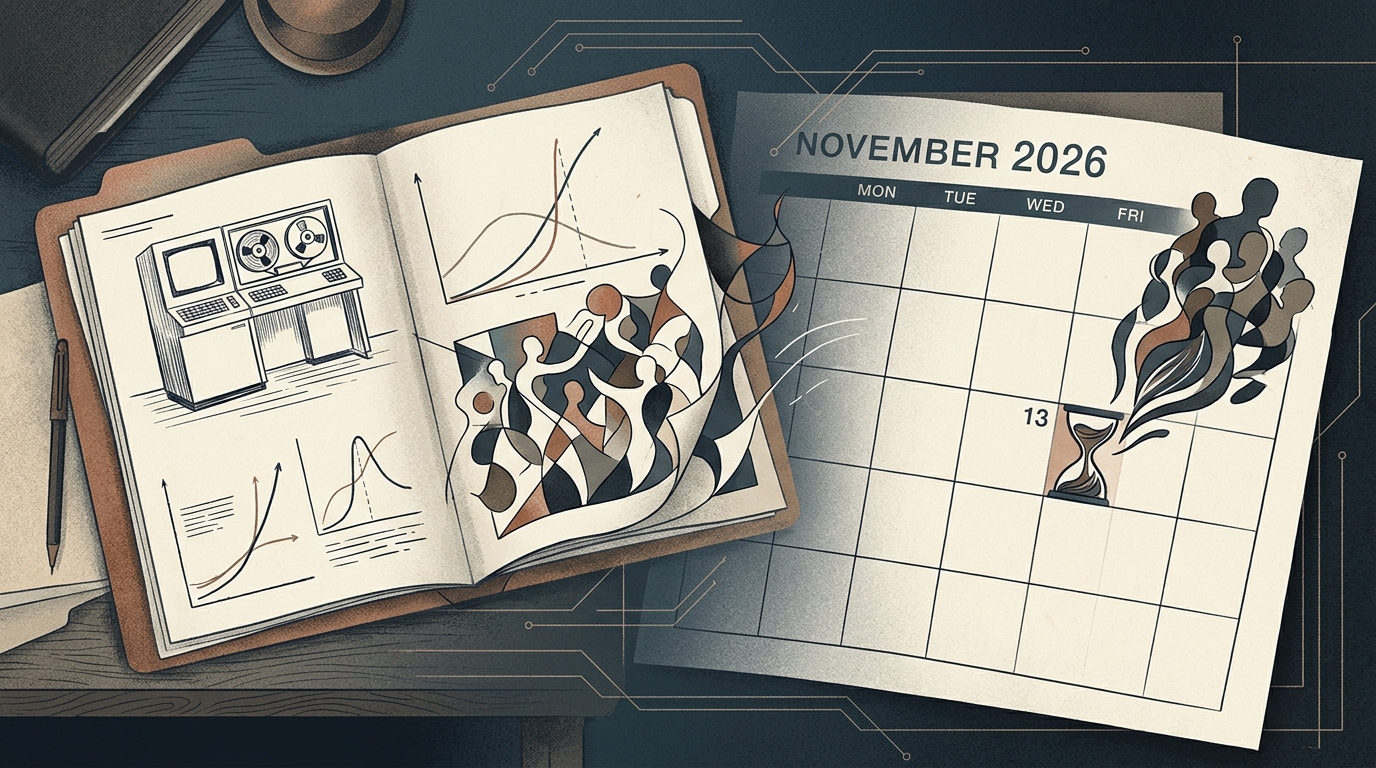
In 1960, one of the world’s leading scientific journals printed an article whose title gave a date for doomsday: Friday, 13 November, A.D. 2026. Sixty-six years later that Friday is almost here, and the paper is back on millions of screens. This page records what the three authors actually wrote, why it is spreading now, and what happened afterwards.
Prediction record
- Prediction: if world population kept growing as it had for two thousand years, it would head towards infinity, and humanity would be “squeezed to death”, around 13 November 2026.
- Attributed to: Heinz von Foerster, Patricia M. Mora and Lawrence W. Amiot, Department of Electrical Engineering, University of Illinois
- First documented: Science, vol. 132, no. 3436, 4 November 1960
- Checkable? Yes: world population is counted and published by the United Nations
- Predicted date: Friday, 13 November 2026 (the paper’s fitted value was A.D. 2026.87 ± 5.5 years)
- Checked on: 14 November 2026
- Status: not fulfilled. The date passed; world population stayed finite at roughly 8.3 billion and is growing more slowly than in 1960. The authors’ own error margin formally stays open until about 2032, but the curve stopped describing reality in the early 1990s.
Update, 14 November 2026: what happened on the day
Friday, 13 November 2026 came and went. Nothing in the world’s population figures resembled the paper’s runaway curve: there was no sudden surge, no crowding crisis and no warning from any demographic or scientific body. The UN’s projections, which put world population at around 8.3 billion this year, remain finite and point to a peak later this century rather than an explosion now.
We have therefore moved this prediction to our archive of predictions that were not fulfilled. That does not make the 1960 paper worthless. Its real point was a warning about growth, and the birth-rate decline it called for largely happened. What failed was the idea that a curve fitted to the past could name the day the future would arrive.
What was said, and by whom
The paper, “Doomsday: Friday, 13 November, A.D. 2026”, was written by the Austrian-born physicist and cybernetician Heinz von Foerster with two of his students. All three worked in the Department of Electrical Engineering at the University of Illinois at Urbana. They took 24 historical estimates of world population covering about two thousand years and looked for the curve that fitted them best.
The curve they found was not exponential, where a population doubles at regular intervals. It was hyperbolic: the doubling time kept shrinking. Their formula, N = 1.79 × 10¹¹ / (2026.87 − t)0.99, gives a population that rushes towards infinity as the year t approaches 2026.87. That moment, which falls in mid-November 2026, is the “doomsday” of the title. The authors’ explanation was that humans, unlike other animals, cooperate and build technology, so each gain in numbers makes further growth easier.
They did not predict an asteroid, a war or a final judgement. Their best-known line is about crowding: “Our great-great-grandchildren will not starve to death. They will be squeezed to death.” The paper’s real purpose was a warning, and it argued that the world birth rate should be reduced. Its body gives the date only as about 2026.87, with an uncertainty of roughly five and a half years either way; the weekday and the 13th appear in the title.
How the rumor spread
The paper has resurfaced online several times. In September 2024 the Portuguese fact-checker Observador rated as misleading a series of Facebook posts claiming that a “Harvard specialist” had predicted the end of the world. Von Foerster was not at Harvard; he worked at the University of Illinois. The “Harvard” version still circulates in Spanish- and Portuguese-language media.
As the date came closer, interest grew. In October 2026 the historian Alan MacEachern wrote about the paper for The Conversation, and the piece was republished by Gizmodo. Futura-Sciences and outlets in Britain, India, Italy, Austria and Latin America followed, many with countdown headlines. A Friday the 13th makes a memorable doomsday, and a peer-reviewed journal makes it sound authoritative.
How the authors’ own era received it
The paper was not quietly forgotten. According to MacEachern, mathematicians and demographers wrote to Science calling the work “ridiculous” and “manifestly absurd”; Observador notes a published critique by the Stanford mathematician Marvin Shinbrot. The authors replied and defended their mathematics. Many readers took the article as partly tongue-in-cheek, and the text supports both readings: the equations are presented formally, but there are also jokes about space travellers needing a “re-entry permit”. The story reached Time, The New York Times and the Pogo comic strip, and for decades textbooks cited it at face value.
What the official figures say
For a surprisingly long time the curve held up. MacEachern writes that its projections tracked reality better than most demographers’ through the 1970s and 1980s, and that world population began falling behind them only around 1993. The annual growth rate peaked in the 1960s, at around two per cent, and has fallen since.
The United Nations’ World Population Prospects 2024 puts world population at 8.2 billion in 2024 and projects a peak of around 10.3 billion in the mid-2080s, easing to about 10.2 billion by 2100. Global fertility is 2.3 live births per woman, down from 3.3 in 1990. These are large numbers, but they are finite ones, far from the formula’s infinity.
How science explains it — and where it stops
- Extrapolation. Any curve fitted to the past assumes the forces behind it stay the same. A hyperbola must hit infinity somewhere; that is a property of the mathematics, not a forecast of an event. The paper is often taught as a cautionary tale for exactly this reason.
- What changed. Falling birth rates, linked by demographers to lower child mortality, education, urbanisation and access to contraception, bent the curve. MacEachern points out that the global birth rate is now slightly less than half its 1960 level, which is close to what the authors recommended.
- Where it stops. Demography can say that the formula has stopped describing the world. It cannot say whether the warning helped, how many people the planet can support, or what the 22nd century will bring. Long-range projections carry wide uncertainty, and the UN publishes ranges for that reason.
Known, disputed, open
- Known: the paper is real, peer-reviewed and published in Science in 1960; its doomsday meant runaway population, not the end of the planet; world population is now about 8.3 billion and growing more slowly; the named date passed without the predicted outcome.
- Disputed: how seriously the authors meant the exact date. Some commentators read it as a joke wrapped around a serious argument; the paper itself does not settle the question.
- Open: the authors’ own error margin runs to about 2032, so a strict reader can say the window is not formally closed. Nothing in current UN data points towards the formula’s infinity.
Frequently asked questions
Is the world going to end on November 13, 2026?
The 1960 paper did not claim the planet would end. It said that if population kept growing along a particular curve, numbers would become impossible around that date. World population has not followed that curve since the early 1990s, and no scientific body has issued any warning for 13 November.
Who predicted the end of the world in 2026?
Heinz von Foerster, Patricia M. Mora and Lawrence W. Amiot of the University of Illinois, in Science on 4 November 1960. Posts describing a “Harvard specialist” are wrong about the institution.
What is the doomsday equation?
It is the formula N = 1.79 × 10¹¹ / (2026.87 − t)0.99, fitted to historical population estimates. As the year t approaches 2026.87, the predicted population N grows without limit.
Was the doomsday paper a joke?
Partly, by most readings. The mathematics and the call to reduce birth rates were presented seriously, while some passages are plainly playful. The authors defended their work against critics in the pages of Science.
Where next
- All predictions and how we check them
- The November 17 cyberattack rumor
- The Prophecy of the Popes: did St Malachy predict the last pope?
Sources
- Heinz von Foerster, Patricia M. Mora and Lawrence W. Amiot, “Doomsday: Friday, 13 November, A.D. 2026”, Science 132 (3436), 1960, pp. 1291–1295. DOI: 10.1126/science.132.3436.1291.
- United Nations, World Population Prospects 2024: Key Messages. Link.
- Alan MacEachern, “Scientists once calculated the date of doomsday — and it’s next month”, The Conversation, republished by Gizmodo, 1 October 2026. Link.
- “Fact Check: Especialista da Universidade de Harvard prevê que o fim do mundo aconteça em 2026?”, Observador, 23 September 2024. Link.
- Futura-Sciences, report on the 1960 doomsday paper, 14 October 2026. Link.