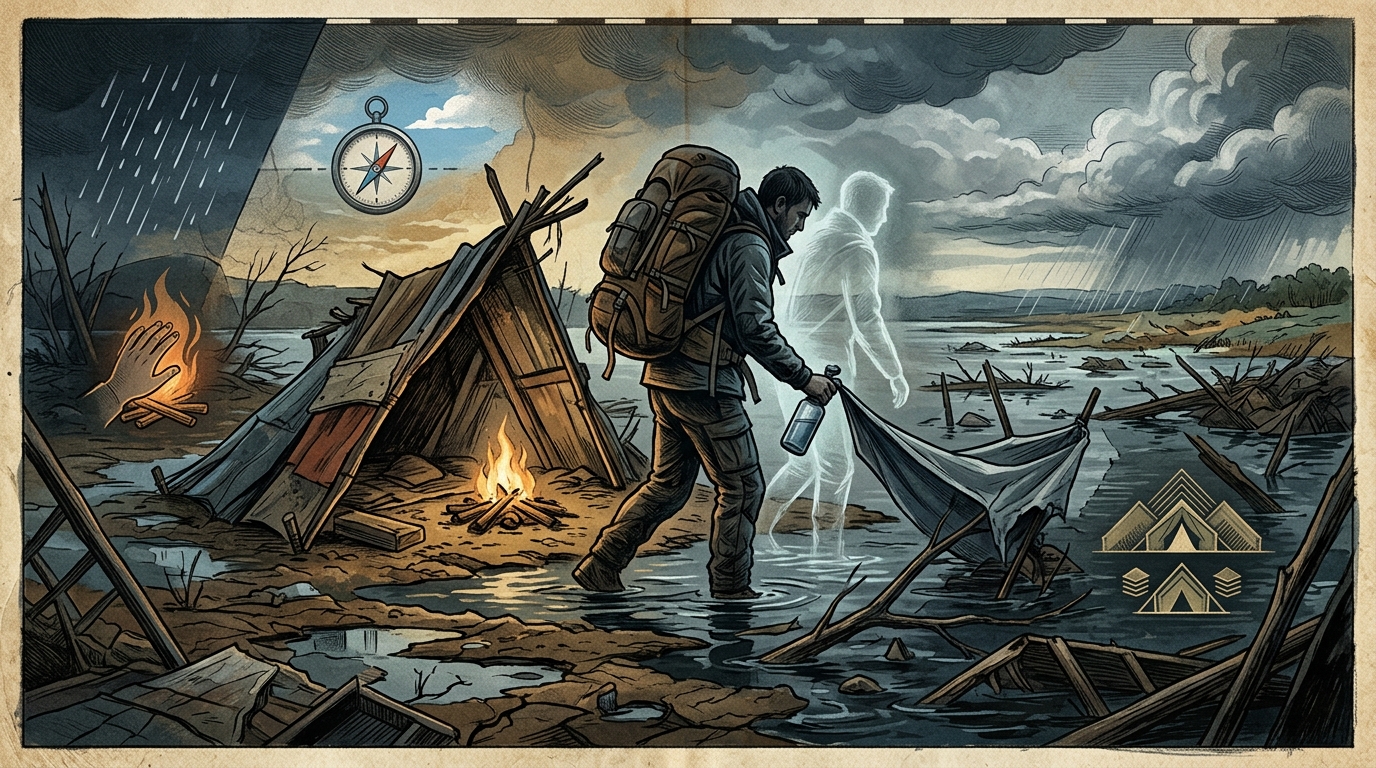
Survival & Self-Reliance · Main guide · Practical knowledge
The lights go out. The tap coughs and runs dry. The phone shows no signal, the radio says the roads are closed. Most disasters do not look like films: they look like an ordinary evening that suddenly stops working. What happens in the next three days depends less on courage than on knowing a few simple things in the right order.
This is the main guide of our Survival & Self-Reliance section. It gives the overall picture; five companion articles go deeper into water, heat, home shelter, improvised shelter outdoors, and where to take cover from each kind of danger. AVAVEDMAK studies how people pass through borderline states — and few states are as borderline as the hours after a catastrophe. So at the end we also look at what happens to the mind under extreme stress, and at the mysterious “companion” that survivors keep describing.
First rule: official instructions come first. If your local emergency service tells you to evacuate, shelter in place or boil water, do that. This guide is general information to help you understand the reasons behind such instructions and to act sensibly when no one is telling you what to do.
The rule of threes: what kills first
Survival instructors use a rough rule of thumb to set priorities. It is not exact science, but it puts things in the right order:
- 3 minutes without air — smoke, carbon monoxide, water. This is why the most dangerous mistake in a winter blackout is a generator or a gas oven used indoors.
- 3 hours without shelter in harsh cold, wind or rain — hypothermia can develop far faster than people expect, especially when wet.
- 3 days without water — less in heat or with children, the elderly and the sick.
- 3 weeks without food — food matters for strength and morale, but it is rarely the first thing that kills.
Many people stock up on tins and forget water, or buy a heater and forget a carbon monoxide alarm. The rule of threes corrects that: air and safety, then warmth and shelter, then water, then food.
The first hour: stop, think, observe, plan
Rescue services teach lost hikers the acronym STOP, and it works just as well at home:
- Stop. Do not run, drive or start doing things in panic. A minute of stillness costs nothing; a wrong move can cost everything.
- Think. What exactly has happened? Is there immediate danger — fire, gas smell, rising water, smoke?
- Observe. Who is with you, who is injured, what do you have: water, light, warm clothes, charged phones, medicines, fuel?
- Plan. Decide: stay or leave. Then the next three steps, not the next three days.
Stay or go?
Leave immediately if officials order evacuation, if there is fire, a gas leak, rising floodwater, structural damage, or if you cannot keep people warm and safe. Stay if you are told to shelter in place (for example during a chemical release or a radiation warning), if roads are dangerous, or if your home is safe, warm enough and supplied. If you leave, leave early: most deaths in floods and wildfires happen to people who left too late or drove into danger.
The five pillars of the first 72 hours
Each of these has its own detailed guide in this section.
1. Safe water
Official US guidance is to store at least one gallon (about 4 litres) per person per day for at least three days, more for hot climates, nursing mothers and the sick. If the water supply is suspect, boiling kills germs, but nothing you can do at home removes fuel or industrial chemicals. How to boil, filter and disinfect correctly — and when water simply cannot be saved: How to make water safe to drink in an emergency.
2. Warmth without poisoning yourself
In a winter power cut, the cold is dangerous, but the attempt to fight it is often deadlier. Carbon monoxide from generators, gas ovens, charcoal grills and camping heaters kills families every winter, often in their sleep. The safe approach is to gather everyone into one warm room and dress in layers: How to stay warm without power.
3. Shelter at home
There is no universal bunker. Against a tornado you go down — basement, lowest floor, interior room. Against a chemical cloud, which is heavier than air, you go up and inward. Against radioactive fallout, you put as much mass as possible between you and the outside. What your basement, a safe room and a public shelter can and cannot do: Home shelter in an emergency.
4. Shelter away from home
Stranded in a forest, an open field, a broken-down car or a city without power? The first job of an improvised shelter is to cut you off from wind, wet and, above all, the cold ground. How to choose a place and build a safe temporary shelter: How to build an emergency shelter in the woods, a field and the city.
5. Knowing where to take cover
Lightning, tornado, wildfire, flood, chemical release, missile or air-raid alert — each demands a different place and a different posture, and instincts are often wrong (hiding under a motorway overpass in a tornado, driving through floodwater, climbing into a closed attic). The quick reference: Where to take shelter in a storm, wildfire, flood, chemical release or missile alert.
A 72-hour kit: the short list
Emergency agencies in the US, UK and elsewhere recommend roughly the same basics. Keep them in one place that everyone in the household knows:
- Water: at least 3 days’ supply, 1 gallon / 4 litres per person per day.
- Food that needs no cooking, and a manual can opener.
- Battery or hand-crank radio, torches, spare batteries; a power bank for phones.
- First aid kit and at least a week of any prescription medicines; copies of prescriptions.
- Warm clothes, blankets or sleeping bags, sturdy shoes, rain gear.
- Whistle (three blasts is the international distress signal), dust masks, plastic sheeting and duct tape.
- Unscented household bleach (for disinfecting water, in the right dose) and moist wipes, rubbish bags.
- Battery-backed carbon monoxide alarm and smoke alarm (installed, not in the box).
- Copies of documents, some cash, spare keys, a paper list of important phone numbers.
- Needs of babies, elderly people and pets: formula, nappies, food, leads, carriers.
Agree a family plan in advance: where you meet if you are separated, and one out-of-area contact everyone calls or texts. Text messages often get through when calls do not.
The mind in a disaster: what happens and how to steady it
Under sudden threat the body floods with adrenaline. People describe time slowing down, tunnel vision, sounds going quiet, hands that will not obey. Some freeze. Survivors of disasters often report that many around them did nothing at all for precious minutes — not out of cowardice, but because the brain was searching for a familiar script and found none. That is why preparation works: a rehearsed plan is a script.
Box breathing: a technique used by soldiers and first responders
Slow, controlled breathing is one of the few ways to act directly on the stress response. A simple version taught to police, military and emergency personnel:
- Breathe in through the nose for a count of four.
- Hold for four.
- Breathe out slowly for four.
- Hold for four. Repeat three or four times, then act.
It is the same principle that monks have used for centuries in rhythmic prayer: slowing the breath slows the heart and clears the mind. In a crisis it buys you the thirty seconds you need to think. Giving yourself and others simple tasks — fill the bottles, find the torches, check on the neighbour — also pulls the mind out of panic.
The “Third Man”: the companion that appears at the edge of survival
In 1916, after his ship Endurance was crushed by Antarctic ice, Ernest Shackleton crossed the unmapped mountains of South Georgia with two companions, Frank Worsley and Tom Crean, on a 36-hour march to reach help. In his book South he wrote that during that march he often felt there were four of them, not three — and later learned that Worsley had felt the same thing, independently.
He was not alone. In 1933 the British climber Frank Smythe, alone high on Everest, felt so strongly that someone was with him that he broke off a piece of mint cake to offer to his invisible companion. Mountaineers, polar explorers, solo sailors, divers and survivors of the 11 September attacks have described a calm presence that encouraged them and showed them the way. The writer John Geiger collected such accounts in The Third Man Factor (2009); the name comes from T. S. Eliot’s The Waste Land, inspired by Shackleton’s story.
Neuroscience offers an explanation: extreme cold, exhaustion, isolation and monotony may disturb the brain’s sense of where the body begins and ends, producing a “sensed presence” — something that can even be triggered in the laboratory. People who experienced it often call it a guardian, an angel or God. AVAVEDMAK draws no conclusions. We note only that this presence almost always helps: it does not frighten, it guides. Whatever it is, those who met it say they would not have survived without it.
After the first 72 hours
- Check on neighbours, especially the elderly and people living alone.
- Do not return to an evacuated area until officials say it is safe.
- Throw away food that has been in floodwater or at room temperature too long: “when in doubt, throw it out”.
- Take photographs of damage before cleaning up, for insurance.
- Expect delayed reactions: sleeplessness, irritability, replaying events. They are normal; talking about it helps, and lasting distress is a reason to seek professional support.
Frequently asked questions
What is the rule of threes in survival?
A rule of thumb for priorities: a person can survive roughly 3 minutes without air, 3 hours without shelter in harsh conditions, 3 days without water and 3 weeks without food. It tells you to deal with air and safety first, then warmth and shelter, then water, then food.
How much water should I store for an emergency?
At least one gallon (about 4 litres) per person per day for a minimum of three days; two weeks is better if you have space. Store extra for pets, hot weather and anyone who is ill or nursing.
What should be in a 72-hour emergency kit?
Water, no-cook food, a radio, torches and batteries, a first aid kit and medicines, warm clothing and blankets, a whistle, dust masks, plastic sheeting and tape, copies of documents, cash, and supplies for babies, older people and pets.
What is the Third Man factor?
The experience, reported by many people in extreme survival situations, of an unseen companion who offers comfort and guidance. Shackleton described it in Antarctica in 1916; the term was popularised by John Geiger’s 2009 book.
The full Survival series
- How to make water safe to drink in an emergency
- How to stay warm without power — and avoid carbon monoxide
- Home shelter: basement, safe room or public shelter
- Emergency shelter in the woods, a field and the city
- Where to take shelter: storm, wildfire, flood, chemical release, missile alert
- All Survival & Self-Reliance articles
Sources
- “Build a Kit” and “Water”, Ready.gov (US Federal Emergency Management Agency).
- “Carbon Monoxide Poisoning: Prevention”, CDC.
- Ernest Shackleton, South: The Story of Shackleton’s Last Expedition 1914–1917 (1919).
- John Geiger, The Third Man Factor: Surviving the Impossible (2009).
- Blanke O. et al. (2014). Neurological and robot-controlled induction of an apparition. Current Biology 24(22): 2681–2686.