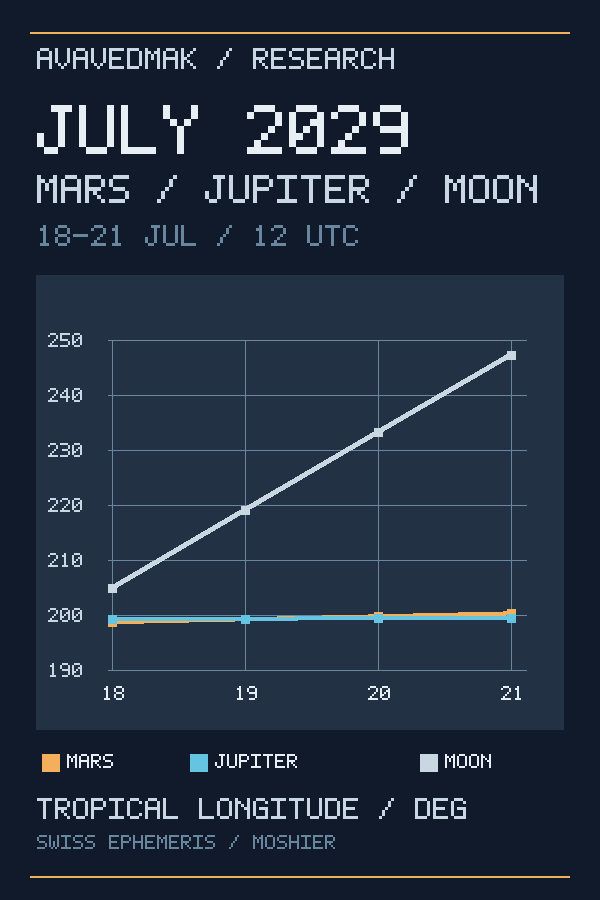
Research record, 29 November 2026. William Frederick published a dated forecast on The End Times Forecaster on 27 November 2026. He connects 19–21 July 2029 with a possible change in global political and religious order, based on astrological symbolism and his interpretation of biblical chronology. We verify what he published and examine its premises, not assume that the predicted scenario is real.
The published timeline
Frederick takes 13 October 2025 as the hypothetical beginning of a seven-year period, identifies 25 March 2029 as its midpoint, and considers 19–21 July 2029 a possible turning point. His argument draws on the song Aquarius and a purported planetary configuration. The claim that a cultural work encodes a deliberate future agenda is not established by the material.
What the planetary data actually show
The July 2029 tropical geocentric calendar places the Mars–Jupiter longitude conjunction on 19 July. Our independent Swiss Ephemeris calculation (Moshier, geocentric tropical longitude at 12:00 UTC) yields Mars at 198.70°, 199.23°, 199.76° and 200.30° on 18–21 July; Jupiter at 199.23°, 199.32°, 199.42° and 199.53°; and the Moon at 204.92°, 219.13°, 233.29° and 247.35°. Values are rounded. Alignment in ecliptic longitude does not mean the planets physically approach one another.
A significant problem: the essay equates the seventh astrological house with Libra. As Astrodienst explains, houses depend on the time and location for which a chart is cast. The 19 July ephemeris also places the Moon in Scorpio, not Libra. Without a specified location, time and house system, the claimed combination has not been established.
Checking the chronology
Adding 1,260 elapsed days to 13 October 2025 gives 26 March 2029. An inclusive count with the starting day as day one gives 25 March, the date used in the essay. The counting convention is unspecified. Hebcal confirms that the 2029 Tisha B’Av observance begins on the evening of 21 July and is observed on 22 July because the ninth of Av falls on Shabbat. The calendar overlap is real, but it does not establish a causal or predictive connection.
A prospective monitoring record
ETF-2026-1127-MAR: claimed date 25 March 2029, review 26 March. ETF-2026-1127-JUL: window 19–21 July 2029, review 22 July. Our proposed observable test asks whether the window sees a documented new supranational authority exercising transferred state powers, or a specific international legal decision matching the claimed turning point. Check official records and independent reporting; routine summits, individual laws and coincidental timing do not suffice. The original language is conditional and partly theological, so the editorial test cannot adjudicate every aspect of the belief. Both entries are pending and the specificity of the original claims is limited.
Conclusion
A public, dated forecast is valuable for transparent prospective monitoring. A calculable celestial configuration is not evidence that a political or religious outcome will occur. Preserve misses and contradictions as well as possible matches; do not revise criteria after events. Compare our Daragan World 2040 watchlist for another approach to dated forecasts.