Practice card · For familiarization · Catholic orders
In 1521 a Basque soldier lay recovering from a cannonball wound. Bored, he read the only books in the house: a life of Christ and a book of saints. He noticed something: when he daydreamed of knightly glory he felt excited and then empty; when he imagined following Christ he felt a lasting peace. Ignatius of Loyola turned that discovery into a method of prayer that uses the imagination as a door — and founded the Jesuits.
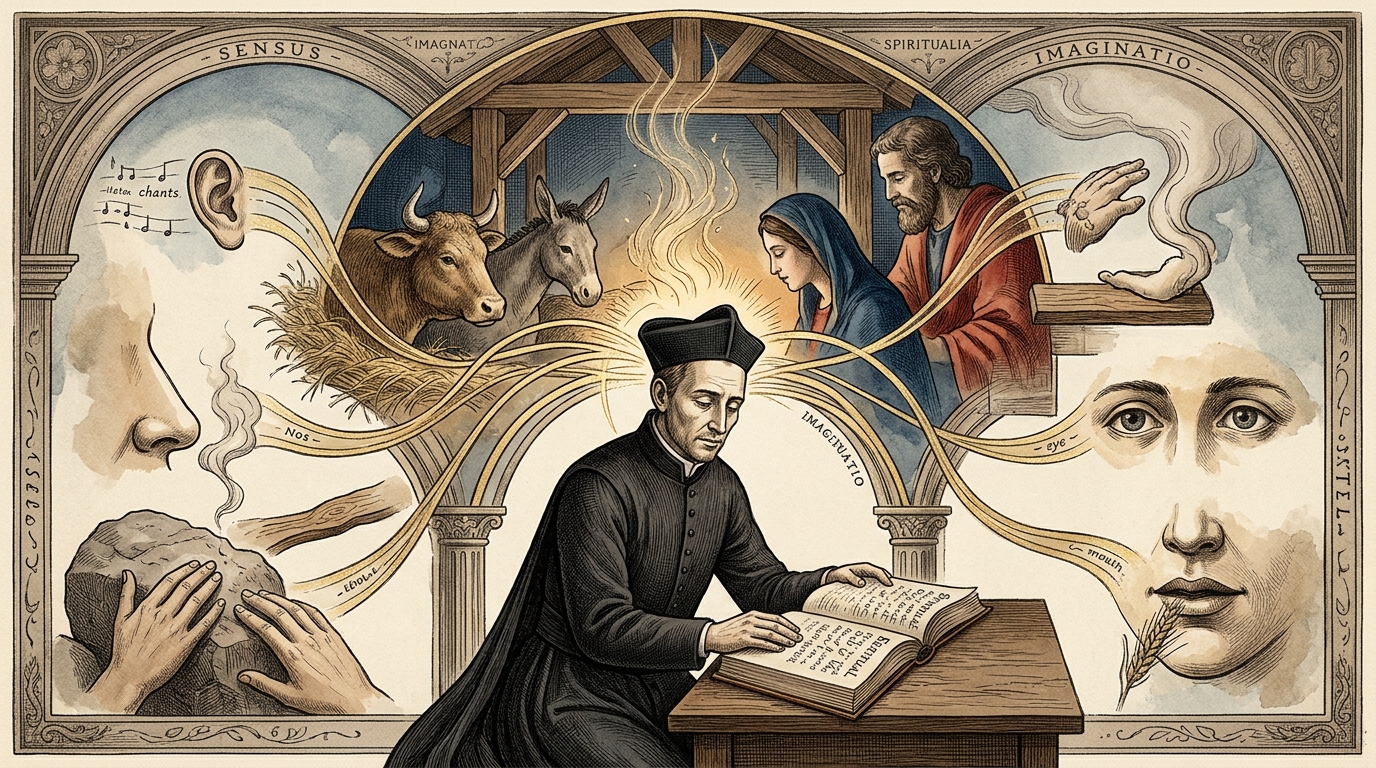
In short: Ignatian contemplation is a form of prayer from St Ignatius of Loyola’s Spiritual Exercises (first drafted around 1522–24). The person imagines a Gospel scene in vivid detail — the “composition of place” — and then “applies the senses”: seeing, hearing, smelling, tasting and touching what happens, even taking part in it. It ends with a personal conversation (“colloquy”) with Christ. The full Exercises are a 30-day retreat in four “weeks”, still given by Jesuits worldwide; shorter forms are used in daily life.
How people experience it
People are often surprised by how real the scenes become. In imagining the Nativity, one person finds themselves holding the child; another notices a shepherd they had never thought of; someone else feels unexpectedly sad. Ignatian teachers say that these unexpected details — what Ignatius called the movements of consolation and desolation — are where the prayer speaks. Many who make the 30-day retreat describe it as one of the decisive experiences of their lives.
How the tradition explains it
Ignatius believed God works through the whole person, including feelings and imagination. The Exercises guide the retreatant through four weeks: sin and mercy; the life of Christ; the Passion; the Resurrection. Throughout, the retreatant learns “discernment of spirits”: noticing which inner movements lead towards God and which away.
Contemplating the Nativity
A simplified version of the Exercises, about 30 minutes. For familiarization.
- Prepare. Sit quietly, become aware that you are in God’s presence, and ask for what you want — for example, to know Christ more closely.
- Read. Read Luke 2:1–20 slowly, twice.
- Composition of place. Picture the road to Bethlehem, the size of the cave or stable, the light, the weather.
- Apply the senses. See the people; hear what they say; smell the animals and the straw; feel the cold. Let yourself be present — as a servant, a shepherd, yourself.
- Colloquy. Speak to Mary, Joseph or Jesus as a friend, about whatever arose.
- Review. Afterwards, note briefly what moved you and how.
How science explains it — and where it stops
Psychologists have shown that vivid mental imagery activates many of the same brain areas as real perception and has a stronger effect on emotion than thinking in words. Imagery techniques are used in therapy to change emotional memories and rehearse new behaviour. The anthropologist Tanya Luhrmann, studying evangelical Christians, found that people who practise imaginative prayer become better at producing vivid images and more often report experiencing God as real and present. Ignatius, in effect, designed a structured training of imagination and attention.
Where science stops: it shows that the method trains the mind. It cannot say whether the one who seems to answer in the prayer is only the mind.
Known, disputed, open
- Known: the Spiritual Exercises were approved by Pope Paul III in 1548 and remain the foundation of Jesuit spirituality; imagery strongly affects emotion.
- Disputed: how far the Exercises can be adapted for people without Christian faith.
- Open: where the unexpected details that arise in contemplation come from.
Notes. Imaginative prayer can bring up strong feelings and memories. The full Exercises are traditionally made with an experienced guide; people with a history of trauma or psychosis should not attempt an intensive retreat alone.
Frequently asked questions
What are the Spiritual Exercises?
A programme of prayer and reflection written by St Ignatius of Loyola, usually made as a 30-day retreat or over months in daily life.
What is composition of place?
Imagining the setting of a Gospel scene in concrete detail before entering it in prayer.
Is imaginative prayer just daydreaming?
It is structured, guided by Scripture and followed by reflection — very different from drifting fantasy.
Where next
Sources
- Ignatius of Loyola. The Spiritual Exercises, §§ 47, 110–126. Trans. G. E. Ganss. Chicago: Loyola Press, 1992.
- Luhrmann T. M. (2012). When God Talks Back. New York: Knopf.
- Holmes E. A., Mathews A. (2010). Mental imagery in emotion and emotional disorders. Clinical Psychology Review 30(3): 349–362.