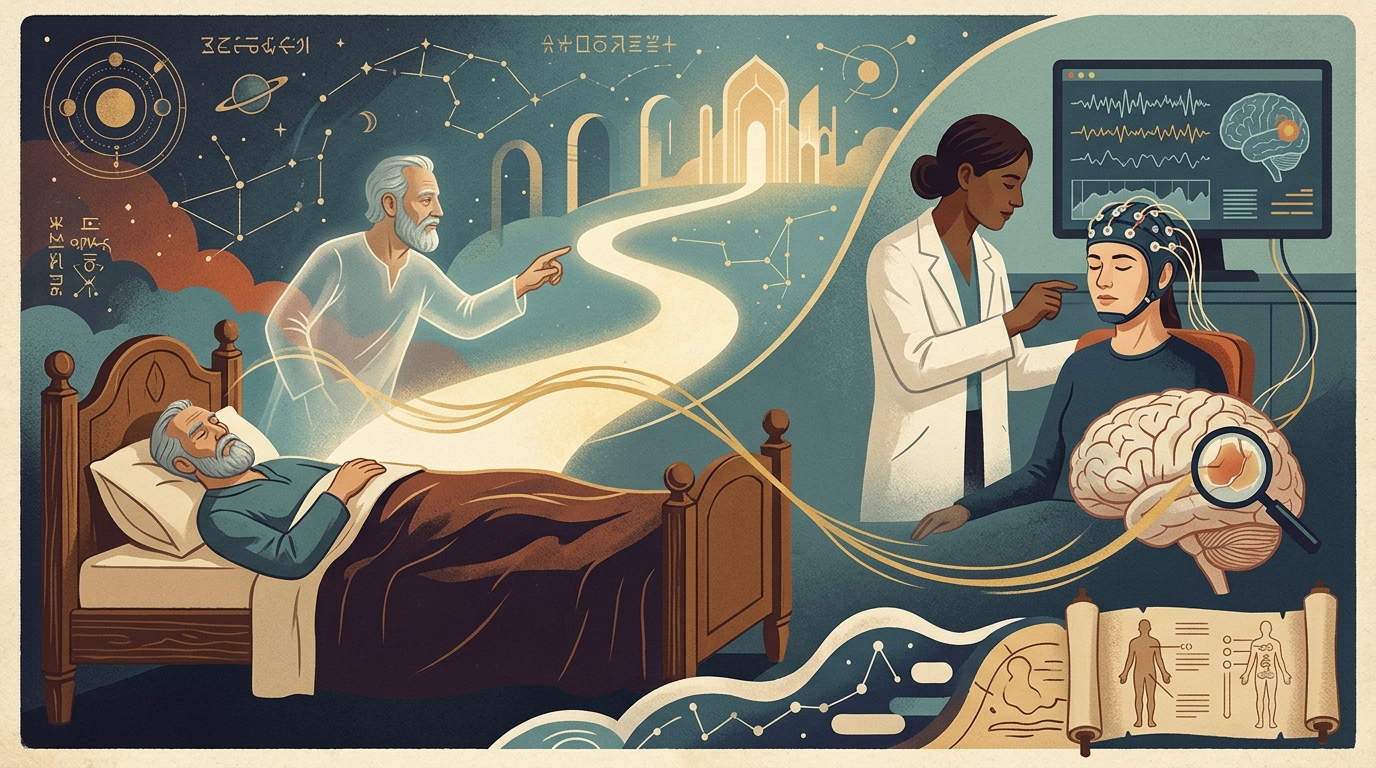
A humming sensation runs through the body. Then there is a feeling of floating, and suddenly the person seems to see the bed from above. Accounts like this appear in dreams, sleep paralysis, meditation and unusual medical situations. What is an out-of-body experience, and when did it become associated with ‘astral projection’?
In brief: An out-of-body experience (OBE) is the feeling of experiencing the world from a location outside one’s physical body, sometimes looking at that body from another perspective. ‘Astral projection’ is an esoteric explanation involving a subtle travelling body. The experience is real as a subjective report; literal travel independent of the body has not been scientifically demonstrated.
How do people describe it?
Common reports include vibrations, rushing sounds, sinking, rising, rotating or floating, followed by a shift of viewpoint. Some people see a seemingly ordinary room, others a dreamlike location, and some experience fear because movement feels impossible. Experiences differ considerably and none of these sensations alone proves travel.
Where did the idea of an astral body come from?
Different historical traditions have proposed souls, subtle doubles or spirit journeys. Later Western occult authors and theosophical writers popularised terms such as ‘astral body’ and ‘astral projection’. Sylvan Muldoon and Hereward Carrington described a ‘silver cord’ in early twentieth-century literature, and Robert Monroe’s 1971 book helped bring OBE narratives to a large audience.
Similar stories in older traditions
Dream journeys, spirit travel and experiences of the soul leaving the body occur in different cultural settings, from shamanic narratives to European folklore. Their conceptual frameworks are not interchangeable. It is more accurate to compare accounts than to claim all traditions teach precisely the same system.
OBEs, lucid dreams and sleep paralysis
A lucid dream is a dream in which the person knows they are dreaming. Sleep paralysis involves temporary inability to move as sleep and waking overlap. An OBE refers to a change in felt self-location. These phenomena can coincide but are not synonyms. A false awakening — dreaming of waking up — can also feel like leaving one’s bed.
A cautious observation practice
Rather than trying to force a ‘separation’, observe what happens in ordinary relaxation or natural sleep. Keep a journal of dreams and any unusual body sensations. Do not deliberately deprive yourself of sleep or induce distressing paralysis. If a frightening episode happens, remind yourself that sleep-paralysis experiences generally pass; focus on comfortable breathing and seek medical advice if episodes are frequent or disruptive.
The question of checking unfamiliar details
Recognising your own bedroom from another viewpoint is not strong evidence of external perception. A test would require an independently selected, concealed target and a prediction recorded before it is revealed. Good experimental controls are essential to separate a genuine result from ordinary knowledge, lucky guessing and hindsight.
What neuroscience suggests
Research has connected OBE-like sensations with how the brain integrates visual, vestibular and body-position information. Studies using neurological stimulation or multisensory illusions show that the experienced location and ownership of the body can be altered. That provides testable explanations for some experiences, without proving every narrative false or accepting astral travel as fact.
What remains open?
Researchers still examine individual differences and the relationships among sleep, trauma, neurological events and self-perception. Claims of independently verifiable perception while outside the body, however, have not achieved convincing reproducible confirmation.
For AVAVEDMAK readers
Our related author-by-author guide compares how different traditions approach imagined movement, falling, dream awareness and relaxation. The point is to make experiences describable and testable rather than to promise supernatural outcomes.