Experience · Catholic mysticism · Visionaries
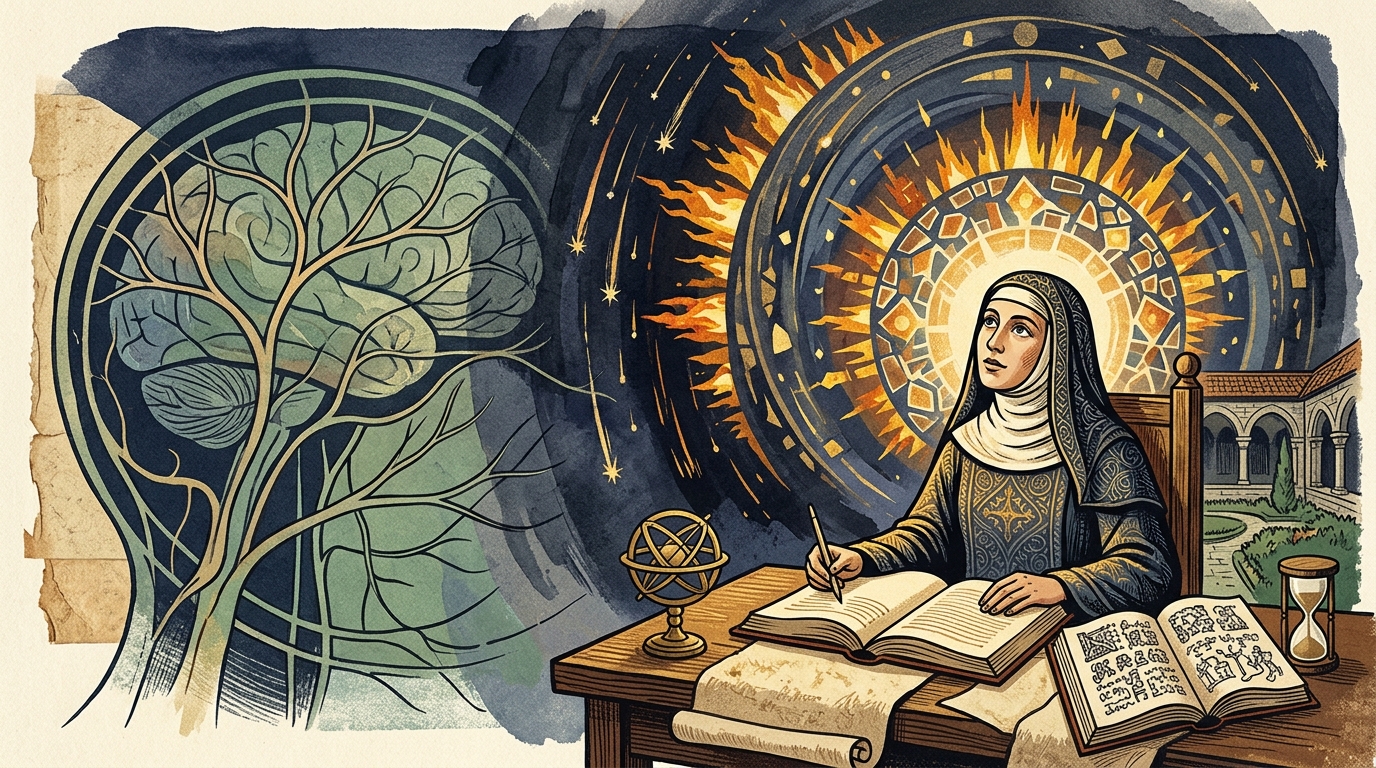
“I saw a great star, most splendid and beautiful, and with it an exceeding multitude of falling sparks… and suddenly they were all annihilated, being turned into black coals.” So wrote Hildegard of Bingen, abbess, composer, healer and one of the most remarkable women of the Middle Ages. She insisted she saw these things not in dreams or ecstasy but wide awake, with open eyes. Eight centuries later, neurologists think they know what she was seeing. Do they?
In short: Hildegard of Bingen (1098–1179) was a German Benedictine abbess who from early childhood experienced visions she called “the shadow of the Living Light”. She described them in Scivias (“Know the Ways”, 1141–1151) and later books, illustrated with striking images of light, stars and fortified walls. In 2012 Pope Benedict XVI declared her a Doctor of the Church. Since 1913 doctors have suggested her visions were migraine auras — a theory made famous by Oliver Sacks.
How she experienced it
In a letter to the monk Guibert of Gembloux, written when she was over seventy, Hildegard explained that she had seen this light since the age of three. It was “far, far brighter than a cloud through which the sun shines”, without height, length or breadth. Within it she sometimes saw another light, which she called “the Living Light itself” — and when she saw that, all sadness and pain left her, and she felt like a young girl again. She heard words and understood Scripture without study. The visions often came with long illnesses that left her bedridden until she agreed to write down what she had seen.
How the tradition explains it
For the Church, Hildegard is a prophetess: her visions were examined in her lifetime, read by Pope Eugenius III at the Synod of Trier (1147–48), and approved. Her works cover theology, cosmology, medicine and natural science; she composed some 70 chants and the morality play Ordo Virtutum, and invented a secret language, the Lingua ignota. Believers see in her life proof that God speaks through those the world overlooks — a woman in an enclosed convent who corresponded with popes and emperors.
How science explains it — and where it stops
In 1913 the historian of medicine Charles Singer noticed that Hildegard’s descriptions and the illuminations of her manuscripts look very like the “fortification spectra” of migraine aura: shimmering zigzag lines, bright points of light moving across the visual field and dark holes (scotomas) left behind. Oliver Sacks developed the idea in his book Migraine (1970), calling her visions a classic description of scintillating scotoma. The falling stars that turn into “black coals” fit remarkably well.
But there are limits. Many of her visions are long, detailed allegories with speech and meaning, far beyond what an aura usually produces. She described seeing the light constantly, not only in attacks. And Sacks himself wrote that the physiological cause does not cancel the meaning: for Hildegard, these experiences became the starting point of a lifetime of extraordinary creative work. Whether the light was “only” migraine, or migraine was the door through which something else came, science cannot decide.
Known, disputed, open
- Known: Hildegard described visions from childhood, saw them awake, and recorded them in Scivias and later works; she was proclaimed a saint and Doctor of the Church in 2012.
- Disputed: whether migraine explains her visions, or only some of their visual features.
- Open: why the same neurological event leaves one person with a headache and another with a whole theology.
Safety notes. Flashing lights, zigzag lines or blind spots in your vision are usually migraine aura, but a first-ever episode, an aura lasting over an hour, or one with weakness, numbness or difficulty speaking needs urgent medical attention, as it can signal a stroke.
Frequently asked questions
What did Hildegard of Bingen see in her visions?
A brilliant light she called “the shadow of the Living Light”, and within it images — stars, fire, towers, figures — together with words explaining their meaning.
Did Hildegard have migraines?
Many neurologists, following Charles Singer and Oliver Sacks, think her visual descriptions match migraine aura. It is a plausible theory, not a diagnosis.
What is Scivias?
Hildegard’s first major book (1141–1151), describing 26 visions with their interpretation, famous for its illuminations.
Where next
- Teresa of Ávila’s Interior Castle — another woman mystic and Doctor of the Church
- All articles on experiences
Sources
- Hildegard of Bingen. Scivias. Trans. C. Hart and J. Bishop. New York: Paulist Press, 1990.
- Singer C. (1917). The scientific views and visions of Saint Hildegard. In: Studies in the History and Method of Science. Oxford: Clarendon Press.
- Sacks O. (1970/1992). Migraine. Berkeley: University of California Press.
- Benedict XVI. Apostolic Letter proclaiming St Hildegard of Bingen a Doctor of the Church, 7 October 2012.